
Donald Shoup, Parking And The City, Routledge (Taylor & Francis Group), 2018, p. 53.
A meeting of minds on carbon taxes
The rifts over carbon pricing that have engulfed the climate movement in recent years and helped sink the 2016 Washington state carbon tax referendum softened noticeably at a public forum in New York’s Westchester County on Monday evening. Lines of convergence outweighed points of contention, perhaps signaling that proponents of transparent and robust carbon pricing can surmount our ideological differences and move forward together.
The forum, Carbon Tax: Solution to the Climate Crisis, was organized by local climate activist Andrew Ratzkin and held at Pace Law School, whose affiliate, the Pace Energy and Climate Center, has for decades been a bulwark of policy and legal analysis for energy efficiency, renewable energy and environmental taxation. While the four panelists — I was one — hale from different disciplines and generations, we were conversant with climate science, economics and organizing and respectful of each other’s endeavors.
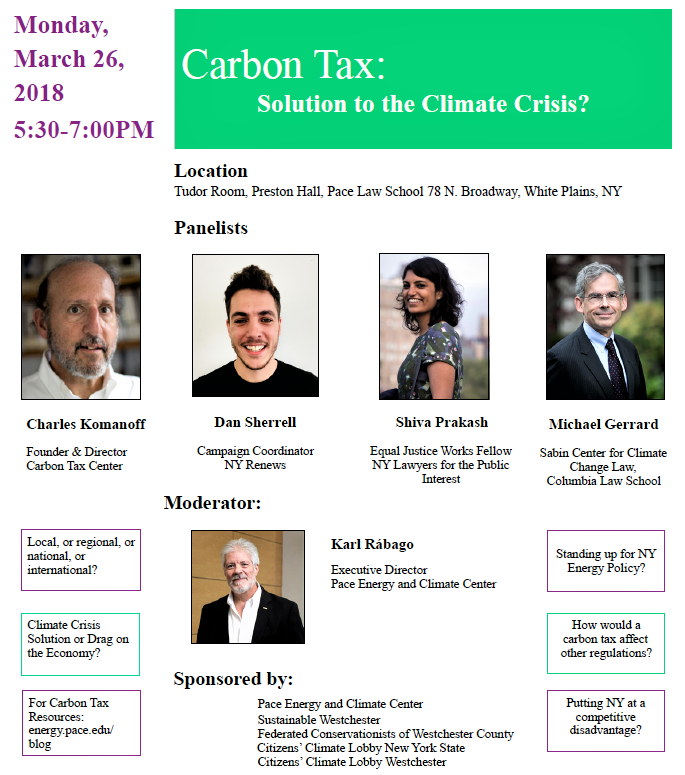
The younger panelists, Dan Sherrell and Shiva Prakash, outlined the ambitious New York State carbon tax proposal developed by NY Renews that has attracted wide support — with sign-on from 143 organizations — through its pledges to apply the carbon revenues to protect low-income families, invest in sustainable energy technology, help workers transit out of fossil-fuel jobs, and remediate “front-line” communities disproportionately damaged by fossil fuel processing and combustion.
While there’s room to question whether spreading the revenues so broadly can achieve all four objectives, NY Renews rests its optimistic projections — which include, by 2030, a halving of New York CO2 emissions and creation of 150,000 net new jobs — on a detailed study by the U-Mass Political Economy Research Institute. The group also formulated its carbon-tax proposal through extensive consultation with advocates from labor, environment, low-income and environmental-justice communities — a far more holistic process than Carbon Washington followed in fashioning its doomed I-732 referendum, and one that should augur well for the eventual legislative effort.
You may have noticed that my description led with the proposed use of the revenues, not the level of the tax. One reason is that the carbon tax amount in any state proposal tends to be constrained by “leakage” concerns over cross-border business flight as well as the political difficulty of getting too far out front of neighboring states; for the record, the NY Renews carbon tax would start at $35 per ton of CO2 and increase indefinitely at 5 percent a year.
The other, weightier reason for emphasizing revenue use is that it has become the boulder on which carbon tax advocacy has splintered. Revenue-investment proponents like NY Renews, who tend toward the political left, want the carbon revenues applied to the “Green New Deal” elements outlined above (and shown in the graphic below) which collectively constitute what they call “the just transition” from coal, oil and gas to renewables.
An opposing revenue-neutral camp tends to be less overtly political, as exemplified by Citizens Climate Lobby, whose 60,000 national members insist on equal return of carbon “dividends” to households as a way of skirting left vs. right fights and building constituencies of support for raising the carbon tax or fee level (since the dividend checks rise at the same rate). The revenue-neutral camp also places greater trust in the ability of the carbon-price signal to motivate pervasive changes in investment, behavior, technology and societal values that will effectuate the flight from fossil fuels, whereas revenue-investors tend to disdain “market forces” and to eye carbon taxes primarily as a revenue source to pay for socially driven and governed wind, solar, weatherization, public transit and electrification.
While these categories are a gross simplification, a synthesis of sorts appeared to come into view on Pace at Monday, along these lines:
- Taxing carbon emissions is so essential AND politically difficult that establishing a U.S. beachhead is more important than demanding a perfect version.
- The impossibility of enacting a carbon tax at the federal level till at least 2021 leaves states as the locus for that beachhead for several years or more.
- Several factors render revenue-neutrality less imperative in state than federal carbon-taxing:
- The lower tax rates in most state proposals imply lesser need to dedicate revenues to dividends or other income-support;
- Greater political and cultural cohesion within states allows tailoring carbon-revenue investment to be more politically palatable;
- Greater role of coalition politics makes some revenue investment necessary to pass state legislation.
While it’s possible or even likely that initial state carbon taxes that are heavy on revenue investment might repel red-state members of Congress as “Christmas-tree” packages, that specter seems less salient than the need to get some carbon-tax boots on the ground — not to mention the need to overturn the G.O.P. majorities and shrink climate-denialist representation in Congress, period.
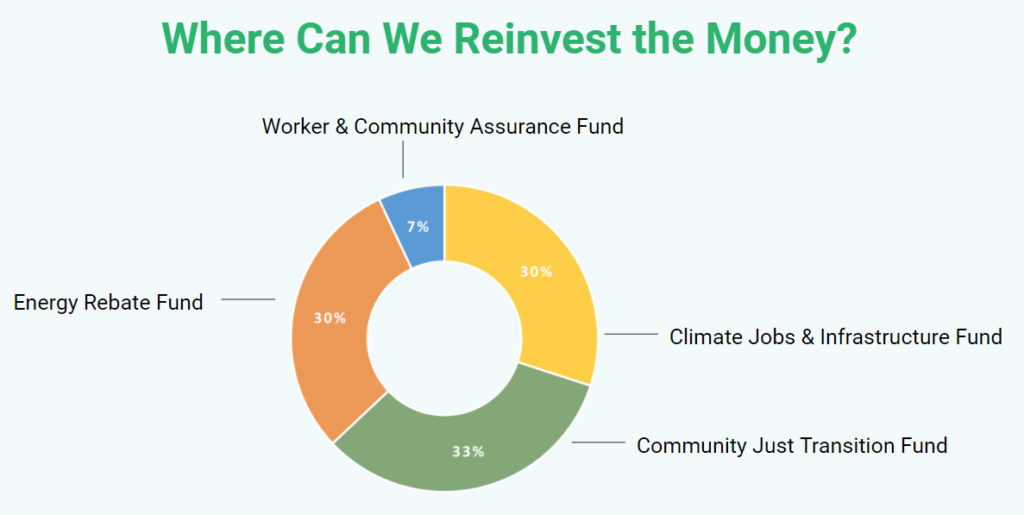
NY Renews’ proposed state carbon tax allocations.
These bullet points sharpen somewhat the long-established position of the Carbon Tax Center to support virtually any carbon tax formulation that doesn’t demonstrably worsen economic inequality. Still problematic for CTC, however, is the insistence of many revenue-investment adherents that their Just Transition include substantial allocations — as much as one-third, in the NY Renews proposal — to offset and remediate disproportionate fossil-fuel impacts on front-line communities.
Our position, which co-panelist Michael Gerrard also voiced, is that the fastest and surest way to reduce and eliminate those environmental injustices is to enact and ramp up the highest carbon tax that’s politically imaginable. Both Michael and CTC premise this on our conviction that the price signal itself is the salient policy tool within the carbon tax, and that a robust carbon charge will create powerful and ultimately irresistible incentives to reduce and eliminate fossil fuel use — and, thus, emissions and other impacts — across-the-board, not just in selected (wealthy and white) communities. It follows, then, that all communities, including but not limited to environmental-justice communities, will be better protected from both climate damage and “traditional” environmental insults if carbon tax proposals are free from what some lawmakers may consider special dispensations and can be legislated as high as possible.
We at CTC took a first stab at articulating this position in a 2016 blog post. We hope to elaborate on it soon and to elicit responses from NY Renews and other climate activists who carry the environmental-justice carbon-tax banner.
At the national level the Republican Party has become a destructive and anarchic political force in American life.”
Trump’s White House is a Black Hole, by Peter Wehner, senior fellow at the Ethics & Public Policy Center, and an official in the Reagan, Bush-41 & Bush-43 administrations, The New York Times, March 3, 2018.
The Carbon Tax Center Last Year . . . and in 2018
Everyone’s 2017 was eventful . . . and disruptive . . . and difficult.
From January into April, we, like many of you, marched and protested while trying to see a way forward for carbon taxes under a denialist U.S. regime.
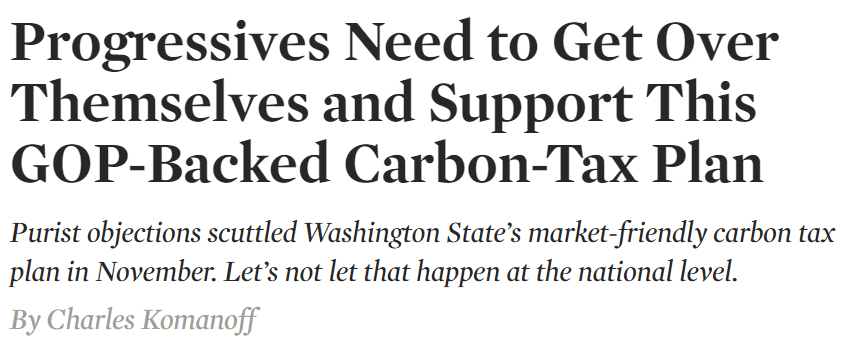
We didn’t write this headline, but we agreed with it. The Left’s opposition to the WA carbon tax was a grievous mistake.
We spoke at gatherings across New York City. We published an article in The Nation magazine decrying left-green dogmatism that doomed the campaign in Washington state to enact the USA’s first carbon tax. We allied ourselves with the Climate Leadership Council’s audacious Republican-branded carbon tax proposal. We published a 120-page guide to state carbon tax prospects compiled by Yoram Bauman, the economist-activist who spearheaded the Washington referendum.
By then we were 100 days into a new administration whose cruelty and heedlessness were sickening. At a climate march in New Jersey, we called the complicit U.S. Republican Party “a racket to restore patriarchy, extractionism and white supremacy.” This truth grew even sharper a month later when Congressional Republicans cheered Trump’s repudiation of the Paris Climate Agreement.
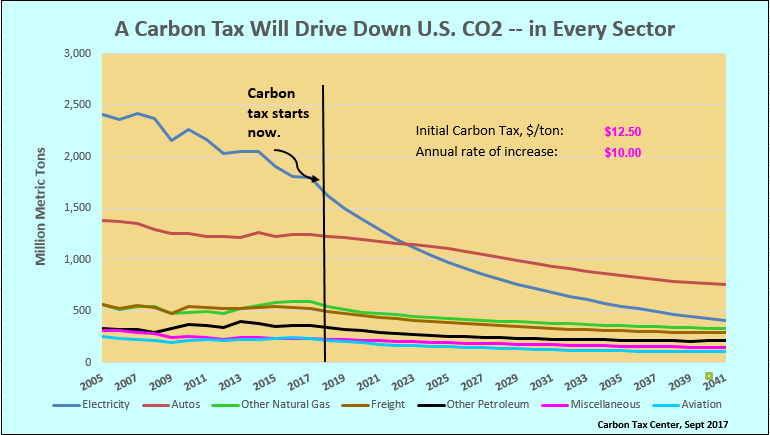
Outputs from CTC’s carbon-tax model: download and use!
We kept working. We retooled CTC’s carbon tax spreadsheet model, incorporating the latest data, snazzing up the user interface and graphics, and for the first time apportioning refinery emissions among their “downstream” sectors — driving, freight and air travel (jet fuel). With this change and the ongoing shrinkage in coal-fired power generation, driving is gaining on electricity for the dubious distinction of most climate-damaging U.S. sector.
Meanwhile, a campaign for congestion pricing in New York City — fees charged to vehicles driven into and within gridlocked city centers — was gathering steam amid meltdowns in the city’s mass transit system, worsening traffic gridlock, and a void of political leadership. When Gotham’s SUV- and helicopter-riding mayor crowned himself leader of state-and-local-government resistance to the White House, we upbraided him on live radio, setting off a media frenzy that continues today.
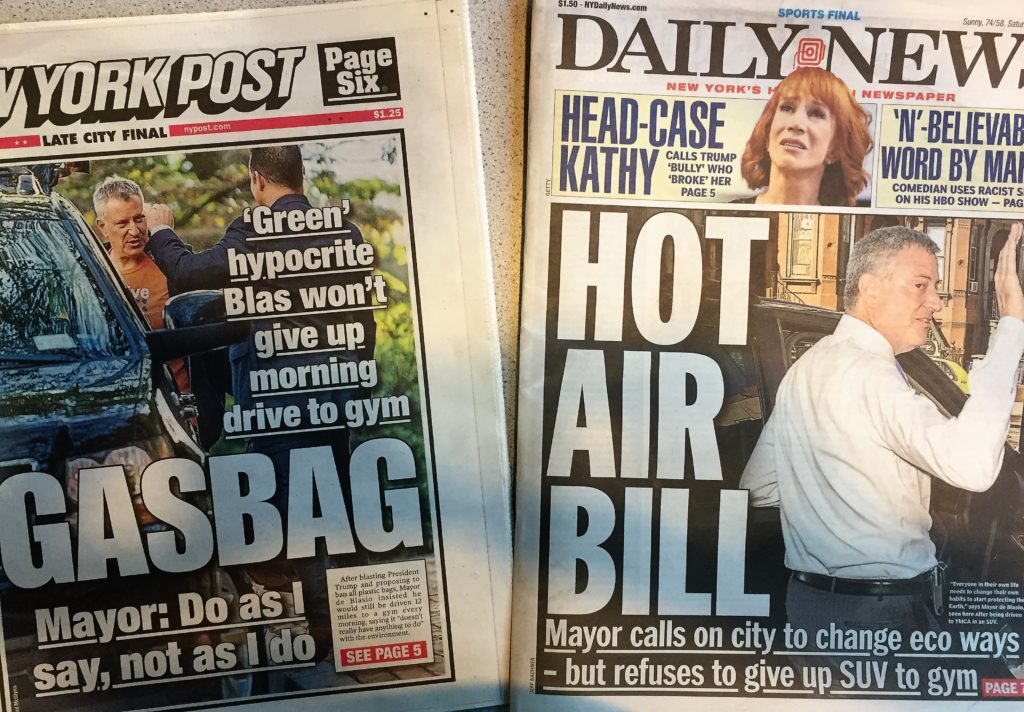
Our radio call-in touched off a roiling debate about the gap between public postures and personal acts.
But our criticism went beyond tabloid fodder; it pointed to the persistent gap between public postures and personal acts — a breach that carbon taxes could help repair.
Our pivot from national carbon tax campaigning accelerated in August, after Gov. Andrew Cuomo unexpectedly announced his support for congestion pricing. Shortly after, the analytics team advising the governor reached out to me: Would I help them deploy my monster congestion pricing model to score different congestion pricing plans?
Of course I said yes and plunged into massive updating and retooling of the model, which continues as I write this post. Details of the governor’s proposal are expected in a few days and the public debate and legislative donnybrook will almost certainly extend for several months. The fight is important, not just for the sustainability of New York and other global cities, as I argued last week on Streetsblog, but to finally establish in the USA the principle at the heart of carbon taxing: that the most surefire and equitable way to reduce pollution is to make polluters pay for it. [Addendum: The details can be found in my January Streetsblog post, The Fix NYC Congestion Pricing Plan Looks Solid — If Cuomo Aims High, which includes a link to the governor’s panel’s report.]
CTC’s program for 2018
At the national level, the main event by far for carbon taxing this year is to bring an end to Republican climate denialism. This could mean routing the GOP in the midterms, or some other path to repudiating the party’s nearly monolithic rejection of science-based climate policy and its all-out embrace of fossil fuels. It may also require, in the states, dismantling the gerrymandering that, combined with Democrats’ “clustering” in urban precincts, entrenches Republicans’ control of Congress far beyond their share of Americans’ votes.
I’m sorry to say that the notion of a bipartisan federal carbon tax is barely on life-support, as we wrote here last week, decrying the passivity of the Climate Solutions Caucus — the Noah’s Ark-like conclave that we formerly touted as a possible incubator for a revenue-neutral carbon tax. Nevertheless, CTC will continue our technical support and policy advice to members of Citizens Climate Lobby and to the Climate Leadership Council. But we harbor no illusions that current Republican officeholders will provide political leadership or even partnership for meaningful carbon pricing legislation.
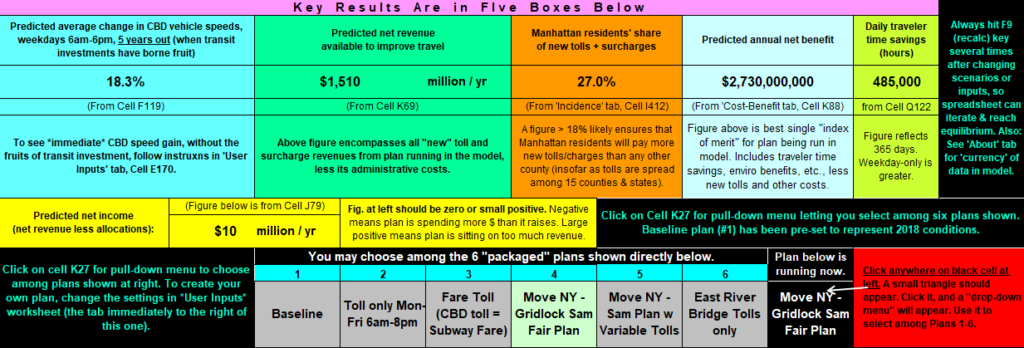
Excerpt from “Results” section of our “BTA” spreadsheet model. A key goal for early 2018: A congestion pricing win for NYC that establishes the “polluter pays” principle in the USA.
There’s a corollary: it may be time to rethink revenue-neutral carbon taxes. As much as we love carbon fee-and-dividend, with its powerful logic of linking rising carbon taxes to rising “green checks,” the revulsion against Trump and the G.O.P. could make it harder to sell progressives on programs with a seemingly middle-of-the-road cast. We also can’t dismiss arguments by Frank Ackerman and others that the “fat tail” of climate worst-cases demands national mobilization on a scale that only government action can generate.
Along with political action and some soul-searching, CTC is primed this year to
- Monitor and parse actual carbon emission reductions in states, sectors and countries with carbon pricing, including the 9 RGGI states;
- Assess and fact-check claims of economies decarbonizing without carbon pricing;
- Expand our networking with state and national carbon tax advocates in the U.S. and overseas;
- Seek common ground on carbon taxing with environmental and climate justice advocates;
- Explore alliances with progressives working to meld carbon pricing with “mobilization” strategies;
- Seek out Republicans-conservatives who have genuine interest in non-token carbon taxes;
- Gain a better understanding of the possibilities and limits in fossil fuel divestment and litigation campaigns;
- Continue improving and disseminating our carbon tax spreadsheet model;
- Restock CTC’s Web site;
- Keep writing op-eds and magazine pieces promoting carbon taxes;
- Use our blog to post commentary on unfolding political developments, policy proposals and energy trends.
As we head into the new year, we thank you for your past support and your partnership. Contributions to support our work in 2108 (please use this link) will, as always, play a valuable role in keeping CTC edgy, timely and forward-focused.
Five Down: Climate Solutions Caucus to lose another Republican
33 to 28. It may look like a football score, but it’s actually the downsizing of the Republican side of the Climate Solutions Caucus.
Rep. Darrell Issa (R-CA-49) this morning announced he’s not seeking an eleventh term representing northern coastal areas of San Diego County in Congress. He joins departing GOP caucus members Ileana Ros-Lehtinen (R-FL-27), Dave Reichert (R-WA-08), Ed Royce (R-CA-39) and Pat Tiberi (R-OH-12).
Unless new members are recruited from current House ranks, the caucus’s roster of Republican members is set to fall from its current 33 to 28 by year’s end. The pending 15 percent shrinkage surpasses the overall 9 percent retirement rate among Republican House members this year. (We count 21 of 240 House R’s leaving, excluding a dozen or so moving or aspiring to higher office, based on Ballotpedia.) GOP Caucus members disproportionately represent swing districts, like Issa’s, possibly explaining the difference.
The Noah’s Ark-like conclave — Republican and Democratic Congressmembers enter as pairs, with Republicans the limiting factor — was founded in Jan. 2016 to provide a safe space and political cover for timorous Republicans to act on climate change. To date it’s been mostly cover and little action.
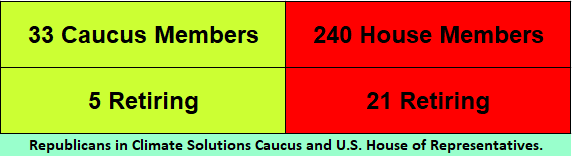 None of the Republican members have uttered a word in favor of carbon taxing, even the intendedly Republican-friendly “fee and dividend” espoused by the caucus’s catalyst, Citizens Climate Lobby, or the carbon dividend proposal devised by the Climate Leadership Council and advanced by Republican elders. Since Trump took office, moreover, none has fought legislation or deregulation enabling the administration’s fossil fuel juggernaut, save for squelching language in the National Defense Authorization Act that would have barred the Pentagon from analyzing climate threats to U.S. military installations.
It may seem incongruous that Issa, whose lifelong loathsomeness (full details at Wiki) has run the gamut from petty thievery and dangerous driving to obsessive Obama-bashing, not to mention amassing riches from his blaring, motion-detecting “Viper” car alarm, would have joined the Climate Solutions Caucus. There is no entrance criterion, however. That can be viewed as either a bug, enabling joiners to rack up green cred at no cost, or a feature, helping Republicans who might be seeking to exit the cult of climate denialism incubate pro-climate words and, eventually, deeds.
Both perspectives got a hearing in a feature article on the caucus last week in E&E News, A bunch of House Republicans accept warming. Is it real? Sierra Club Executive Director Michael Brune spoke for the first group, rhetorically asking, “[W]e are supposed to jump up and down and spew happy talk because now there’s a safe space for people to talk about climate change? Forgive me if I’m not happy.” Others quoted in the story, such as Emily Wirzba of Friends Committee on National Legislation, cited the need to rest climate policy on a bipartisan base, saying “The policy will be stronger even if Democrats take control of Congress, you know you’ll have Republicans that support climate policy.”
Defenders of the caucus also point to victories like inclusion of renewable energy credits (RECs) in the Tax Extender Act of 2017 (S-2256), pleas by Rep. Ryan Costello (R-PA-6) and other caucus members to bar oil drilling in U.S. coastal waters or the Alaska National Wildlife Refuge, and a vote by 11 caucus Republicans that ultimately led the Senate to protect the Bureau of Land Management’s natural gas waste rule to prevent methane venting/flaring. Measured against the full dimensions of the climate crisis, however, these appear little more than baby steps. And measured against Trump’s drumbeat of deregulatory and verbal assaults on climate protection and policy, like his dizzying attack of falsehoods today on the Paris climate agreement, the positive moves by GOP caucus members pale even further.
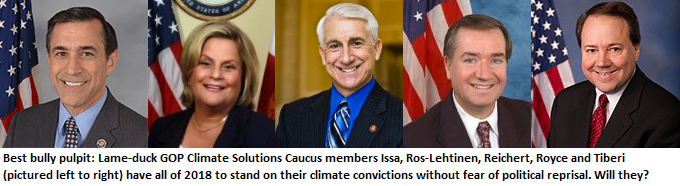 Nevertheless, Issa and the caucus’s other lame-duck Republican members have a rare opportunity: a full year still in office to speak their minds on climate (or other issues) without fear of being primaried by unabashedly denialist insurgents. They could push back against Trump’s climate lies and call on their party to assume its Rooseveltian mantle of environmental stewardship. In doing so, they could set a standard for their 28 Republican colleagues who hope to keep their seats and, by their caucus membership, have ostensibly committed themselves to pursuing climate solutions.
Let’s hope they do. Otherwise, it becomes even harder to rebut the argument that the path to a better and safer world requires a Democratic sweep of the House, including Republican caucus members, in this year’s midterms.
A Strong Thread Connects Congestion Pricing and Carbon Taxes
Could Gov. Andrew Cuomo’s declaration in August that congestion pricing for New York City “is an idea whose time has come” bring needed momentum to carbon taxing?
A strong thread connects congestion pricing and carbon taxes. Just as limited street space in New York warrants a congestion fee, the atmosphere’s limited capacity to absorb carbon necessitates a carbon emissions fee.
 Congestion pricing levies fees on vehicle travel into or within the core of a city. Singapore, London and Stockholm have deployed such fees for decades to discourage unnecessary traffic and raise revenue to improve transit and road infrastructure.
I’ve been quantifying the benefits of congestion pricing for New York City city and mobilizing public support for well over a decade. The campaign I’m allied with, called Move NY, proposes tolling car and truck traffic into Manhattan’s central business district, surcharging yellow cabs and Ubers circulating within the CBD, and lowering tolls on outlying bridges that have been used as cash cows to fund transit.
The governor controls the city’s mass transit, and political tradition dictates that congestion pricing legislation must run through Albany. Since Cuomo’s “August surprise” — he rebuffed the idea throughout his tenure as governor — I’ve re-directed my advocacy from carbon taxes to congestion pricing.
That’s a shift in venue but not in philosophy. Both types of fees incentivize all of us who would fire up fossil fuels or occupy road space to do so sparingly. They also help bring forth investment and innovation in alternatives: renewables and efficiency in the case of carbon; transit, cycling and density in the case of urban transport.
A congestion charge for New York will establish in America the foundational principle for a carbon tax: safeguarding our climate and other public goods requires that we charge for uses that damage or deplete it.
Cuomo’s announcement also validates conservative luminary Milton Friedman’s dictum about crises and change:
Only a crisis — actual or perceived — produces real change. When that crisis occurs, the actions that are taken depend on the ideas that are lying around. That, I believe, is our basic function: to develop alternatives to existing policies, to keep them alive and available until the politically impossible becomes the politically inevitable.

“Subway meltdown” images like this from NY Times in November have filled the city’s paper this year, putting pressure on Gov. Cuomo to find solutions.
How has the political impossibility of congestion pricing in New York given way to an air of inevitability? As Friedman prescribed, a crisis was required. It came this year, as a twin storm of gridlocked streets and cascading subway delays. But years of concerted advocacy were required to blast through political inertia and lay the crisis at Cuomo’s doorstep.
And true to Friedman’s dictum, NYC advocates for transit and livable streets have developed alternatives: the Move NY plan has dozens of elements that together can unsnarl the streets and modernize transit, as the New York Times reported last month in this profile of the “three amigos” leading the plan: traffic guru “Gridlock” Sam Schwartz, political campaigner (and CTC board chair) Alex Matthiessen, and myself.
We don’t yet know if Cuomo’s congestion proposal, which is expected next month, will be strong medicine or weak tea. But as one long-term advocate said last week, the argument is no longer whether to charge a congestion price, but how much.
The lesson for climate campaigners is clear: our job is to keep building the philosophical and political groundwork for carbon taxing.
That way, when the seeming political impossibility of carbon taxing gives way to the aura of inevitability, the carbon tax that emerges can be robust, comprehensive and fair.
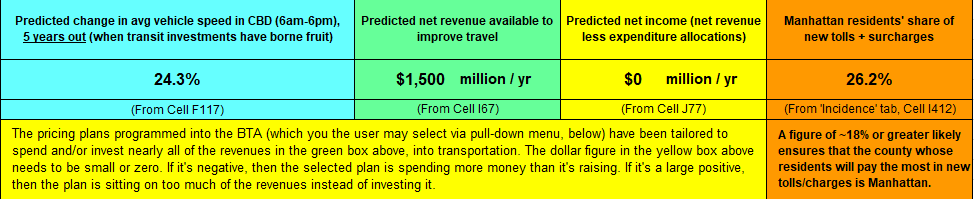
Snapshot from my Excel model shows key projections for the Move NY plan.
In the meantime, if you live or work in New York City or State, voice your support your city and state rep’s and urge them to support the Move NY congestion pricing plan.
Join and work with Move NY’s grassroots partners such as Riders Alliance, Transportation Alternatives, the NYC Environmental Justice Alliance. (More are listed here.)
And don’t stop organizing, teaching and advocating for U.S. carbon taxes.
The arc of the physical universe appears to be short, and it bends toward heat. Win soon or suffer the consequences.”
Bill McKibben, in Winning Slowly Is the Same as Losing, Rolling Stone, Dec. 1.
Climate change is not a future threat; it is happening now, and we are paying for it in lost lives and billions of dollars in damage.”
Michael Bloomberg & Jerry Brown, The U.S. Is Tackling Global Warming, Even if Trump Isn’t, The New York Times, Nov. 14.
Bob Corker and the Climate Swerve
“He’s holding the world hostage … So far, nobody seems to be willing or able to stop him,” lamented commentator Heather Digby Parton, in “Give Me What I Want Or The Planet Gets It” (no longer web-available).
The trope about Trump “holding the planet hostage” isn’t entirely new. But it came into sharper relief for me over the weekend as I read Robert Jay Lifton’s insightful new book, The Climate Swerve. And it gave added weight to the apostasy of a ranking Republican senator who earlier this month told the New York Times that Trump’s bluster toward North Korea may be setting the United States “on the path to World War III.”
The senator issuing the warning was Bob Corker (R-TN), chairman of the Senate Foreign Relations Committee. His words capped a 10-day raging argument in which Trump ridiculed Corker’s decision not to seek a third term next year, and Corker tweeted that “the White House has become an adult day care center” struggling to keep its main occupant in check. “He concerns me,” the senator said of the president. “He would have to concern anyone who cares about our nation.”
Corker’s blunt talk about Trump brought to mind his independent stance on climate in the months following the 2008 election of Barack Obama. The defeated GOP candidate, Senator John McCain, had been a backer of carbon cap-and-trade, as were many Congressional Democrats and nearly all of the major environmental organizations. Corker took a minority view, speaking out in favor of carbon taxing in a January 2009 hearing before the Foreign Relations Committee:
I wish we would just talk about a carbon tax, 100 percent of which would be returned to the American people. So there’s no net dollars that would come out of the American people’s pockets.
Not everyone back then viewed Corker as a straight shooter. Grist blogger David Roberts lambasted him for “talk[ing] his way inside the carbon policy tent and now … trying to burn it down” by diverting support from cap-and-trade. But the New Republic’s Brad Plumer insisted that “Bob Corker [is] making sense … for a fruitful conservative position” that’s revenue-neutral and transparent. (Roberts now blogs for Vox while Plumer writes for The New York Times.) Indeed, it’s not much of a stretch to credit Corker’s 2009 words as the launch pad for the Citizens’ Climate Lobby’s fee-and-dividend idea and its recent offshoot, the Climate Leadership Council’s carbon dividends approach.
Unfortunately, carbon taxing didn’t advance beyond the fringe in either political party, and climate rejection soon became an element of Republican tribal identity, leading Corker to give up on carbon taxes and on climate generally. And for more than a decade few public figures had much to say about nuclear weapons and the specter of nuclear war. That began to change this year with the launch of nuclear-capable missiles by North Korea and Trump’s vow that if “North Korea … make[s] any more threats to the United States, they will be met with fire and fury like the world has never seen.”
Trump has also repudiated the Paris climate agreement and taken steps to annul the Obama Clean Power Plan and to greenlight fossil fuel development across North America. Humankind now is staring at not one but two “apocalyptic twins,” in Lifton’s words: a nuclear threat and a climate threat. Both the parallels and differences between the two are the subject of Lifton’s new book, Climate Swerve, which appears in the immediate wake of climate furies that have devastated Houston, Puerto Rico and Northern California.
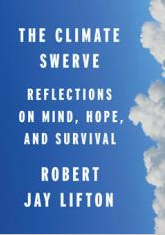 Lifton, a psychiatrist who turned 90 last year, has long observed, lived among and written about the perpetrators and victims of some of the 20th Century’s most profound atrocities — the atomic bombings of Japan, the Vietnam War and, of course, the Nazi Holocaust. His writing humanizing the hibakusha (literally, “explosion-affected people”) of Hiroshima and Nagasaki and his explorations of the “malignant normality” embodied in the Cold War policy of “mutually assured destruction” galvanized public and political support for both the Kennedy-Khrushchev 1963 ban on atmospheric nuclear weapons testing and the Reagan-Gorbachev 1987 agreement eliminating short- and intermediate-range nuclear missiles.
It was only recently, however, that Lifton turned his attention to climate change. His brand-new book, eloquent and spare, has two tracks. In one he encourages what he calls the climate swerve — humanity’s “evolving awareness of our predicament” as we collectively cause, and face, climate ruin. In the other he seeks to bring to climate consciousness his perspective on what was, at least until this year, mankind’s turn from the brink of nuclear ruin.
This passage (slightly edited for readability, emphasis added in bold) is emblematic:
Nuclear and climate threats are separate and different from each other. With nuclear weapons, the mind must contemplate specific things — bombs that bring about revolutionary dimensions of blast, heat, and radiation. The imagined catastrophe is immediate and decisive, and the atomic bombing of Hiroshima and Nagasaki provides a model of unprecedented slaughter and suffering. With climate threat, the mind encounters no new physical entities or things, but rather an incremental sequence of an increasingly inhospitable habitat, a progression rather than an explosion, and a series of projections of what can be expected, as opposed to a clear display of ultimate destruction.
Nevertheless, an irony — and a strangely hopeful one — of Lifton’s book is that Hurricanes Harvey and Irma have produced, for all who care to see, painfully “clear displays of ultimate destruction.” Lush Puerto Rican farmlands and woodlands flattened and laid barren are now literally concrete, as are obliterated California vineyards. Lifton himself put these facts front and center in an op-ed for The New York Times earlier this month (emphasis added):
Climate images have never been able to convey our full planetary danger until now. The extraordinary recent four-punch sequence of hurricanes … threatened the lives of millions of people, obliterated their homes and has raised doubts that some places will ever recover … The hurricanes … provided imagery equivalent to the danger, imagery equivalent to nuclear disaster. When we viewed photographs and film of the annihilated cities of Hiroshima and Nagasaki, we sensed that the world could be ended by nuclear weapons. Now these hurricanes have conveyed a similar feeling of world-ending, having left whole islands, once alive in their beauty and commerce, in ruin.
I imagine I’m not the only one brought to tears but also galvanized by those words. They appeared in print on the same Sunday morning, October 8, that Bob Corker called the New York Times to warn about Trump putting us “on the path to World War III.”
While there may not be a direct line from Lifton’s op-ed to Corker’s speaking out, both of their testimonies are proof that we’re not hostages. We still have voices, and both the advance of climate ruin and the renewed chances of nuclear ruin require that we raise them. Republican voices like Corker’s are especially critical, but anyone with power and a pulpit shouldn’t hesitate to use them. And for the rest of us, a letter to our local paper, a Facebook post, or plain old face-to-face sharing can help others grasp the gravity of the risks we are living with and how we can overcome them.
When we viewed photographs and film of the annihilated cities of Hiroshima and Nagasaki, we sensed that the world could be ended by nuclear weapons. Now these hurricanes [Harvey, Irma, Jose and Maria] have conveyed a similar feeling of world-ending, having left whole islands, once alive in their beauty and commerce, in ruin.”
Robert Jay Lifton, Our Changing Climate Mind-Set, NY Times, Oct. 7.
- « Previous Page
- 1
- …
- 19
- 20
- 21
- 22
- 23
- …
- 171
- Next Page »