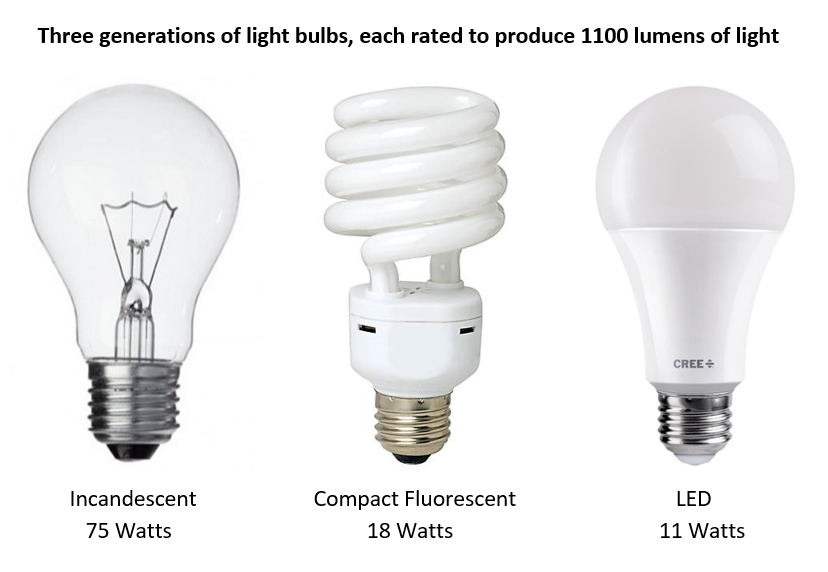
Forty years ago, the only “screw-in” light bulbs were incandescent. Little-changed since their invention in the late 1800s, “Edison” bulbs were cheap, disposable and staggeringly inefficient. “Small electric heaters that give off a bit of light” is how someone once described them. Coal guzzlers, given how much electric current they drew.
Around twenty-five years ago, compact fluorescent light bulbs became widely available and reasonably affordable. CFL’s were marketed as offering the same illumination as incandescents for far less power, enabling them to quickly pay off their higher initial costs with the saved electricity. But they were unwieldy — taking a bit too much time to reach full brightness, for example — their light was unattractive, and the bulbs contained mercury, rendering them, for some people, off-putting. CFL’s were a climate solution, but far from an ideal one.
Finally, a decade or so ago, LED bulbs came on the market. More efficient than CFL’s, non-toxic, long-lasting and beaming brilliant light through dozens of tiny light-emitting diodes, LED’s are about as perfect a means of artificial illumination as can be imagined. Unsurpisingly, consumers ate them up.
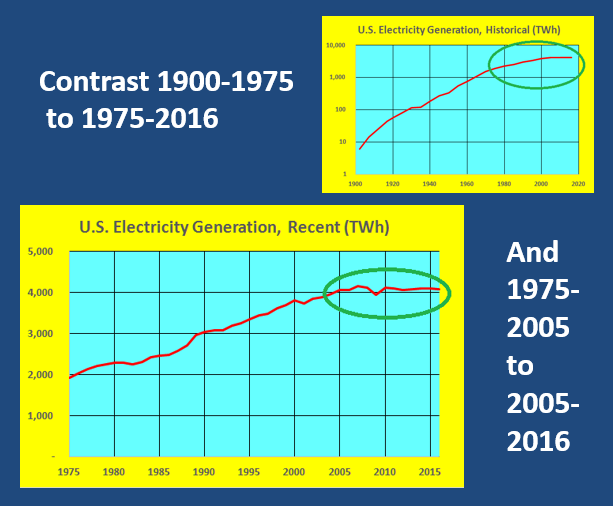
The widespread switch from incandescents to CFL’s and ultimately to LED’s is a big reason that starting in 2005 and lasting for more than a decade, the U.S. economy was able to hold total electricity consumption constant even as output of goods and services grew 20 to 25 percent. So unprecedented was this “decoupling” of electricity from economic activity that we at CTC produced a report, The Good News, celebrating it and explaining it. (Electricity usage did jump nearly 4 percent last year — Trumpism in action, perhaps? — but thus far in 2019 it’s down 2 percent.)
To be sure, more-efficient light bulbs weren’t the only factor holding down power demand. Penetration of digital tech in manufacturing and energy management also helped, as did the emergence of a robust business sector to harness energy efficiency. Ditto the structural shift from heavy manufacturing to service industries, along with a shift to urban living and delayed family formation, which resulted in smaller dwellings with fewer appliances (with the appliances themselves gaining in efficiency due to increasingly ambitious standards).

The LED revolution has played a big part in flattening U.S. electricity usage, which since 2005 has done more than even wind and solar combined to hold down carbon emissions.
Nevertheless, the revolution in lighting offers the perfect rebuttal to the notion that energy efficiency — the linchpin of quickly eliminating fossil fuels from our energy supply — somehow entails sacrifice. LED’s are superior to incandescents along every criterion, most critically in producing the same or better lighting with more than an 80 percent saving in electricity. And if they cost more to buy, many utilities offer “demand-side” programs to help cut the customer price.
Which makes Elizabeth Warren’s handling of the light-bulb question during yesterday’s climate debate so frustrating. Yes, there was such a question, and it offered a fabulous opportunity to push back against the notion that energy efficiency entails Americans sacrificing. Alas, the opportunity was missed, as can be seen in this edited version of Sen. Warren’s exchange with moderator Chris Cuomo:
Cuomo: Do you think the government should be in the business of telling people what kind of light bulb they should buy?
Warren: Oh come on, give me a break. This is exactly what the fossil fuel industry hopes we’re all talking about. That [climate] is “your” problem. They want to stir up a lot of controversy around light bulbs, around your straws and around your cheeseburgers when 70% of the pollution and of the carbon we’re throwing into the air comes from three industries. Why don’t we focus there? It’s corruption. It’s these giant corporations that [are] making big bucks off polluting our earth.
To be fair, Warren’s full answer (included here, at the end) had more nuance than this excerpt. She took pains to say “There are a lot of ways … to change our energy consumption. And our pollution. And God bless all of those ways.” But her attempt to deflect Cuomo’s question backfired, because she let his implicit equation of efficiency with deprivation go unchallenged.
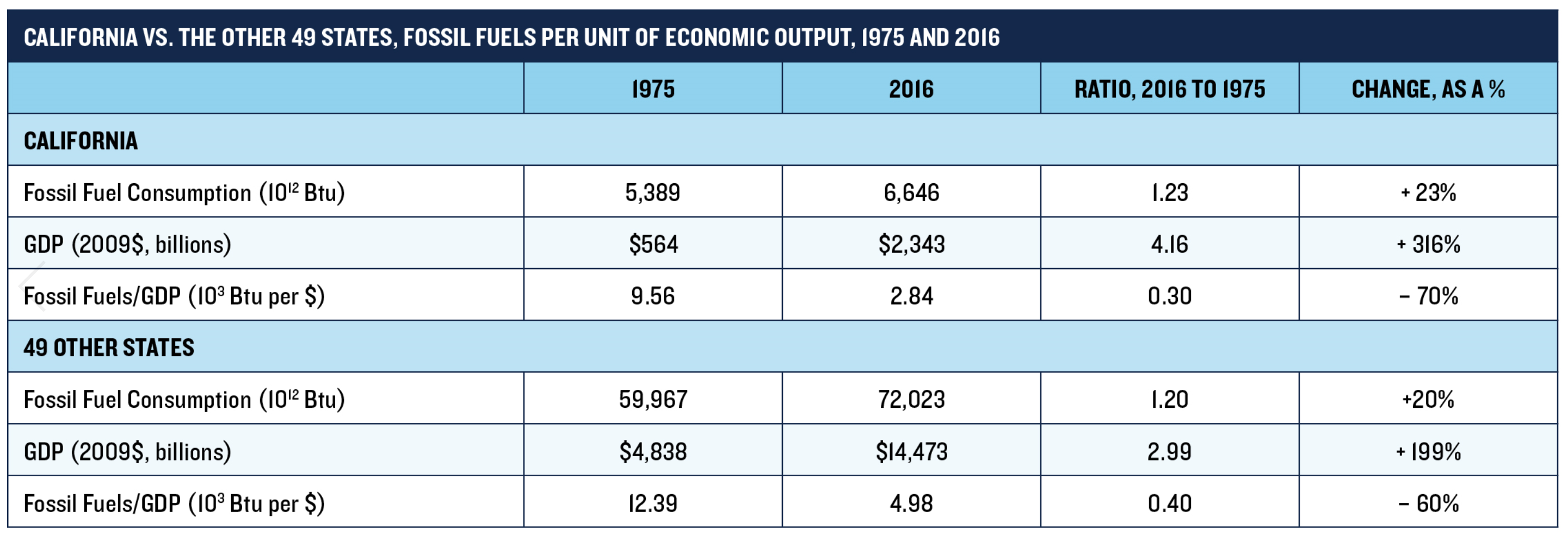
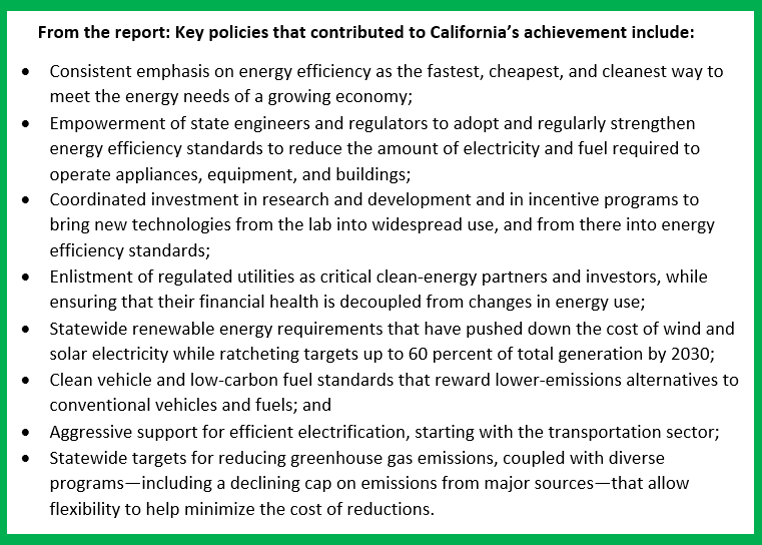
Moreover, Warren’s “70% of the pollution comes from three industries” notion is grossly misleading. Yes, it’s the electric power plants, not the person at home, that spews carbon; but cutting demand so those plants slow and stop their emissions during the transition to solar panels and wind turbines is going to require redoubling our efficiency efforts (emulating California would be a great start). Which means continually ratcheting upward efficiency standards for lighting, appliances and industry.
If we can’t proudly defend not just lighting efficiency but the 40-year collaboration of engineers, environmentalists and regulators that painlessly delivered efficiency to the entire U.S. appliance sector (refrigerators, air-conditioners, dishwashers, heat pumps, etc.), how are climate hawks going to champion the necessary choices that may actually entail some sacrifice, such as flying less, driving less mindlessly, welcoming urban density and transit-oriented development, and so on?
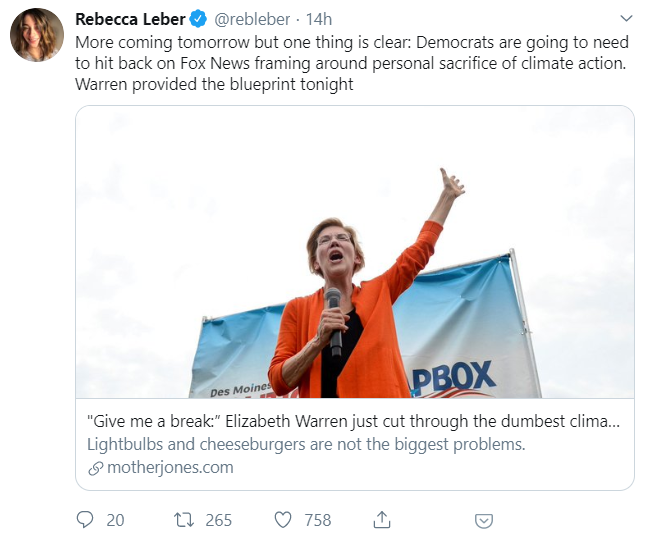
That is why Warren’s punt on the light-bulb question hurts. And the harm has been exacerbated by the enthusiastic reaction of prominent left-green commentators. Rebecca Leber at Mother Jones congratulated Warren for “cutting through the dumbest climate argument,” despite the fact that Warren didn’t cut through the argument, she ducked it. At Vox, Li Zhou wrote that “Warren’s response speaks to how the fossil fuel industry [is] eager to shift the framing of subjects like light bulbs and paper straws in order to put the focus on consumer choice and deflect from the larger issue of reducing pollution,” a take that disconnects the vital matter of electric generation pollution from the demand that helps give rise to it.
Sure, it’s politically attractive to put the entire onus for climate catastrophe on giant corporations. But actually tackling and overcoming the climate crisis will require even more fundamental change than dismantling Big Oil.
Following is Sen. Elizabeth Warren’s Q&A with moderator Chris Cuomo on light bulbs, in the Sept 4, 2019 CNN Climate Town Hall
https://www.cnn.com/videos/politics/2019/09/04/bernie-sanders-sot-trump-stance-climate-cnn-town-hall-vpx.cnn/video/playlists/climate-change/
Chris Cuomo — The president announced plans to roll back energy saving lightbulbs and he wants to reintroduce four different kinds which I am not going to burden you with but one of the ones is the candle shaped ones and those are in favor for a lot of people. But do you think the government should be in the business of telling people what kind of light bulb they should buy?
Elizabeth Warren — Oh come, on give me a break! (Sighs) You know…
CC: Is that a “yes”?
EW: No… Here’s… Look, there are a lot of ways that we try to change our energy consumption. And our pollution. And God bless all of those ways. Some of it is with lightbulbs, some of it is with straws and some of it… Dang!… is with cheeseburgers. Right? There are a lot of different pieces to this and I get that people are trying to find the part that they can work on and what can they do. I’m in favor of that and I’m gonna support that. But understand, this is exactly what the fossil fuel industry hopes that we are all talking about.
(Applause)
EW: That’s what they want us to talk about. That this is “your” problem.
(More applause.)
EW: They want to be able to stir up a lot of controversy around your light bulbs, around your straws and around your cheeseburgers when 70% of the pollution, and of the carbon we’re throwing into the air, comes from three industries. And we can set our targets and say by 2028, 2030, and 2035, no more. Think about that. Right there. Now, the other 30% we still gotta work on. Oh no, we don’t stop at 70%. But the point is that’s where we need to focus. And why don’t we focus there? It’s corruption. It’s these giant corporations that keep hiring the PR firms and everyone has fun with and gets it all out there so that we don’t look at who’s still making the big bucks off polluting our earth. The time for that has passed. We have a chance. A chance left in 2020 to turn this around but we are running out of time so we’ve got to do this in 2020 and that means the first thing we’ve gotta do is that we have to attack this corruption head on in Washington and say enough of having the oil industry and the fossil fuel industry write all of our laws in this area. No more!
Transcription by CTC intern Rohan Kremer Guha


“Divestment can’t loosen the fossil fuel stranglehold without a carbon tax,” we wrote in a photo caption in 
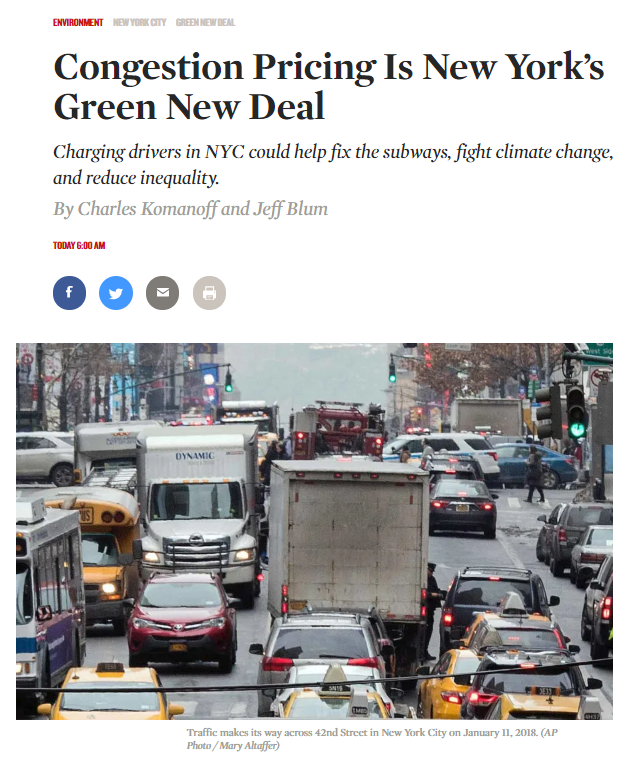
These considerations appear to have finally pushed New York’s Mayor Bill de Blasio off the political fence last month to 
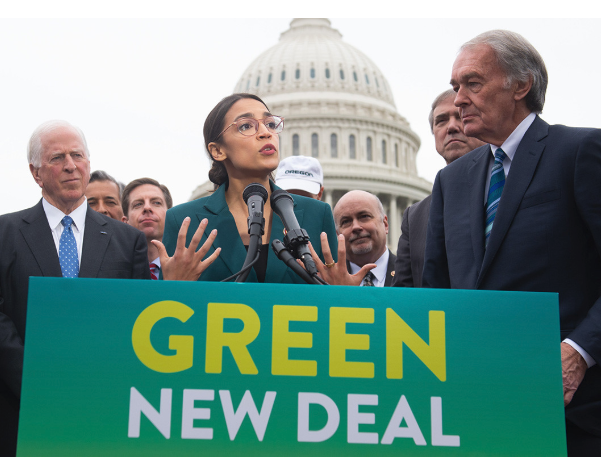
The Green New Deal means many things to many people, but the unifying concept is to position climate change mitigation as a retooling of the U.S. economy, particularly our infrastructure, with massive green investment and millions of green jobs. The closest thing to an official statement of purpose is