
Canada Day — the First of July — is observed "not only throughout the nation, but also internationally." This year, Canada’s third-most populous province is giving the world extra cause to celebrate: on July 1, British Columbia becomes the first state or province in the Western Hemisphere with a comprehensive, revenue-neutral carbon tax.
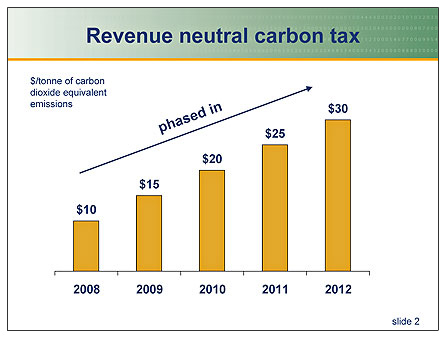
The BC carbon tax starts at a level of $10 (Canadian) per metric ton of carbon dioxide, equivalent to 2.41 (Canadian) cents per litre of gasoline. In U.S. terms and at current exchange rates, that’s $8.91 per short ton, or just under 9 cents per gallon of gas. The rate rises by $5 in each of the next four years, reaching $30 Canadian per tonne (U.S. $26.73 per ton) in 2012.
The tax is revenue-neutral. As we reported in April, the province’s Finance Ministry has dedicated the revenues to four tax reduction measures:
- A new Climate Action Credit will pay lower-income BC’ers $100 per adult and $30 per child per year.
-
The bottom two personal income tax rates have been reduced by 2% on the first $70,000 in earnings.
-
The corporate income tax rate has been reduced to 11% from the current 12%.
-
The small business tax rate has been cut to 3.5% from 4.5%.
Each provision will expand in tandem with the tax rate. And, showing impressive political pitch, the ministry last week preceded the tax with what it calls “an immediate Climate Action Dividend” — $100 for every man, woman and child in British Columbia — via dividend checks sent to province residents.
The BC program has catalyzed an intensive discussion of carbon taxes across Canada. Liberal Party Leader Stéphane
Dion is staking his party’s campaign to replace the Conservative government on a carbon tax featuring a $15.4 billion, four-year Green Shift. Canadians are receiving, and participating in, a national tutorial on carbon pricing, “tax vs. cap” and revenue-neutrality.
The BC tax is modest. One
source says it will deliver less than a tenth of the province’s legislated greenhouse gas reductions for 2020. That’s partly because abundant hydropower has obviated the need for fossil fuels to generate electricity. (Memo to BC: please consider an excise tax on electricity; power surpluses from price-induced conservation could be sold into the grid, with revenues flowing to the Climate Action Dividend.)
Still, the tax is a giant step — even a leap. At midnight tonight, North America will have its first large-scale, socially-mandated carbon price. Millions of carbon-impacting decisions will begin to be made with at least some recognition of the climate-curing effect of reduced carbon emissions.
Starting now, BC residents who use less carbon than average will be rewarded with an income boost. With luck, the province’s ruling Liberal Party will be rewarded as well by voters for showing courage, vision and populist appeal. And perhaps in the not too distant future the U.S. will take a page from its northern neighbor’s play book and supplement its imports of ice-hockey players and Canadian Club with something even more sustaining.
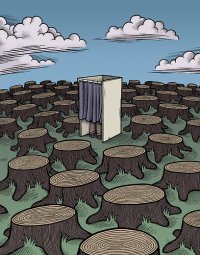
Graph: Flickr/paradigm4.
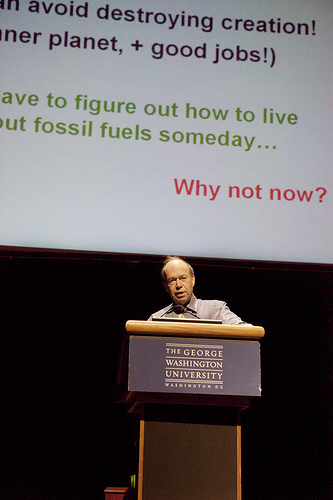 If politicians remain at loggerheads, citizens must lead. We must demand a moratorium on new coal-fired power plants. We must block fossil fuel interests who aim to squeeze every last drop of oil from public lands, off-shore, and wilderness areas. Those last drops are no solution. They yield continued exorbitant profits for a short-sighted self-serving industry, but no alleviation of our addiction or long-term energy source.
 Why is setting a price (or tax) for emissions more efficient than a cap? Because reducing greenhouse gas emissions is more like a marathon than a sprint. The cost of cutting emissions tends to go up with each additional reduction, while the benefit remains essentially constant. (Every ton of CO2 has the same heat-trapping effect.)
 A December 16 article in the Miami Herald,
  The most recent poll, a
 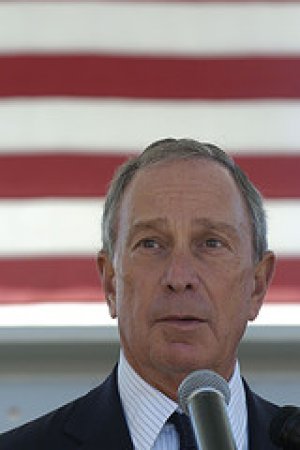 With his speech today, Mayor Bloomberg joins former Vice-President Al Gore as the nation’s leading advocates of a carbon tax to cap and reduce carbon emissions from fossil fuels. French President Nicolas Sarkozy
  "We need to profoundly revise all of our taxes… to tax pollution more, including fossil fuels, and to tax labour less."
 (The quote is from Section 4,