
Cap and Trade is a Carbon Tax Collected by Wall St. (Rolling Stone)
Search Results for: cap and trade
Happy New Year – A New Political Reality for Carbon Taxes
For too long the conventional wisdom has been that while carbon taxes may be superior to cap-and-trade schemes, there is no way that politicians would ever support a new tax, even one that was revenue-neutral. Environmentalists who might otherwise be supporting a carbon tax because it could produce real reductions in greenhouse gas emissions far more rapidly than cap-and-trade have dismissed carbon tax advocacy as naive and have rallied behind cap-and-trade.
 Just as conventional wisdom was consistently proven wrong in the 2008 presidential election, it’s also proving wrong about the political infeasibility of a carbon tax. Just look at events over the past two days.
On Saturday, the lead editorial in the New York Times, The Gas Tax, made a compelling case that the president-elect and Congress should impose a “gas tax or similar levy to keep gas prices up after the economy recovers from recession.”
On Sunday, two prominent Republicans, Congressman Bob Inglis of South Carolina and supply-side economist Arthur Laffer, unequivocally endorsed a U.S. carbon tax in a New York Times op-ed, An Emissions Plan Conservatives Could Warm To, that concisely summarized the politics of climate change and the rationale for a carbon tax from a conservative perspective:
Conservatives don’t support tax increases that are veiled as “cap and trade” schemes for pollution permits. But offer us a tax swap, and we could become the new administration’s best allies on climate change.
The Inglis/Laffer summary of why the Liberman-Warner cap-and-trade bill failed is short and to the point:
A climate-change bill withered in Congress this summer because families don’t need an enormous, and hidden, tax increase. If the bill’s authors had instead proposed a simple carbon tax coupled with an equal, offsetting reduction in income taxes or payroll taxes, a dynamic new energy security policy could have taken root.
Inglis/Laffer cogently present the economic basis for a carbon tax:
We need to impose a tax on the thing we want less of (carbon dioxide) and reduce taxes on the things we want more of (income and jobs). A carbon tax would attach the national security and environmental costs to carbon-based fuels like oil, causing the market to recognize the price of these negative externalities.
They recognize that “the costs of reducing carbon emissions are not trivial” and the concomitant need for revenue-neutrality in carbon pricing:
It is essential, therefore, that any taxes on carbon emissions be accompanied by equal, pro-growth tax cuts. A carbon tax that isn’t accompanied by a reduction in other taxes is a nonstarter. Fiscal conservatives would gladly trade a carbon tax for a reduction in payroll or income taxes, but we can’t go along with an overall tax increase.
Inglis/Laffer directly address concerns that putting a price on carbon (whether through a carbon tax or cap-and-trade) would put Americans at a competitive disadvantage:
If China and India join the United States in attaching a price to carbon, their goods should come into this country without a carbon adjustment. But if they do not, every item they place on our shelves should be subject to the same carbon tax that we would place on our domestically produced goods, again offset by a revenue-neutral tax cut.
If World Trade Organization rules entitle members to an unwarranted exemption from such a carbon tax, then we should change them. Outliers should not be allowed to frustrate the decision-making of the countries that are trying to prevent the security and environmental train wrecks of this century.
Although other conservatives including George W. Bush speechwriter David Frum and the American Enterprise Institute’s Ken Green have made similar arguments, Inglis and Laffer are the two most prominent Republicans to publicly articulate such a clear pro-carbon tax position.
The same day as the Inglis/Laffer op-ed, conservative pundit Charles Krauthammer published his own strong endorsement of a gas tax. Though his Weekly Standard article, The Net-Zero Gas Tax – A Once-in-a-Generation Chance, begins by describing Americans’ “deep and understandable aversion to gasoline taxes,” Krauthammer quickly presents what he refers to as the “blindingly obvious” energy independence and other benefits of an increase in the federal gas tax, and proposes what he calls:
Something radically new. A net-zero gas tax. Not a freestanding gas tax but a swap that couples the tax with an equal payroll tax reduction. A two-part solution that yields the government no net increase in revenue and, more importantly — that is why this proposal is different from others — immediately renders the average gasoline consumer financially whole.
Krauthammer envisions the simultaneous enactment of a carbon tax and an offsetting reduction of payroll taxes, with the payroll tax reduction kicking in a week before the gas tax takes effect. He notes as a “nice detail” the fact that the payroll deduction would be “mildly progressive” and follows with a constructive analysis of some of the nitty-gritty details of implementing his net-zero gas tax.
Finally, Times columnist Thomas Friedman weighed in with yet another strong call for a gasoline and/or carbon tax in Win, Win, Win, Win, Win. Echoing the previous day’s Times editorial, Friedman states what should be obvious:
It makes no sense for Congress to pump $13.4 billion into bailing out Detroit — and demand that the auto companies use this cash to make more fuel-efficient cars — and then do nothing to shape consumer behavior with a gas tax so more Americans will want to buy those cars. As long as gas is cheap, people will go out and buy used S.U.V.’s and Hummers. (emphasis in original)
Friedman follows with a geopolitical argument very similar to that made by Inglis, Laffer and Krauthammer:
A gas tax reduces gasoline demand and keeps dollars in America, dries up funding for terrorists and reduces the clout of Iran and Russia at a time when Obama will be looking for greater leverage against petro-dictatorships. It reduces our current account deficit, which strengthens the dollar. It reduces U.S. carbon emissions driving climate change, which means more global respect for America. And it increases the incentives for U.S. innovation on clean cars and clean-tech.
The weekend explosion of support for carbon and/or gas taxing followed by just three weeks a similar confluence, also described here, in which Thomas Friedman called for a carbon tax, the Wall Street Journal stated its clear preference for a carbon tax over cap-and-trade and Ralph Nader and Toby Heaps made a compelling case for pricing carbon emissions via a tax rather than a trading scheme in a Wall Street Journal op-ed.
This convergence of opinion from Left and Right signals an extraordinary opportunity to obtain bipartisan support for a revenue-neutral carbon tax. As Congressman Inglis and Mr. Laffer conclude:
As president, Barack Obama, by working with conservatives as well as the members of his own party, can at once clean the air, create jobs and improve the national security of the United States — a triple play for the next American century.
Will the environmental community unite to actually help pass climate change legislation? That remains to be seen as environmental groups continue to be split between carbon tax and cap-and-trade camps. I’ve worked closely with some of the groups supporting cap-and-trade, have tremendous respect for them and know they understand how important it is to put a price on carbon and to make very large reductions in greenhouse gas emissions as soon as possible. I know that some cap-and-trade supporters are genuinely convinced that a carbon tax is simply not possible politically. Will that change as bipartisan support grows for a revenue-neutral carbon tax?
It’s time to recognize that 2008’s conventional wisdom is wrong. If we join together in a bipartisan alliance, Congress can adopt and implement a carbon tax in 2009.
Photo: Valerio Schiavoni / Flickr.
Media Buzz Intensifies Ahead of Carbon Tax Hill Briefing
The Carbon Tax Center’s Capitol Hill briefing is just two days away (Dec. 9), and we couldn’t have choreographed a more turbocharged buildup than the one provided over the past few days by The New York Times and The Wall Street Journal.
Thomas Friedman’s column in today’s Times, The Real Generation X, is his most full-throated call ever
for a carbon tax. It’s a welcome return to his earlier editorializing in favor of carbon taxing from his recent slight tilt toward cap-and-trade (emphases added):
It makes no sense to spend money on green infrastructure — or a bailout of Detroit aimed at stimulating production of more fuel-efficient cars — if it is not combined with a tax on carbon that would actually change consumer buying behavior.
Many people will tell Mr. Obama that taxing carbon or gasoline now is a
“nonstarter.” Wrong. It is the only starter. It is the game-changer. If you want to know where postponing it has gotten us, visit Detroit. No carbon tax or increased gasoline tax meant that every time the price of gasoline went down to $1 or $2 a gallon, consumers went back to buying gas guzzlers. And Detroit just fed their addictions — so it never committed to a real energy-efficiency retooling of its fleet. R.I.P.If Mr. Obama is going to oversee a successful infrastructure stimulus, then it has to include not only a tax on carbon — make it revenue-neutral and rebate it all by reducing payroll taxes — but also new standards that gradually require utilities and home builders in states that receive money to build dramatically more energy-efficient power plants, commercial buildings and homes. This, too, would create whole new industries.
Demonstrating the bipartisan support for carbon taxes from across the political spectrum, the Friedman op-ed followed two powerful Wall Street Journal columns this week. A Dec. 3 op-ed by Ralph Nader and Toby Heaps, We Need a Global Carbon Tax, subtitled, "The cap-and-trade approach won’t stop global warming." makes a compelling case for pricing carbon emissions via a tax rather than a trading scheme:
A global carbon tax levied on a relatively small number of large sources can be monitored by satellite and checked against the annual surveillance of fiscal and economic polices already carried out by IMF staff. Thus, the accounting involved is much more precise and much less subject to the vagaries of corruption and conflict over which industries and companies get their free handouts of carbon credits — carbon pork — than in a cap-and-trade system.
Nader and Heaps go on to provide "three reasons why countries, such as China and India, that have traditionally resisted any notion of a common responsibility to make current polluters pay would do well to enlist in this effort (emphases added)."
First, while there is
no limit on the downside for missing a hard cap, with a carbon tax you
just pay as you go. If a fast-growing
country like China accepted an emissions cap and then overshot it, they
would have to purchase carbon credits on the international market. If
they missed their target by a lot, carbon credits would be scarce, and
purchasing them would suck dry their foreign exchange reserves in one
slurp. That’s why a carbon tax is much easier to swallow and, anyway,
through the power of the price signal, it would produce the same
desired result as a hard cap.Second,
administering billions of dollars of carbon credits in a cap-and-trade
system in an already chaotic regulatory environment would invite a civil war between interest groups seeking billions in carbon credit handouts and the regulator holding the kitty.
By contrast, a uniform tax on CO2 emissions levied at a small number of
large sites would be relatively clear-cut. During the Montreal Protocol
talks in the 1980s, India smartly balked at a suggestion to phase out
CFCs in certain products and not in others because of the chaos that
would result from the ambiguity.Third, key people in China read
our newspapers. They see the ominous clouds of protectionism under the
guise of environmentalism in bills like Lieberman-Warner and they don’t
want to be harmed; neither should we, given the trillions of dollars of
Treasury bills they hold. Showing compliance with a harmonized
carbon tax at a small number of large bottleneck points would be
child’s play compared to the chaos of cap-and-trade.
That was Wednesday. On Friday, the Journal raised its own profile with an editorial, Some Carbon Candor: A climate guru rebukes his mates on cap and trade.
The "climate guru," of course, is Dr. James Hansen, director of NASA’s Goddard Institute of Space Studies, and headliner of our Hill briefing this Tuesday.
The Journal noted that "Mr. Hansen endorses a straight carbon tax as
the only ‘honest, clear
and effective’ way to reduce emissions, with the revenues rebated in
their entirety to consumers on a per-capita basis. ‘Not one dime should
go to Washington for politicians to pick winners,’ he writes."
The Journal editorial continues with a clear statement of its preference for a carbon tax over cap-and-trade (emphases added):
The
risks of fossil fuels remain speculative, but if they really are the
apocalypse of Mr. Hansen’s prophecies, then the cleanest remedy is a
tax. That would raise energy and all other prices as the incentive for
new technologies and investments. But a tax would be neutral,
eliminating the market distortions caused by subsidies and regulation,
and the proceeds could be used to offset other taxes. The
transition to a world in which growth is not tied to carbon would still
be long and extremely expensive, but a tax would be the least painful
way to get there."A tax should be called a tax," Mr. Hansen writes. "The public can understand this and will accept a tax if it is clearly explained and if 100 percent of the money is returned." Clearly the man is not standing for elective office.
Beltway
sachems prefer posturing that disguises the cost of rising energy
prices, such as cap and trade. This "subterfuge," as Mr. Hansen terms
it, shifts the direct burden onto businesses, which then pass it along
to consumers. Congress may flatter itself that it is saving mankind,
but what the Members really want is a cap-and-trade windfall that they
can redistribute in the green pork of Mr. Obama’s "new energy
economy," whatever that means.
To be fair, carbon tax revenues could also end up as green pork. But
the transparency of a carbon tax — from the candor in its name to its frank acknowledgment of its impact on energy prices — militates in
favor of a revenue-neutral outcome in which the revenues are
distributed or tax-shifted to American families rather than skimmed off
by political and corporate rentiers.
Why the carbon tax trifecta this week? While
we can’t know precisely what led Mr. Friedman to go all out today for a carbon tax (rather than cap-and-trade), perhaps the financial meltdown has played a big
part by opening up political space for bold action and discrediting the notion of creating another trillion-dollar market in
arcane securities. As for The Journal, while it might prefer to to
stifle any move toward carbon emission pricing, its
straightforward arguments for the relative efficacy of carbon taxing
over a cap-and-trade scheme are welcome.
In any event, the setting couldn’t
be more propitious for our carbon tax briefing this Tuesday, which the
Carbon Tax Center has organized along with the Climate Crisis
Coalition, the Environmental and Energy Study Institute, Friends of the
Earth, and the Friends Committee on National Legislation. As a side-benefit, the media buzz might help convince C-Span to provide live
video. The briefing,
featuring not only Dr. Hansen but other climate-policy experts Gilbert
Metcalf, Robert Shapiro and James Hoggan, hosted by Rep. John Larson
(D-Conn.), who was just elected chair of the House Democratic Caucus,
and moderated by FoE president Brent Blackwelder, is in Rayburn House
Office Building B318 and runs from 9:00 a.m. to 11:30 a.m. Tuesday. We
hope to see you.
Photo: Flickr / kakariki.
Emissions Migration: One More Reason for the U.S. to Lead with a Revenue Neutral Carbon Tax
Guest post by Wyatt Boyd, an intern at the Carbon Tax Center and graduate student in Columbia University’s Climate and Society Program
————————————————————————————————————————————————-
It usually doesn’t take long for conversations about carbon taxes to turn to “emissions migration.” Won’t a U.S. carbon price, it is asked, simply push coal-fired power plants, factories and jobs out of the country? It turns out, however, that the issue of emissions migration perfectly illustrates the merits of revenue-neutral carbon taxes.
During an internship with the Carbon Tax Center this summer, as part of my graduate work at Columbia University, I prepared a working paper that weighs the costs and benefits of a carbon tax and emissions migration. My main finding is that the risks of not pricing carbon far outweigh the possible pitfalls of carbon taxes. Click here to see a copy of my paper, Global Emissions Migration and a Revenue Neutral Carbon Tax.
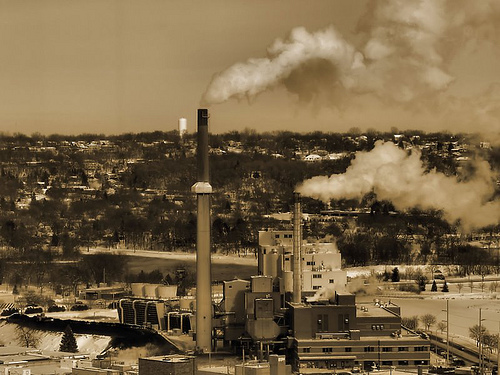 My paper demonstrates that the gloom and doom about America’s industries packing their bags and heading for low-cost countries in Asia or elsewhere at the first serious sign of a U.S. carbon price is grossly exaggerated. In fact, if carbon taxing leads the U.S. to reward labor and income more, and greenhouse gas emissions less, the opposite is more likely to occur. Placing a clear and certain price signal on carbon, which by the way is elusive with a cap and trade design for all the reasons described in an issue paper prepared by the Carbon Tax Center, has huge implications for the 10 trillion dollars of new capital the IEA estimates will be available for energy investments by 2030. With a revenue neutral tax, capital will neither be left sitting on the sidelines waiting for the rules to be clarified, or, still worse, locked up in soon to be obsolete or outlawed dirty coal plants. Instead, with clean energy a clear winner on their balance sheets thanks to a tax shift, U.S. firms will capture a huge new competitive advantage in the “next big thing” in the global economy – clean, carbon-free energy. The new investments will create many new middle-income jobs at home and contribute to a sustainable infrastructure driven boom. According to the excellent new book Earth: The Sequel by Fred Krupp, President of the Environment Defense Fund, clean tech typically provides twice the jobs per investment as traditional nuclear or coal plants. The costs of not enacting a carbon tax are millions of jobs lost and trillions of dollars of new investments stuck in limbo in the coming decades. The people who harp on emissions migration rarely mention this sobering opportunity cost to not pricing CO2.
Our country’s dependence on foreign oil creates huge economic, environmental and national security issues. Reliance on dirty coal is an environmental disaster, with new coal plants locking us into either intolerable emissions or the need to throw away money by shutting the plants before the end of their useful lives. By providing a powerful new incentive for clean energy development and deployment, the United States will not just see new investment and sustainable economic growth for decades to come, but get way ahead of the innovation curve in key areas like concentrated solar – and export these technologies to the world! Technologies like solar thermal, direct current transmission lines and clean coal + carbon capture are rapidly maturing today. The problem is they have to compete with coal, which is literally and figuratively as cheap as dirt, when its true costs are not factored into its price. Alas, with our current stagnant and backwards energy plan, Germany and Japan are dominating the field of clean tech (about 90% market share) while the U.S. sits paralyzed for lack of responsible public policy. The real issue is not emissions migration, a drop in the bucket compared to the torrent of new investments and development that would flow from a revenue neutral price on carbon. The real issue is when will the U.S. stop searching high and low for excuses and scapegoats like emissions migration, and develop a real energy plan?
Photo: Flickr / cjohnson7
Barnes on A Convenient Windfall
In A Convenient Windfall: Global Warming’s Big Cash Dividend, published on March 23, 2007 at www.commondreams.org, Peter Barnes makes the excellent points that “we need to make polluters pay for fouling the atmosphere” and that “we’ll earn an enormous cash windfall if we fight global warming the right way.” Unfortunately, his “right way” is a cap-and-trade program.
As Barnes acknowledges, polluters are arguing that they should receive future carbon emission permits free of charge to avoid being hurt by a cap and trade program. In fact, they have received free allowances under existing cap-and-trade programs for NOx and SO2 and they have good reason to expect that they will receive free allowances if there is a carbon cap-and-trade program. Barnes is correct that “there’s real-world evidence that privatizing the climate windfall would be a serious mistake” and that when the European Union gave out free carbon emissions permits to coal-burning utilities, “the undisputed results were windfall profits for the utilities, higher prices for everyone else, and zero public benefit.”
Barnes concludes that the permits should be auctioned rather than given away. The danger is obvious. When it comes to making deals in Congress, the coal-mining companies and the companies burning coal have tremendous clout and the inevitable result will be a cap-and-trade program with the allowances given to the polluters along with the cash windfall.
The good news is that we really can earn an enormous cash windfall by fighting global warming the right way. That right way is by implementing a carbon tax, which is superior to cap-and-trade programs for all the reasons set forth in our issue paper on Carbon Taxes vs. Cap-and-Trade.
The World Welcomes CTC!
Here’s a sampling of e-mails to info@carbontax.org since our launch yesterday.
Keep those cards and letters coming. Even better, comment here, on this blog. Please also add a link to CTC on your Web site. Tell your friends and neighbors.
And feel free to donate. Already received: 6 contributions totaling $500. We’re thrilled and grateful.
— Dan and Charles
Great idea. I like your FAQs addressing the various issues. It’s about time someone did this! — (veteran energy policy analyst)
You can count on me to promote the idea whenever and wherever I get the chance because it’s the right way to go on this important issue. (economist, author, educator)
Nice work! Better late than…. But it may be too…. (longtime sustainability writer-activist)
This new clearinghouse for information on Carbon Tax is great. I’ll pass this on to the authors I am working with in environmental studies. (editor)
Site looks great! I think it will make a big impact. (a friend)
Dear global warming activists: great news below! Please forward this to your friends and lists, and spread the word. (climate activist)
Sounds intriguing. Please keep us in the loop. (CEO of an international environmental policy org.)
Good luck! I posted this on The Oil Drum. (eco-activist, Peak Oil-er)
My instinct has always been that imposing a tax on carbon is a better way to go than the cap-and-trade approach simply because it would force all actors to reduce their emissions no matter how efficient or inefficient they presently are and we need all the reductions we can get if we hope to arrest the worst case scenarios. (CEO of a grassroots enviro org)
The site looks good. Like the name of the newsletter vis a vis Al G. Signed up. Good luck! (family member)
Congratulations on your new carbon-tax group! I signed up for your email. I think the time is right for a c-tax. (author)
Good for you. The debate is needed. (founder of a major sustainability org.)
Your proposal, it seems to me, is the very sort of thing we need more of — and the very sort of thing that any number of well-heeled, self-styled “greens” would like to avoid (e.g., let’s stick a wind tower in Podunk and let’s drive our SUV out to take photos of it). (writer)
This is really a great contribution to the dialog. I especially like your assertion of how a CT is better than cap and trade. That really deserves its own slide show. (Solar-photovoltaic and energy-efficiency entrepreneur)
Congratulations. This is a noble effort. (cycling and livable cities advocate)
Interesting, and even elegant site…I am freezing on behalf of the cause, etc. (writer)
A Lesson for NYC Congestion Pricing Came Last Week from Washington State
This post is adaped from my essay yesterday on Streetsblog USA, A Lesson for NYC’s Congestion Pricing Came Last Week from Washington State. It was posted on the eve of NY Gov. Kathy Hochul’s announcement today that she has ended her June “pause” and authorized New York’s Metropolitan Transportation Authority to begin implementing a scaled-down but still-robust version of the original plan, beginning at midnight January 5, 2025.
The Streetsblog post was intended to steel Hochul’s courage and, as we congestion pricing advocates have demanded since June, to prod her to “flip the switch” on the Manhattan toll scheme that was set to go into effect on June 30. It was actually written last weekend with the hope of placing it in the New York Times, but they could not fulfill our request for rapid publication. No matter, the governor’s turnaround was already in the works.
The post takes a few liberties with actual events in Washington, eliding the differences between the straight-up carbon tax measure that voters rejected in 2016 and the cap-and-trade measure that also failed at the ballot in 2018, and the state’s Climate Commitment Act that was enacted into law in 2021 and backed by voters last week. This was in service of the larger point: that the conception of what is fair changes when an effective policy has been given time to work, and that if a policy is wise, politicians should stay the course, confident that public support will emerge.
We’ll have more to say in the coming weeks about the pending rollout of New York’s congestion pricing plan, arguably the first-ever large-scale application of externality pricing in the U.S.
— C.K., Nov. 14.
The first time Donald Trump was elected president, in 2016, Washington State residents also voted down an initiative that would have created the country’s first statewide carbon tax.
The second time Trump won the presidency, last week, Washington residents flipped their 2016 stance on carbon pricing, voting to preserve the comprehensive carbon pricing program that their legislature ended up enacting. And therein lies a message for New York Gov. Kathy Hochul, who paused New York City’s Central Business District toll plan on June 5, just as it was about to go into effect after years of debate.
The message: If the policy is wise, stay the course. The facts on the ground will soon change, generating the political support to validate your policy and prepare you for the next policy battle.
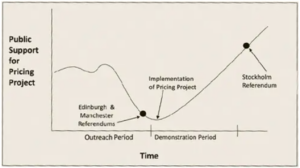
The famous chart of why politicians should stay the course when a policy is good, but unpopular.
Congestion pricing proponents have always known the odds. Taxes are unpopular, check. Driving is a birthright and change is hard, check. We were aware congestion pricing in London and Stockholm had only 40 percent favorability before adoption. But both cities’ experience showed that once traffic visibly lessened and transit improvements got underway, opinion flipped. Roughly 60 percent of residents now support the tolls.
The 2016 vote against Washington carbon pricing was a landslide: 59.3 percent no to 40.7 percent yes. The 2024 vote to keep the state’s carbon pricing law was a landslide in the opposite direction: 62 percent to keep it and 38 to repeal it. Hmm, looks like that 60-40 rule has legs!
A brief look at the law that Washington State voted to keep last week will demonstrate how it’s cut from the same cloth as New York’s congestion pricing.
Washington’s innovative Climate Commitment Act requires fossil fuel companies to buy permits keyed to the carbon content of their fuels. That includes oil refineries, which pass on the costs of the permits to motorists and homeowners as higher prices for gasoline and heating fuels.
The intent is to motivate industry and consumers to curb their carbon dependence, much like congestion pricing in New York would impel motorists to drive less often into gridlocked Manhattan. Sales of the emission permits in Washington are already helping finance electrification and renewable-energy substitutes for fossil fuels, just as New York’s congestion revenues would have bankrolled $15 billion in better transit.
And just as it has been in New York, the road to this decision wasn’t easy. Washington’s climate law took root after voters twice rejected ballot referendums for statewide pricing of carbon emissions by margins of around 60 to 40. (A 2018 initiative failed as well, 56.6 percent to 43.3percent.) But after Democrats won control of the legislature in 2020, Gov. Jay Inslee, a Democrat and unabashed climate champion, pushed through the Climate Commitment Act, much as New York Gov. Andrew Cuomo in 2019 won legislation directing the regional transit authority to institute a congestion pricing system.
This year, however, fossil fuel backers in Washington collected enough signatures to place Initiative 2117on the Nov. 5 ballot. A “yes” vote would have repealed the legislation and discarded the emission permits — perhaps slowing energy price increases but stalling the state’s shift toward clean power.
Well, the returns are in, and supporters of the emissions permit scheme won big.
 True, what was on the ballot in Washington last week — making gasoline and other fossil fuels more costly to elevate lower-emission substitutes from smaller cars to electric cars and, best of all, less driving — isn’t the same as congestion pricing. But it’s a close cousin. What stands out is that a policy rejected by nearly 60 percent of voters in 2016 and again in 2018, won with around 60 percent in 2024. Attitudes can shift when facts warrant.
What enabled the turnaround? A resolute governor stayed the course, allowing the “default” to recalibrate from cheap gas to clean power and letting the public warm to this novel policy for cutting carbon pollution. Once it did, 20 percent of voters came aboard, just like they did in London and Stockholm.
New York hasn’t been as fortunate yet. This spring, our executive gazed at the pending $15 peak congestion toll and rather than seeing less gridlock and a transformed transit system, saw a political abyss. Advocates and even her own staff tried to brace her for this “valley of political death” between congestion pricing’s initiation and its eventual acceptance. The warnings did no good. On June 5, she placed the tolls on “indefinite pause.”
There is talk that the governor will soon un-pause the tolls now that the suburban House races she feared would be swept up in a congestion pricing backlash are decided. But Gov. Hochul must move with urgency. The incoming president has made his distaste for the tolls abundantly clear. His return to power is less than 10 weeks away, with at least four of those weeks likely gobbled up by red tape. The plan’s logic that Hochul herself once articulated so well remains intact: better commutes and healthier, safer streets.
Hochul must act fast and trust the message from Washington State: with strong leadership, good policy and good politics can be one and the same.
What Price Giant Wind?
Belief that bigger is better — or, at least, a lot cheaper — helped sideline nuclear power. It now imperils wind power.
In July, at the first commercial-size U.S. wind farm under construction, near Martha’s Vineyard, a turbine blade split apart and fell into the Atlantic. In May and again in August, at the new Dogger Bank wind farm 80 miles east of England, blades broke off their towers and slammed into in the North Sea.
All three failures involved a mammoth new wind turbine design from GE Vernova, optimized to abundant offshore winds. The 13-megawatt turbines, dubbed Haliade-X by GE Vernova, a spinoff from the old General Electric conglomerate, are the world’s largest, and are nearly four times more powerful than the average wind turbine installed in the U.S. last year, and a full order of magnitude (10x) beyond typical windpower machines installed 20 years ago, according to U.S. Department of Energy data.
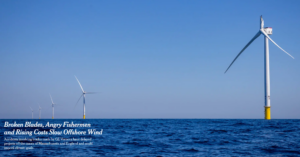
Photo of Vineyard Wind farm by Randi Baird. This image led the Sept 12, 2024 NY Times business section.
To be sure, dozens of other turbines at both wind farms are operating trouble-free and helping displace fossil-fuel generation, although the Vineyard Wind farm is now shut. The expected output of each 13-MW unit, 56 million kilowatt-hours a year, will let power grids pull back on incumbent fossil-fuel power plants that would otherwise spew 25,000 tons a year of climate-disrupting CO2, while maintaining wind energy’s meteoric growth. In Great Britain, wind turbines now stand neck-and-neck with power plants burning “natural” (methane) gas as the top electricity source, providing a third of Britain’s electric generation in the first quarter of 2024, according to Energy Advice Hub. In the U.S., although wind power’s kilowatt-hour production fell by 2 percent in 2023 — the first year-on-year slip this century — wind turbines are producing 40 times more electricity than two decades earlier and now account for 10 percent of the nation’s electricity generation.
Despite, or perhaps because of, wind power’s growing prominence, the concatenation of the three incidents is worrisome. The Vineyard breakage seemed to validate the fears of East Coast commercial fishers and other objectors to the large-scale offshore windpower development that has become a linchpin of regional and national drawdowns from fossil fuels. “Jagged pieces of fiberglass and other materials from the shattered blade drifted with the tide, forcing officials to close beaches on Nantucket,” the New York Times reported this week.
Indeed, the Times headlined its story on the Vineyard mishap, “Broken Blades, Angry Fishermen and Rising Costs Slow Offshore Wind,” adding the subhead, “Accidents involving blades made by GE Vernova have delayed projects off the coasts of Massachusetts and England and could imperil climate goals.”
What happened?
Why the blades broke apart isn’t yet clear. According to the Times’ story, GE Vernova has labeled the three incidents “one-offs rather than systemic flaws … but has provided few details about their causes.” The first failure at Dogger Bank, in May, resulted from “an error during installation,” a company spokesperson told the paper, while the second, in August, “happened because a turbine was left in a ‘fixed position’ during a storm.” Trade publication Maritime Executive reported that GE Vernova told investors that the Vineyard blade rupture resulted from a “manufacturing deviation” in the bonding of the blade at a Canadian production facility. But the company “declined to confirm any details about the blade[s] that failed at the UK wind farm and if [both] came from the same manufacturing facility,” the publication said.
[On Sept. 20, just hours after we posted this story, GE Vernova said it planned to downsize its offshore wind business with 900 job cuts, many at the company’s turbine factory in Saint Nazaire, France.]
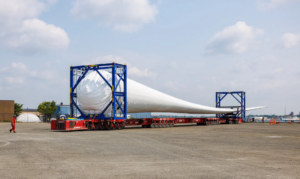
A GE Vernova 13-MW wind turbine blade awaiting shipment offshore, photographed for NY Times by Bob O’Connor. Its weight is almost certainly double and perhaps triple that of conventional 3.3-MW blades.
The cause could be rooted in the sheer size of the blades and, perhaps, the rapidity with which the industry has scaled up. The blades on the Haliade-X offshore wind turbine are 50 percent longer than those on a representative 3.3-MW land-based wind turbine: 220 meters tip-to-tip for the 13-MW model, according to GE Vernova, vs. 148 meters for the 3.3-MW machine, per the U.S. National Renewable Energy Laboratory’s 2022 Cost of Wind Energy Review (pdf). The disparity in bulk is probably well over 2 to 1; if the blade shapes are the same, the ratio of their areas would be 1.50 squared, i.e., 2.25 to 1. If the bigger blades are thicker as well, their weight could be triple that of the conventional blades.
It may be that current technology can’t mass-produce such enormous objects to the quality required to withstand the stresses from constant rotation. Even slight manufacturing defects that smaller turbines could handle might be unforgiving for giantic blades.
This isn’t to say that advances in metallurgy, material bonding and non-destructive testing couldn’t restore reliability for giant wind turbines in the future. The checkered history of rapid size-scaling in the U.S. nuclear power industry may be instructive.
Boosting reactor sizes proved disastrous in the U.S.
Throughout U.S. nuclear power’s “bandwagon era” — circa 1957-1974 — the U.S. Atomic Energy Commission and reactor manufacturers subscribed to the idea that nuclear costs would enjoy pronounced economies of scale. Their rule of thumb was that any doubling of reactor capacities — from 100 to 200 megawatts (for so-called “pilot” plants) and, later, from 500 to 1,000 MW — should raise costs only around 50 percent, tantamount to a 25 reduction in per-kW costs.
(The 50 percent cost rise would equate to a factor multiple of 1.50. Dividing that by two, for the doubling in megawatts, would yield a per-kW cost multiple of 0.75, i.e., a 25 percent drop.)
 This impressive scale-economy made sense — on paper. Costs tend to track equipment surface areas, while capacity is proportional to reactor volume, portending only a 60 percent rise in costs per doubling of capacity. (Mathematically, two raised to the two-thirds power is roughly 1.6. Why two-thirds? Because surface area rises with the square of length while volume rises with the cube.) This would dictate a 20 percent reduction in per-kW costs from doubling plant capacity. Other cost elements like siting, permitting, engineering, and project mangement would, it was thought, display steeper economies, lifting the overall per-kW cost reduction per doubling of capacity to around 25 percent.
These upbeat expectations from reactor upsizing motivated successive doublings in reactor capacities through the 1960s and into the 1970s. The size increases did cut per-kW costs (or, at least, they helped hold back the tide of increased costs to comply with increasingly stringent safety regulations), but with diminishing returns. My own empirical analysis of costs to complete U.S. reactors, published in 1981, found only a 13 percent drop in per-kW costs per doubled reactor size, even when controlling for so-called regulatory creep. That saving was only half as great as the AEC had posited. Worse, larger reactors took far longer to build than smaller ones, which tied up vast amounts of capital, postponed nuclear displacement of fossil-fuel electricity, and spooked investors.
Larger reactors also proved harder to keep in service, their “teething” problems sometimes persisting for decades. That troublesome era is now decidedly in the past. The U.S. nuclear power sector’s average “capacity factor” has climbed steadily from the post-Three Mile Island accident trough of 55-60 percent operability to nearly 90 percent since around 2000. Still, with investor losses, high utility bills and excess carbon emissions, the toll from too quickly upsizing U.S. nuclear power plants proved immense.
A mid-range carbon price would match cost savings from doubling wind turbine sizes
The scale-economy curve for wind power in the graph above isn’t statistically stout, having been extrapolated from a mere two data points for land-based turbines in the NREL Wind Energy Cost report referenced earlier. (Readers with additional data: please share it with us!) That said, it conveys a message: double the size of an individual wind turbine and the per-kW capital cost should diminish by 18 percent. Factor in greater productivity — I assume that each kW of capacity of the larger turbine produces 9 percent more kWh’s than the smaller one — and the overall cost per kWh of wind power (“levelized cost of electricity,” in industry parlance) falls by 25 percent with a doubling of the turbine’s megawatt size.
That’s no small saving for supersizing, though of course it requires that projects employing the extra-large turbines actually come to fruition. According to the most recent (Aug. 19) Nantucket Town and County 2024 Turbine Blade Crisis Updates page — the name alone is a telling indicator — all installation and operation of turbine blades for the Vineyard Wind project are on hold, though placement of towers and nacelles (the equipment-bearing structures topping each tower) is permitted.
 For Vineyard Wind, then, and perhaps for the Dogger Bank project as well, paper savings from going large have become a cruel joke, at least for the time being. Putting that aside, I’ve calculated the theoretical carbon price that would raise the sale price of wind electricity by the same amount that a halving of turbine capacity raised its all-in cost. Rephrased as a question: How big of a carbon price would have to be baked into the cost of prevailing fossil-fuel electricity — assumed to be from the mainstay of the U.S. power system, a combined-cycle power plant burning methane gas — to compensate for sticking with prior 6-7 MW sized offshore wind turbines and, thus, foregoing the assumed 25 percent per-kWh cost reduction from doubling turbine sizes to 13 megawatts?
The answer is displayed in the text box at right: $72 per ton of CO2 (equivalently, $80 per metric ton, or tonne; these figures decrease somewhat if we factor in separate methane fees such as the levy enacted as part of the Biden Inflation Reduction Act).
In other words, a $72/ton CO2 price would have given the offshore windpower industry the same profitability enhancement it thought it would reap from doubling its wind turbine megawatt capacities . . . but without the heavy blow rendered by the multiple Haliade-X blade failures.
Granted, there’s no actual link between instituting robust carbon-emissions pricing and easing up on the impulse to push technological advances faster and faster. Even with a $72/ton carbon price, offshore wind turbines would still be in a size race.
The point, rather, is to illustrate the economic power of carbon pricing. If a $72/ton carbon price could raise wind farm profitability by the same degree as a huge and perhaps premature push into bigger frontiers, imagine the leverage that robust carbon pricing could exert on every sphere of economic and physical activity.
Only a National Carbon Tax Can Halve U.S. Carbon Emissions
The first major update of CTC’s carbon-tax model since 2021 is now in the books, calibrated to 2023 emissions and the putative emissions-reducing provisions of the Inflation Reduction Act. One result stands out: Without federal legislation mandating a robust national carbon tax, the U.S. won’t come close to achieving the hoped-for 50% decline in carbon emissions (from 2005 levels) in the reasonably foreseeable future.
A $20/$15 carbon tax could halve carbon emissions by 2035
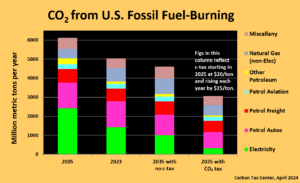
A national carbon tax starting next year at $20/ton and rising annually by $15/ton will cut U.S. CO2 emissions in half from 2005 levels in 2035. To halve emissions by 2030 requires $25/ton for both the starting price and the annual rises.
A national carbon price that took effect in 2025 at $20 per (short) ton and rose by $15 per ton each year would, by 2035, halve U.S. emissions of carbon dioxide from fossil fuel combustion: from 6,120 million metric tons (“tonnes”) in 2005, the standard baseline year, to an estimated 3,068 million tonnes in 2035, according to CTC’s model (Excel spreadsheet, 2 MB). That computes to a 50% reduction (rounded from 49.9%).
[NB: The site hosting the Excel file is temporarily down, please check back soon.]
But without a national carbon price, our model projects U.S. emissions in 2035 of 4,606 million tonnes. That would be just 25% below 2005 emissions, putting the country only halfway to the 50%-reduction goal in 2035. And even that piddling progress entails pushing back the customary 2030 target for halving U.S. emissions to 2035, a 5-year delay.
To be fair, the “halving by 2030” goal is generally construed to encompass not just carbon dioxide but also methane, which is regarded as lower-hanging greenhouse-gas fruit on account of its relative concentration in more easily regulatable oil and gas extraction and transport. This January methane began to be subjected to emissions pricing, through a provision of the Inflation Reduction Act mandating that emissions above a certain threshold be taxed at a rate of $900 per tonne.
But even assuming an optimistic three-fourths reduction in methane and other non-carbon GHG’s, CO2 emissions from fossil fuel-burning would have to fall by 44% from 2005 to achieve an overall 50% reduction in U.S. greenhouse gas emissions. Without a national carbon price, the projected CO2 reduction from 2005 is just 17% in 2030 and, as noted, only 25% in 2035, according to CTC’s model.
Halving carbon emissions by 2030 requires a more heroic carbon tax, one starting at $25/ton in 2025 and rising annually by that amount
We also ran the CTC model to determine the carbon price level and trajectory required to halve U.S. 2005 carbon emissions by 2030 rather than 2035. Talk about a tall order! Here’s what the requisite carbon tax would look like:
- The carbon tax would take effect in 2025 (same as in the 2035 scenario).
- The initial price would be $25 per ton of CO2 rather than $20.
- The annual price rise would be the same $25/ton, rather than just $15/ton in the 2035 scenario. That means reaching triple digits in the tax’s fourth year.
- And — this is a bit technical — we’re relaxed the model assumption of the maximum annual tax rise to which the U.S. economy can fully react, from $20/ton previously to $25/ton.
It goes without saying that the present-day American political system isn’t equipped to enact and implement such an “heroic” (an adjective we prefer to “draconian”) carbon tax.
The still-lonely radical center
Prominent voices calling for carbon taxes beyond token amounts (e.g., $10 or $20 per ton with little or no increases) are precious few, not just in absolute terms but relative to the pre-2010 period in which climate concern was widespread and neither the left nor the right had been consumed by their respective demonizations: carbon pricing (on the left) or climate concern of any sort (on the right).
Indeed, here at Carbon Tax Center, we’ve traded in our web pages that previously celebrated carbon tax supporters for pages like Carbon Pricing and Environmental Justice, Progressives and Carbon Pricing, and Conservatives, all of them grouped under a heading of “Politics.” Each is essentially a litany of grievances and rejections of carbon pricing and/or climate action, period.
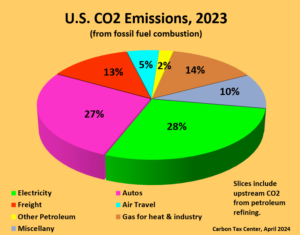
This chart, from CTC’s newly updated carbon tax model, shows the futility of looking for a single invention or regulation or subsidy to slash U.S. emissions. Fossil fuels suffuse our economy, making robust carbon pricing essential to achieving big across-the-board cuts.
This isn’t polarization, it’s a simultaneous disavowal by both ends of the political spectrum of the lone plausible transformational climate-preserving policy measure. (Rather than “ends” I should say “sides” of the spectrum, given that anti-pricing has spilled over from the confines of the respective extremes and now appears to occupy most of the two sides.)
Omens
Consider these two minor but telling signposts from the past week.
One was a NY Times “Sunday Review” guest essay last weekend, I’m a Young Conservative, and I Want My Party to Lead the Fight Against Climate Change, by one Benji Backer, founder-director of the American Conservation Coalition.
Alas, the essay was cut from the same generic cloth as other conservative calls to climate action. Here’s an excerpt:
We cannot address climate change or solve any other environmental issue without the buy-in and leadership of conservative America. And there are clear opportunities for climate action that conservatives can champion without sacrificing core values, from sustainable agriculture to nuclear energy and the onshoring of clean energy production.
Ho-hum. But, most strikingly, zero mention of carbon pricing — not even a nod to the revenue-neutral type such as fee-and-dividend that circumvents right-wing canards about government overreach by “dividending” the carbon revenues to households, thus correcting the market failure driving carbon emissions without “growing the government.”
So much for the right wing. On the left, I had the frustrating experience of meeting a director of an iconic American environmental organization at a public event and bonding with him over our shared dismay at the organization’s post-2016 submission to anti-carbon-pricing rhetoric . . . only to be ghosted when I tried to arrange a meet-up to possibly grow our newfound patch of common ground.
So much for dialogue in service of effective climate policy.
Can’t we bring U.S. emissions down sharply without carbon pricing?
Alas, no. U.S. emission progress perennially falls short of even modest hopes. Almost from the moment the 2022 Inflation Reduction Act — which CTC supported from the git-go — was enacted into law, it has bumped up against a calamity of transmission bottlenecks, supply-chain woes and high interest rates. Even worse, perhaps, is the legal-regulatory “default” against building almost anything, even essential elements of the clean-energy infrastructure the IRA was intended to unlock
(Just after this post went up, I came across NY Times columnist Ezra Klein and Atlantic staff writer Jerusalem Demsas’s trenchant dive into the permitting-resistance phenomenon. Their analysis traces much of today’s disabling red tape and NIMBYism to Democratic Party empathy that prioritizes concerns about marginalized constituencies over the common good. Audio version here, transcript here.)
And let’s not overlook the emergent hellspawns of energy demand like AI processing, cyber-currency computing and ever-larger SUV’s and pickup trucks driven ever more miles, all of which threaten to pile on new carbon emissions almost as fast as incumbent emissions are removed.
As we’ve argued in post after post — just scroll through our monthly archives — these and other decarbonization derailments would be greatly alleviated by the robust carbon taxes we scoped above. Pricing the climate benefits of reduced fossil fuel use into the vast array of alternatives — from clean energy to all the ways of using less — will raise their profitability and, before long, bend society’s defaults toward replacing fossil fuels.
Our updated carbon-tax model shows that U.S. carbon emissions fell by 2.3% from 2022 to 2023. If there weren’t a climate emergency, that might qualify as a decent win. But in our real, overheating world, that rate doesn’t come close to the 4.1% compound annual decline needed to halve 2005 emissions by 2035, much less the 6.9% annual emissions shrinkage required to meet the same goal in 2030.
The insufficiency of even the best-intentioned policies and programs to meet necessary carbon targets without robust carbon taxing can’t be hidden indefinitely. The carbon tax reckoning awaits.
Strawberry Yields Forever: A tax on California groundwater broadens the case for carbon pricing
Please admit California’s Pajaro Valley to the storehouse of evidence that charging a fee to use scarce resources can stretch those resources, to the benefit of all.
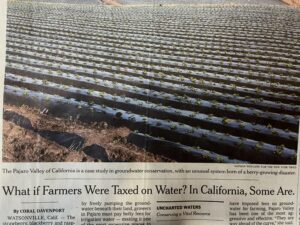
Never heard of Pajaro Valley? Me neither, until I came across NY Times climate reporter Coral Davenport’s compelling end-of-year story, Strawberry Case Study: What if Farmers Had to Pay for Water? Turns out I once hitch-hiked there en route to the spectacular Big Sur coast south of Monterey. But the payoff today is in the story’s subhead: With aquifers nationwide in dangerous decline, one part of California has tried essentially taxing groundwater. New research shows it’s working.

California’s Pajaro Valley, at center of this Google Map, hugs the Pacific Coast midway between Santa Cruz and Monterey and straddles the two counties named for those cities.
What’s working? A charge for groundwater extracted to grow strawberries, raspberries, brussels sprouts, lettuce and kale, administered by the state-chartered Pajaro Valley Water Management Agency to prevent saltwater from the adjacent Pacific Ocean from intruding into underground aquifers. The fee, which began several decades ago at a nominal $30 per acre-foot of water to recover PVWMA’s water-metering costs, now runs as high as $400, according to Davenport.
Lest that rise seem meteoric, and today’s price appear punitive, consider that currently the agency’s total annual water fees, $12 million, equate to barely 1 percent of annual Pajaro Valley crop revenues of $1 billion. What’s more, an acre-foot — the standard volumetric for water supply — is enormous, roughly 326,000 gallons. Even the projected 2025 groundwater fee of $500 per acre-foot translates to just 0.15 cents to a gallon, or a mere one-hundredth of a cent for an 8-ounce glass of water.
To be sure, that calculation is merely illustrative; water for drinking and water for growing crops are two different things. But consider what Pajaro Valley growers get from paying for water.
First, their payments are helping assure increased supplies of crop-worthy water. Revenue from the water fees enabled PVWMA to undertake a $6 million project that captures excess rainwater from a creek near the ocean and injects it into underground wells to be used for irrigation, and a $20 million water recycling plant that cleans 5 million gallons of sewage a day and pipes it to farm fields. Next up, Davenport tells us, is an $80 million system to capture and store more rainwater for irrigation. By replenishing and “stretching’ supplies of groundwater, these investments help ensure that brackish water from the ocean doesn’t seep into Pajaro Valley wells.
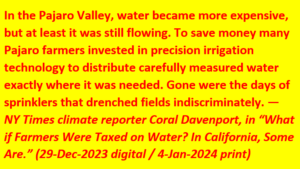 Just as importantly, the growers receive a potent incentive to use available water supplies more efficiently. “Gone were the days of sprinklers that drenched fields indiscriminately,” Davenport writes. “To save money, many Pajaro farmers invested in precision irrigation technology to distribute carefully measured water exactly where it was needed.” (See text box.) Though the article doesn’t mention it, these investments by dozens of individual growers might not have materialized had not all growers been subject to the same incentives to conserve as well.
Economics
Undergirding Davenport’s upbeat reporting is a 2023 working paper, The Dynamic Impacts of Pricing Groundwater, by three economists at U-C Berkeley’s Dept. of Agricultural and Resource Economics. In academic parlance, “dynamic” doesn’t connote a Marvel superhero, it refers to changes over time. By examining changes in water usage over time, the authors conclude that each “21% price increase led to a … 22% reduction in average annual groundwater extraction” by Pajaro Valley growers.
The implied price-elasticity is roughly negative 1.3. (The paper helpfully reports that “The reduction in annual water use doubles between the first year and the fifth year after the tax, with the implied price elasticity of demand ranging from negative 0.86 to negative 1.97.) This empirically-derived price sensitivity is far greater than the price elasticities assumed in CTC’s carbon-tax model, befitting not only the greater salience of water use for growers vis-a-vis energy use for consumers and even most businesses, but the greater agency of Pajaro Valley growers who, Davenport’s reporting suggests, over time have increasingly bought into PVWMA’s groundwater fee in both theory and execution.
 After reading Davenport’s article I reached out to hydrologist, climatologist and water sustainability expert Peter Gleick, whose latest book, The Three Ages of Water: Prehistoric Past, Imperiled Present, and a Hope for the Future, was published last year by Hachette / Public Affairs. Peter praised the article while preferring to denote the PVWMA groundwater charge “not [as a] tax but a fee or simply a price for a commodity.” He added, “When we pay for something, we’re more conscious of how we use it. When something is free, we’re more likely to misuse and abuse it. That’s certainly been the case historically for California groundwater.”
Carbon Taxes?
A number of posts in this space have touted — we might say “flogged” — other instances of resource or externality pricing, as possible templates for large-scale carbon pricing. In 2016 we wrote about Berkeley’s soda tax, actually a tax on the sugar content of soft drinks, and summarized research showing that sales of sugar-sweetened beverages fell 21% in that city while rising 4% in “control groups,” i.e., neighboring municipalities where soft drinks continued untaxed. Last year we explained why Congestion pricing, coming soon to New York City, could bode well for carbon-taxing — a message we previously broadcast several times in 2019 as the enabling legislation was being enacted in Albany, in March and in April.
We also dug deep in 2017, writing about an incipient NYC nickel fee on carryout bags dispensed at supermarkets, grocery and convenience stores. (The fee was a month away from taking effect, and though we haven’t yet seen before/after comparisons, anecdotal evidence suggests that trees in New York City are today far less encumbered by windblown plastic bags that we referred to then as “gossamer debris stuck, like tumors, to our half-a-million street trees.”) We can also go back half a century, to 1972, when NYC environmental officials conjured a “dirty oil surcharge” that forced petroleum suppliers to cough up a fee for each barrel of high-sulfur oil they brought into the city, a remarkably successful (but little known) instance of externality pricing that I memorialized in a 2009 post for Grist, Pollution Taxes Work.
Needless to say, none of these fees — not the soda tax, not congestion charging, not the carryout bag fee, and not the dirty oil surcharge — has paved the way for full-on carbon pricing. While each of them has been or will be a resounding success, their scale is far too local and the stakes far too small to translate automatically to national or even state-level carbon pricing. The same will hold for California’s Pajaro Valley groundwater fee. Indeed, California water districts are wrestling today with the hard work of fulfilling a state mandate requiring every part of the state to devise a plan to conserve groundwater.
Happily, Davenport notes that PVWMA officials and even some growers are advising their statewide counterparts to emulate their approach, including “local control” rather than state or even county governance. Dedicating the groundwater-fee revenues to investments to expand and extend supply, as Pajaro Valley has done, seems a no-brainer.
Less happily, Davenport notes that the Westlands Water District, which serves the state’s giant Central Valley breadbasket, is pushing a plan “that would allow growers to pay for credits to use groundwater above a certain allocation.” The growers “could buy and sell the credits, starting at about $200 a credit,” Davenport notes. While this scheme certainly improves on the status quo of charging little or nothing for groundwater use, it’s complicated and drenched in market ideology, much as carbon cap-and-trade systems needlessly encumber what could and should be straightforward carbon pricing.
Let’s not end on that dour note, however. All instances of resource charging — whether to stretch a limited resource or to internalize pollution or other externality costs — make it easier to build support for enacting new ones. Davenport’s story — here’s the link again — is both brilliant reporting and cause for optimism.
We close with a snap of the story opening and photo as they appeared on the front page of today’s (Jan. 4, 2024) Times, above the fold. Below it are calculations in which we derived figures in the first part of this post.
Calculation #1: Glasses of water in an acre-foot.
- One acre = 43,560 ft^2, so one acre-foot = 43,560 ft^3.
- One ft^3 (cubic foot) contains 957.5 fluid oz. (per inchcalculator.com; that figure jibes with the 62.4 lb weight of one cubic foot of water).
- A standard water glass contains 8 fluid oz. Thus, one ft^3 of water can fill 957.5/8 = 120 glasses.
- One acre-foot then contains enough water to fill 43,560 x 120 = 5.2 million glasses. Spreading a per-acre foot charge of $500 over that many glasses computes to 0.01 cents each.
Calculation #2: Groundwater-use price-elasticity inferred from empirical finding that a 21 percent price increase evokes a 22 percent decrease in usage.
- It is tempting to reduce this roughly 1-to-1 relationship to a (negative) 1.0 price-elasticity. However, that would ignore the law of diminishing returns and, mathematically, the convex relationship between changes in price and changes in usage.
- The price-elasticity is derived by solving for e in the equation, (1 + 0.21)^e = (1 minus 0.22).
- Using base-10 logarithms, we have: e times log 1.21 = log 0.78, which (omitting one or two steps) leads to e = negative 1.3.
- « Previous Page
- 1
- …
- 20
- 21
- 22
- 23
- 24
- …
- 39
- Next Page »