
CA Senate Leader Proposes Carbon Tax on Motor Fuels (Reuters)
Search Results for: cap and trade
"We Have to Be the Carbon Tax" — an Interview With Tim DeChristopher
“We Have to Be the Carbon Tax” — Tim DeChristopher (Truthout)
Waxman-Whitehouse Carbon Tax Discussion Draft: Serious Questions, Curious Answers
Guest Post by Sieren Ernst, Principal of Ethics & Environment. [See 3/23 post-script, below.]
Whether or not simplicity is a personal virtue, it’s certainly an important advantage of a carbon tax over other forms of carbon pricing. Thus, the “discussion draft” on carbon taxes released last week by a bicameral task force headed by Rep. Henry A. Waxman (D-CA) and Sen. Sheldon Whitehouse (D-RI) shows a laudable trend toward simpler, more transparent ways to price carbon pollution. Despite that encouraging trend, some aspects of the draft seem to have steered out of the way to complicate an otherwise elegant concept.

Sen. Whitehouse and Rep. Waxman
Dozens of peer-reviewed economic papers have examined the key design questions that the Waxman-Whitehouse draft asks: How high should the tax start? What should the escalation rate be? Where to use the revenue? The Waxman-Whitehouse task force offered up a menu of options and asked the public to weigh in, reality-tv style, on their favorites at cutcarbon@mail.house.gov.
It’s axiomatic to microeconomics that larger price signals produce larger responses on both the supply and demand side. One need not consult economic models to know that the impact of a low carbon price and tiny escalation rate — such as the task force’s low-end option of $15 per ton of CO2 with an escalator of 2% per year — would be minuscule. Would you modify your driving behaviors more than slightly over an increase of 15 cents per gallon of gasoline? Clearly, we need the task force’s higher-end option — $35 per ton and 8% escalator — to put a real dent in U.S. CO2 emissions, or at least to top the expected reductions from EPA regulatory proposals.
But the task force didn’t ask for input on a myriad of important design issues that needlessly clutter up the proposal. A major advantage of a carbon tax over cap-and-trade is its simplicity and crystal-clear price signal. An advantage touted by cap-and-trade supporters over a carbon tax is that the pricing mechanism is flexible. The ‘discussion draft’ seems to offer a carbon tax with cap-and-trade characteristics that isn’t especially simple nor flexible.
For starters, the bill uses a confusing and complex upstream/downstream approach, imposing the tax upstream in some instances and downstream in others. The “backgrounder” accompanying Waxman-Whitehouse proposal claims that this is “simpler” and imposes a lower reporting requirement. The background document asserts that “taxing carbon in natural gas at the point of production may be impractical, as there are over 500,000 produce natural gas wells in the United States.” But the number of natural gas wells isn’t the operative figure, insofar as a single corporate entity can control thousands of wells. Even the authors of the backgrounder seem to realize they may have picked an unwieldy point of regulation. They concede, “Applying a tax at the first point of sale would require establishing a new regime, as the federal government does not currently tax the vast majority of natural gas production.” True. Most carbon tax proposals suggest taxing natural gas “midstream” at the pipeline level because there are relatively few pipeline companies and they’re already regulated.
The Waxman-Whitehouse task force suggests that their approach would cover a larger share of the economy. But according to the Congressional Research Service, the Climate Protection Act, an upstream carbon tax proposed last month by Senators Sanders and Boxer, would cover 2,869 facilities and 85% of the greenhouse gas emissions in the economy. According to EPA, the Waxman-Whitehouse discussion draft would cover 7,000 facilities and…85% to 90% of the economy. The EPA and CRS’s methodology may differ but it seems clear enough that imposing the tax upstream would create far less administrative and regulatory burden.
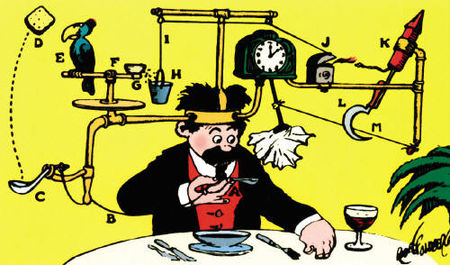
Why add complexity?
The discussion draft instructs the Department of Treasury to sell polluters permits for each ton of CO2 emitted. But the proposal stresses that permits can’t be banked, borrowed, or traded. So why add the extra machinery for a permit-based system instead of a straight point-of-sale tax?
All in all, Waxman and Whitehouse’s proposal looks like an enormous stride, especially when compared to complex, opaque proposals of just a few years ago. But its choice of a permit-based system raises the question of whether their aim is to start with a carbon tax but wind up with linked cap-and-trade systems as Australia and South Africa have announced they will do. Which leads one to ask: Why not continue the trend toward simplicity with a simple, upstream carbon tax with a substantial escalator calibrated to hit long-term emissions targets?
Photo: flickr, Wikipedia: Rube Goldberg machine (“Self-operating napkin”)
Post Script: Coverage of Non-CO2 Greenhouse Gases (3/23/13):
In addition to taxing CO2 pollution, the Waxman-Whitehouse “discussion draft” would tax six non-CO2 greenhouse gases (GHGs): methane, nitrous oxide, sulfur hexafluoride, hydrofluorocarbon-23, perfluorinated chemicals and nitrogen triflouride at CO2-equivalent rates. According to the “backgrounder” released with the discussion draft, these non-CO2 GHGs account for about 20% of the climate damage from U.S. GHG emissions. To address that sector, the draft would apply emission fees to facilities whose emissions of those gases exceed the 25,000 ton CO2-equivalent per year threshold in EPA’s GHG reporting rule.
Those emissions total about 263.3 million tons CO2-equiv. That’s substantial: it’s roughly 4% of the 6.7 billion tons CO2-equiv of U.S. GHG emissions in 2011 and helps explain the Waxman-Whitehouse proposal’s reported coverage of 85-90% of emissions; 5% more than the 85% coverage of the Boxer-Sanders proposal that applies only to CO2 emissions.
But it’s striking that the Waxman-Whitehouse proposal would cover only 263.3 million of the 1.1 billion tons of non-CO2 GHG’s in EPA’s inventory. Given the potent climate impacts of non-CO2 greenhouse gases and reports indicating substantial fugitive methane emissions, we recommend a more comprehensive approach, either by applying the tax further upstream (where more of the emissions would be attributable to large emitters above the threshold) or by reducing the 25,000 ton CO-equiv. threshold, or both.
Breaking News: Alaska Sen. Murkowski Rejects $450/ton Carbon Tax
The arguments being marshaled by U.S. Senator from Alaska Lisa Murkowski to reject either a carbon pollution tax or a carbon emissions cap are timeworn and easy to deflect. Equating more energy with prosperity (and less energy with deprivation) is so far behind the curve, it even got upended in a Super Bowl commercial. (OK, the spot only aired in the Tri-State New York region, but it still had a major car company pushing fuel efficiency with the punchline, “The only way to pay less for gas is to pay for gas, less.”)
What’s harder to absorb is Murkowski’s embrace of that equation at the dawn of the 113th Congress, when enacting a U.S. carbon tax requires at least a modicum of Republican support.
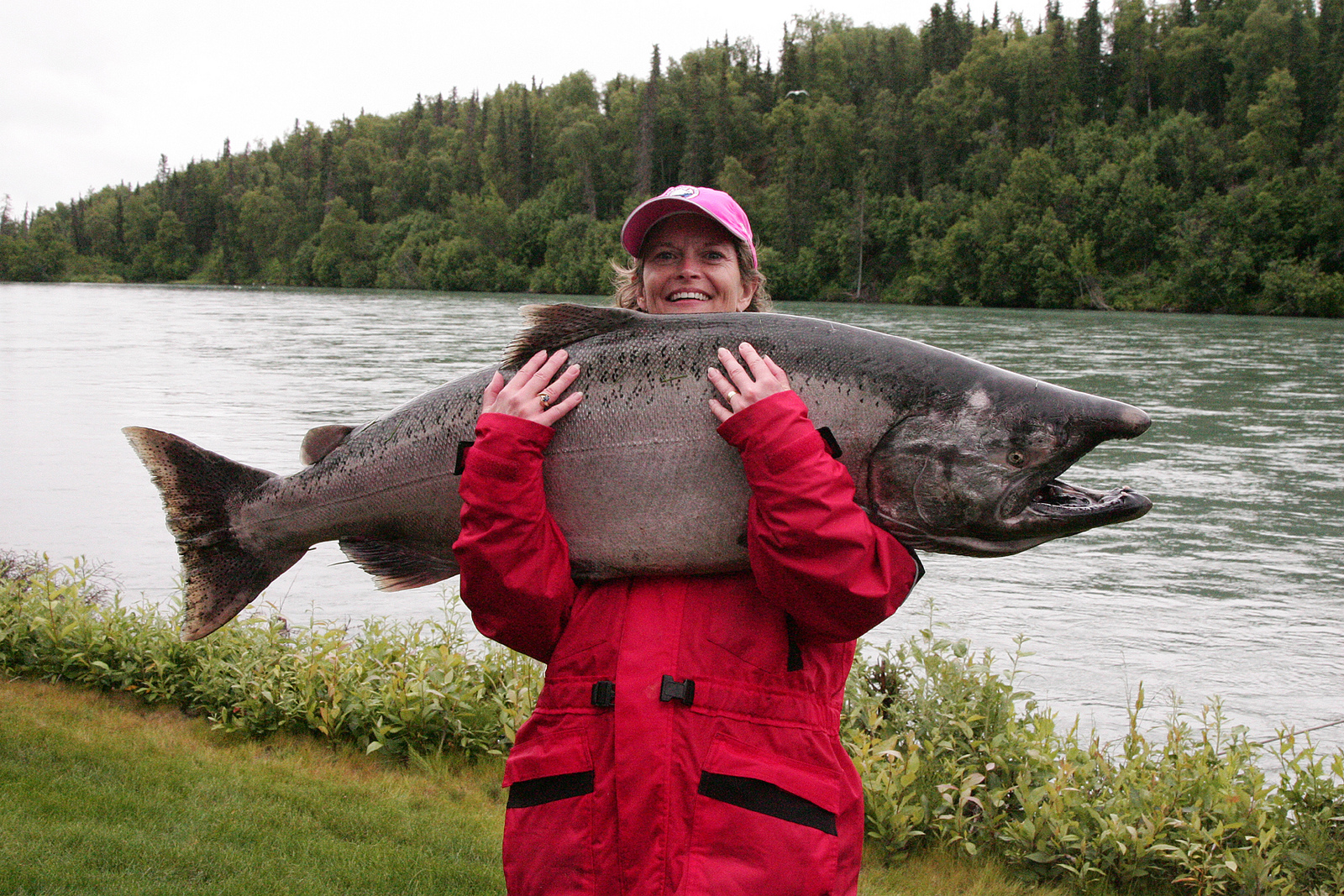
Sen. Murkowski in 2006 with her catch of the day: a 63-lb King Salmon
Murkowski, the ranking Republican on the Senate Energy Committee, has long been regarded as the Republican Senator most likely to someday go for a carbon tax. Back in 2007 she even co-sponsored a carbon cap-and-trade bill, in part because she understood that her state has been experiencing even more severe temperature upheavals than the other 49. Not to mention that the Alaska Permanent Fund’s pro rata distribution of North Slope oil royalties to households has become a model for the fee-and-dividend carbon tax approach.
All of which makes it confounding that, according to press reports, Murkowski’s new energy “blueprint” brings down the hammer on both carbon price disincentives and limits on fossil fuels:
A carbon tax or a cap and trade proposal or something that is going to make energy more expensive is not going to help us . . . We like to be comfortable in our temperatures. We like to be able to move around. This is the mark of a successful and an economically healthy world. Where you have energy these are the prosperous areas.
Those remarks are not from Murkowski’s energy blueprint, called Energy 20/20, which isn’t Web-available yet. They’re direct quotes from the Senator, from a carefully reported article last weekend in the Anchorage Daily News. The same article helpfully reminded readers that “Murkowski herself co-sponsored an attempt in 2007 to impose a cap on carbon emissions, saying at the time that ‘the permafrost is melting, Arctic ice is disappearing and wildlife habitat is changing.’“
But that was then, as the saying goes. The article makes painfully clear that after years of tantalizing climate advocates, Murkowski has resolved to steer clear of carbon tax legislation — at least for now. Indeed, the headline, “Murkowski energy plan calls for more drilling, nothing to rein in greenhouse gases,” says that loud and clear. But here’s the topper:
If you’re sitting in Aniak [a town 300 miles west of Anchorage] and you get a press release from your senator saying the good news is we are going to address emissions, the bad news is you’re no longer going to be paying $6.99 a gallon for your fuel you’re going to be paying $10.99 then do you feel good about that? I can’t do that.
Where to begin? Well, to raise petroleum product prices by $4.00 a gallon, a carbon tax would need to be around $450 per ton of CO2. That’s literally off the charts: $450/ton is quadruple the 10th-year tax level in the Carbon Tax Center’s preferred bill, Rep. John Larson’s America’s Energy Security Trust Fund Act, and 10-20 times as high as taxes advocated by the Brookings Institution, among others.
And the upside of such a massive carbon tax ― of any carbon tax ― is the revenue it raises, which Murkowski’s “Aniak” sound-bite ignored. Carbon tax revenues could be dedicated to reducing the regressive and stifling payroll tax; or they could be “dividended” to Americans. In the latter scenario, Sen. Murkowski’s implied $450/ton carbon tax would yield annual dividend checks to every American household of $8,000, or six times the size of Alaska Permanent Fund checks.
Maybe that would play in Aniak after all.
Photo: Flickr / Esteban Salazar Herrera.
Why the Recent Campaign to Pass Comprehensive Climate Legislation in the United States Failed
Why Cap & Trade Failed (Bartosiewicz & Miley, Columbia U.)
Group says Calif. air regulations discriminate
Civil Rts Groups Sue Calif. For Disproportionate Impact of Cap/Trade (SF Chronicle – AP)
From Wesleyan: An Energized Call to Price Carbon
Author’s note, Dec. 22, 2010: Video and Powerpoints of Hansen, McKibben, the Congressmembers, the carbon-pricing “debate” and other sessions are now available at this page of the Pricing Carbon conference Web site.
Forgive us if this post is a bit breathless. We’re still reeling from the energy we experienced at the Pricing Carbon conference this past weekend at Wesleyan University.
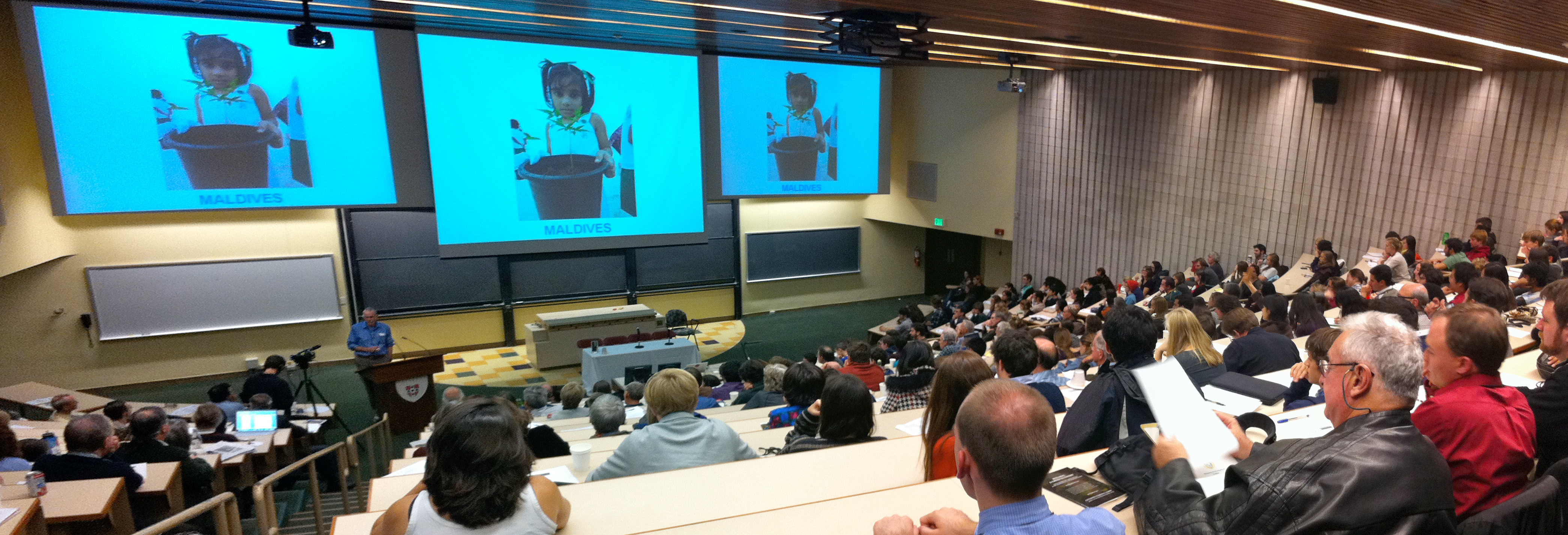
More than 500 people attended the Pricing Carbon conference.
Over 500 people participated in the panels, workshops and strategy meetings, which began Friday evening and continued into Sunday afternoon. A majority were students, including 175 members of Students For a Just and Stable Future, a dynamic activist organization that began in Massachusetts and has spread across New England. Non-students were well represented too, with activists, policy professionals and concerned citizens from two dozen states and Canada. Opinion was unanimous — among presenters and participants alike — that the conference was a vital and worthwhile experience. And as of Sunday morning, Wesleyan’s IT staff had counted 33,000 hits to their site streaming conference video.
We’re sifting through videos, photos and notes from presentations which featured four members of Congress, renowned climate scientist James Hansen, author-advocates Bill McKibben and Peter Barnes, activists including Cecil Corbin-Mark, Tim DeChristopher and Bill Shireman, Wesleyan professors Gary Yohe and Barry Chernoff (director of Wesleyan’s new College of the Environment, the conference host and co-sponsor), and CTC’s own James Handley and Charles Komanoff.
Here’s a handful of quotes from the Congressmembers:
I’m the proud author of that bill, America’s Energy Security Trust Fund Act, and I will be proud to introduce it again in the next Congress. — Rep. John Larson (D-CT)
I’m a carbon tax person. — Rep. Jim McDermott (D-WA)
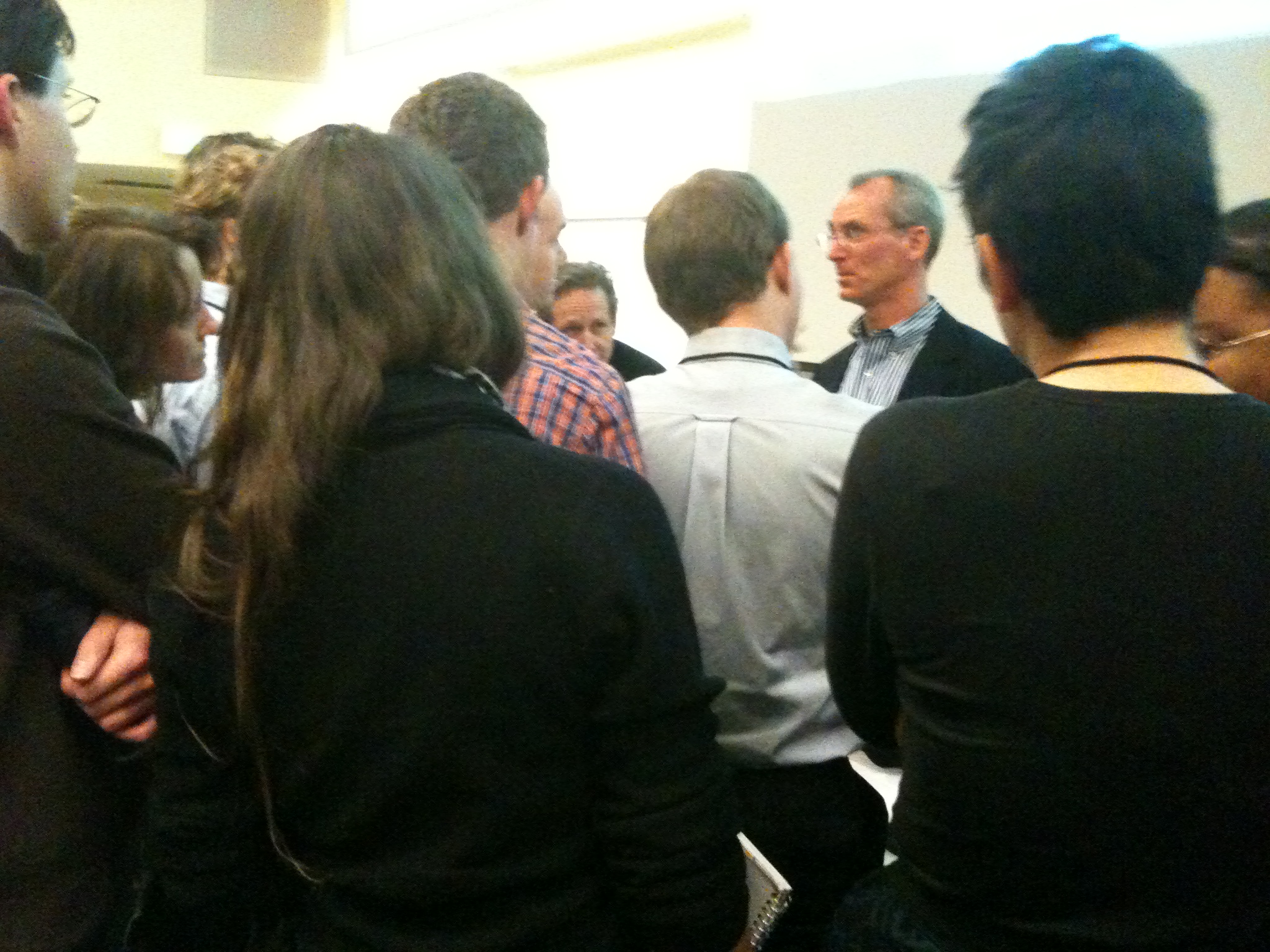
Conference-goers swarmed Rep. Inglis after his talk.
Biblical Law says, “You keep your stuff on your property.” We need to say to coal and oil, “Keep your stuff on your property.” — Rep. Bob Inglis (R-SC)
The Republicans have done us a favor — they’ve given us two years to think, two years to build a movement.” — Rep. Bob Filner (D-CA)
I didn’t need to come up here. There are no votes for me here. I came up here and you gave me faith. Now you need to be thinking about how you’re going to get meetings like this in every part of the country. — Rep. Jim McDermott (D-WA)
Veteran activist Ted Glick, policy director of the Chesapeake Climate Action Network, summed it up neatly:
There was a positive and energetic spirit throughout the conference. One reason for this was the conscious structuring of the conference to maximize opportunities for participation by all of those in attendance; e.g., by limiting the amount of time for speakers in plenaries and workshops, to allow for more time for questions and dialogue.
It was also because the co-sponsoring groups and many of the people who participated believe that the demise of the cap and trade model for comprehensive climate legislation opens up the possibility that a much better approach to pricing carbon and reducing greenhouse gas emissions can now become the preferred national approach. And it was due to the positive combination of a cross-section of older activists, scholars, political leaders and heads of organizations interacting with large numbers of students and youth seriously interested in and passionate about the climate issue.
Click here for the Wesleyan Statement of Carbon Pricing Principles. Come back to this page shortly after Thanksgiving for a sign-on page; links to conference Powerpoint presentations, photos and videos; and, for conference participants, a Google news-group to help us stay connected and strengthen the movement to price carbon emissions efficiently, equitably and transparently.
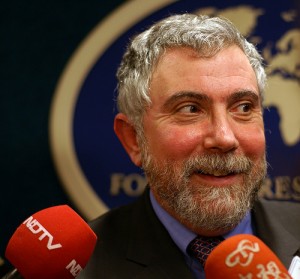
Krugman on Building a Green Economy
Last week’s NY Times Sunday Magazine featured Nobel prize-winning economist Paul Krugman’s take on climate economics. Krugman notes that climate modelers have gained “enormous credibility” by successfully predicting the past 20 years of global warming. He concludes that climate trends over decades (which wash out short-term weather fluctuations), show that “the planet is indeed warming” which will lead to “massively disruptive events, like the transformation of the Southwestern United States into a permanent dust bowl over the next few decades.”
Krugman calls for the use of economic tools to curb the climate threat. He deftly articulates how (“Pigovian”) taxes discourage pollution by placing some of the “externalized” cost of pollution back on polluters, without the inefficiency and intrusiveness of regulations. He notes that a “cap-and-trade system produces the same incentives to reduce pollution… with the price of licenses effectively serving as a tax on pollution.” He explains:
A pollution tax… imposes costs on the private sector while generating revenue for the government. Cap and trade with auctioning… is just like a tax. [But current legislative proposals] involve[s] handing out licenses to existing players, so the potential revenue goes to industry instead of the government… as a way to partly compensate some of the groups whose interests would suffer if a serious climate-change policy were adopted. This can make passing legislation more feasible.
Krugman also acknowledges Dr. Hansen’s (and our) point that cap/trade punishes individual initiative to reduce GHG emissions. But Krugman never mentions the possibility of a carbon tax with revenue returned directly to the public, which should do even more to make passing legislation feasible and would avoid the volatility, manipulation and the need for “offsets” that effectively eviscerate the “emissions certainty” of a cap. Moreover, returning revenue to consumers rather than supporting “incumbent technologies” would encourage consumers to make the choices needed to speed our transition to a green economy.
Krugman confronts the problem of discounting the cost of future climate damage. Normal discounting (typically applied to business investments) drastically reduces the present value of future gains or losses; such discounting thus supports only small investments and low carbon taxes to avoid future climate damage. Siding with Sir Nicolas Stern, Krugman concludes that such large discounting is unfair to future generations; it effectively assumes away the potential for global catastrophe. Thus, despite his political judgment about cap-and-trade, Krugman’s reasoning supports the view that a substantial carbon price with a serious ramp-up is needed.
(Some) Carbon Tax Advocates Are Serious
CTC rep James Handley’s comment on columnist Eric Pooley’s recent piece “Exxon Works Up New Recipe for Frying the Planet” (Bloomberg) sparked this illuminating, constructive exchange.
Dear Mr. Pooley,
Thanks for your article. Climate crisis deniers are indeed doing great harm. Are they really changing tactics from bogus science to bogus economics or just using both? I was with you until I read this:
“A tax wouldn’t guarantee any carbon reductions, let alone bring about the steep cuts needed to stave off the worst climate changes.”
If you’re suggesting that a cap would “guarantee” emissions reductions in some way that a tax would not, I must disagree.
Consider economist Alan Viard’s Aug. 4 testimony to the Senate Finance Committee:
If the market price of allowances under cap and trade is $20 per ton, every firm has an incentive to take any step that can reduce emissions at a cost of less than $20 per ton, but no incentive to take any step that reduces emissions at greater cost… precisely the incentive that each firm would face if it were subject to a carbon tax of $20 per ton or if it were subject to a cap-and-trade program (with the same $20 allowance price) in which all allowances were auctioned.
… The difference, of course, is that the carbon tax or the auction would raise government revenue equal to the aggregate value of the allowances. If the allowances are freely allocated, then that value instead accrues to firms. Cap and trade with free allocation is equivalent to a carbon tax with transfer payments to firms.” [Emphasis added.]
I work with the Carbon Tax Center because, along with most  economists who’ve considered the question, I’m convinced that a clear, transparent, gradually-increasing price on carbon pollution is essential to spur energy conservation as well as development and implementation of alternatives to fossil fuels. A carbon tax, with revenue recycled directly to households to build political support and mitigate the economic impacts of what portends to be a decades-long trek to a low carbon economy, offers a real “game changer” to move broadly enough to substantially mitigate climate catastrophe.
British Columbia has shown that a revenue-neutral carbon tax can be implemented in a few months and gain public support. And it’s far more effective than trading in carbon allowances, especially with offsets. Price volatility has prevented the EU’s cap-and-trade from spurring investment in alternative energy and conservation. See e.g., EU Cap-and-Trade System Provides Cautionary Tale (Roll Call).
The enemy of my enemy isn’t necessarily my friend. Climate crisis deniers’ opposition to cap-and-trade doesn’t make it a good idea. And the “endorsement” of a carbon tax by (former?) deniers can obscure the fact that a growing environmental and social justice coalition is advocating a carbon tax with revenue-recycled to households. Please don’t help the “deniers” poison the water for the most effective, transparent climate policy.
– James Handley, Carbon Tax Center
———-
James,
Thank you for your very thoughtful note. A full treatment of the cap v. tax debate was beyond the scope of the column, but I didn’t mean to suggest that a well -designed tax would be unworkable, rather that any tax Exxon would support is likely to be ineffective.
My basic concern here is political rather than economic– that the carbon tax will siphon enough support to derail cap and trade, but not enough to pass, and we will be left with nothing. I tend to agree with Al Gore when he points out that the nations that have been most effective in reducing emissions have both a cap-and-trade program and a carbon tax in place; ultimately we are likely to need both as well, but that’s a ways off. In the meantime, as Gore has said, “a cap-and-trade system is also essential and actually offers a better prospect for a global agreement, in part because it is difficult to imagine a harmonized global CO2 tax.” The fact is, cap and trade is the only climate program that has a chance of passing now. There’s a big game going on inside the stadium, but the carbon tax proponents are outside in the parking lot, dreaming about next year.
I don’t think cap and trade is (as many tax proponents have argued) a faintly disreputable cousin to the tax which no one would welcome if the tax itself were passable now. I think the cap has real advantages, which I’ll get to. I understand the longing for a simpler approach to the problem but have my suspicions about the simplicity argument; a tax bill would have to respond to the same legitimate regional and sector cost issues that complicated Waxman-Markey, so a bill that could pass would not be simple. How for instance would the straight per capita tax rebate or payroll offset I often see proposed deal with the higher cost burden in coal-dependent states? Staffers on the Hill tell me that adjusting the tax every few years would require a new Act of Congress every few years — it’s hard enough to get this done once.
The free allowance formula devised by EEI and incorporated in Waxman-Markey, by taking into account carbon intensity, isn’t perfect but does a good job of responding to the regional disparity issue. And since the bill requires LDCs [local (electric) distribution companies] to pass on the value of all allowances to their ratepayers, it would prevent the LDCs from enjoying windfalls. Alan Viard’s testimony ignores this requirement when it claims that the value of free allowances accrues to firms. That’s not how the bill works—it’s one of many misconceptions about Waxman-Markey. Overall I’m impressed with the way Waxman et al. learned from the mistakes in the EU ETS. Over-allocation and lack of baseline data were the biggest drivers of volatility there, and this program would avoid those. Nor would utilities be able to charge opportunity costs to their ratepayers, as EU generators did. Giving the transitional allowances to LDCs instead of generators solves other problems as well. It sends a clean price signal to the generators while cushioning ratepayers.
As for the ‘guarantee,’ of course there is no magic wand. But the cap is more than a price signal. We do have the technology to monitor and verify reductions, and I want to see that framework put in place as soon as possible. Finally, no one seems to talk about the penalties for busting the cap, which under Waxman-Markey amount to 2x the allowance price plus a replacement allowance, or three times to compliance incentive — under your $20/ton comparison, the compliance incentive for the cap is actually $60 per allowance, vs. $20 for the tax, plus the strong market signal driven by the knowledge that the cap is ratcheting down over time. The aggressive 2030 reduction target in Waxman-Markey — 42% below 2005 levels —has not received the attention it deserves. It would transform the energy investment decisions of American businesses.
Thanks again for your email and for your work at the Carbon Tax Center. I really would welcome either a tax or a cap. But at the risk of turning your words against you, let me suggest, as someone who has been watching this debate unfold, that it is the carbon tax advocates who have at times been poisoning the water against the cap. Probably both sides have been guilty of this, but it’s too bad that the climate action community is divided at the very moment unity is so badly needed.
– Eric Pooley
———-
Eric,
Thanks for your reply. I think we’re in strong agreement on most points. I want to respond to three:
1) You wrote: “My basic concern here is political rather than economic– that the carbon tax will siphon enough support to derail cap and trade, but not enough to pass, and we will be left with nothing…”
Fortunately, it’s not ACESA or nothing. Although, given that ACESA’s attempted domestic emissions reductions are so modest, and that its cap-and-trade system would entrench Wall Street traders and purveyors of offsets and set the stage for another financial crisis, I’d probably opt for nothing.
If ACESA fails to pass, EPA can continue to develop a regulatory system under the Clean Air Act, which the Center for Biological Diversity has concluded could be quite comprehensive (and might include a cap-and-trade system). This is likely to be better than ACESA in several key ways. For instance, I gleaned from EPA’s Advance Notice of Proposed Rulemaking last year that its rule would not include offsets. (Can you imagine EPA trying to justify the up to 1.5 billion tons of international offsets — essentially, transfer payments — that make a mockery of the notion of a “hard cap” in ACESA?) Furthermore, ACESA as passed by the full House would eviscerate EPA’s proposal to account for indirect impacts of biofuels (e.g., forest clearing to grow corn for ethanol).
Because the Clean Air Act covers stationary sources, mobile sources and the content of fuels, the scope of an EPA GHG reduction program can be very broad. President Obama’s representatives could go to Copenhagen with an EPA draft rule in hand, pointing out that the U.S. is in the process of regulating (or “capping”) more of its GHG sources than any other industrialized nation. That’s far from the most effective policy (a revenue-neutral carbon tax) but it’s also a long way from “nothing.”
2) You quote Al Gore “…a cap-and-trade system is also essential and actually offers a better prospect for a global agreement, in part because it is difficult to imagine a harmonized global CO2 tax.”
Gore’s got it backwards. As the Congressional Budget’s report, “Policy Options for Reduction of CO2 Emissions,” explains, if nations choose different carbon tax rates (or fail to enact them) WTO authorizes border adjustments to equalize tax rates on imported products to the same levels applied to similar domestically-produced products. In effect, the U.S. would collect the carbon tax on imports from any country that didn’t enact its own, providing a powerful incentive for our trading partners to follow our lead.
In contrast, under cap-and-trade, harmonization would require determining the implicit carbon price in a system where carbon prices are hidden and fluctuating. The CBO observed, “Linking cap-and-trade programs would… entail additional challenges beyond those associated with harmonizing a tax on CO2.” The report noted, for example, that linked cap-and-trade programs tend to create perverse incentives for countries to choose less stringent caps so they could become net suppliers of low-cost allowances.
Moreover, as Elaine Kamarck of Harvard’s Kennedy School has pointed out, almost every nation has a tax collection mechanism that could be used to administer a carbon tax, but few (if any) have the means to enact and enforce a complex cap-and-trade system. If we’re going for a global carbon reduction system, it’s a carbon tax.
3) You wrote: “…a tax bill would have to respond to the same legitimate regional and sector cost issues that complicated Waxman-Markey, so a bill that could pass would not be simple… adjusting the tax every few years would require a new Act of Congress every few years — it’s hard enough to get this done once.”
The complexity (and length) of Waxman-Markey seems to have much more to do with preserving (and even expanding) the coal industry than with addressing regional disparities in household income caused by carbon pricing, which, in fact, are relatively small. (See our summary: Regional Disparities.)
Economist Dallas Burtraw (Resources for the Future) studied the regional “incidence” of carbon pricing and concluded that regional differences are dwarfed by very large disparities across the income spectrum. CTC’s proposed carbon tax shift would more than compensate for the inherent regressivity of a carbon tax by distributing revenue progressively either through a payroll tax cut (as proposed in legislation introduced by Rep. John Larson) or a direct, equal distribution. Waxman-Markey only attempts to compensate the lowest income group, leaving middle income households to shoulder the burden of carbon pricing. (Burtraw and others have also shown that ACESA’s free allowances to LDCs would mostly benefit commercial, not residential electricity users.)
We recognize that some regional adjustment might also be needed; but that’s a relatively simple proposition under a carbon tax and could be done administratively, without the need for legislation. Rep. Larson’s bill provides for automatic increases in the carbon tax level to ensure that the trajectory of emissions reductions is in line with the scientific consensus.
Thanks again,
James
———-
James,
I think you’re kidding yourself about the EPA’s ability to impose cap-and-trade under CAA. Someone who knows a lot more about politics than either of us, former White House Chief of Staff John Podesta, has said it would be difficult for EPA to do so without Congressional assistance. Protracted litigation would see to it that years went by before such a system came into force. And there is no chance that an administration promise of such rulemaking – which any subsequent administration could undo – could form the basis of a treaty.
Dallas Burtraw is a fine economist, but the many Senators and members of Congress I have been talking to all summer simply do not agree with him. Regional and sectoral disparities are the single biggest obstacle to climate action, and lawmakers do not believe that the “simple carbon tax” solves them. That’s why Rep. Mike Doyle of Pennsylvania backed Waxman-Markey instead of John Larson’s carbon tax. It’s one of the reasons Waxman-Markey passed the House and Larson’s bill didn’t make it to markup. If the politics were reversed and a carbon tax had a shot at passing, I would expect cap-and-traders to get behind the carbon tax and push hard. But right now, it is the cap that has a real chance of passage, and it could be years before the next opportunity presents itself. Please don’t let your strong shoulders go to waste.
– Eric
———-
Eric,
Regional and income disparities arise under either a carbon tax or cap-and-trade (in fact, Burtraw considered it the same problem), but it’s easier to mitigate these regional and income disparities under a transparent carbon tax by directly distributing the revenues to households.
Rep. Larson and the other members of the Ways and Means Committee, which held a series of very illuminating hearings last spring about the very serious volatility and gaming with cap-and-trade, didn’t get a shot at climate legislation because the House leadership didn’t permit amendments – they didn’t want any discussion of alternatives to cap-and-trade.
I agree with economist Robert Shapiro (Clinton undersecretary of Commerce and U.S. Climate Task Force co-chair) who said at our July 13 Senate briefing that ACESA deserves to be defeated. He fears that, as in the E.U., cap-and-trade would fail to reduce emissions and would delay needed reductions by a decade or more. I cannot support a hidden, volatile and regressive carbon tax (set and collected by Wall Street) whose main advantages seem to be that it hides the price and is called “cap-and-trade”. I believe an explicit, predictable and progressive carbon tax with revenue recycled to households is essential. British Columbia’s experience shows that a revenue-neutral carbon tax is politically feasible. But, to return to my original point, first we need to get beyond magical thinking about “caps”.
– James
photo: Flickr / random dude
Has Krugman Fallen Prey to the Progressives' Blind Spot?
Influential liberal columnist (and Nobel economics laureate) Paul Krugman struck back today in his New York Times blog against critics of the Waxman-Markey bill who view cap-and-trade as an open invitation to massive new depredations by Wall Street. Michael Hoexter, Ph.D., a blogger and consultant on policy, energy efficiency and green marketing to businesses and government, and a previous contributor to this page, sent this reply, which we reprint, with Michael’s permission, in full. (The selections of bolded passages are ours. — Editors.)
Prof. Krugman —
I agree with you on many issues and also learn things from you as well. But sometimes you make purely political decisions that you vest with economic authority but not very careful thinking.
 I think this post is an instance of economics being shaped by politics rather than being the (maybe) science that it attempts to be. I am personally full-time committed to action on climate change but you seem to be simply throwing your prestige behind an instrument that I believe is flawed, and not only because of an inchoate fear of speculation.
Let’s say we invented a market mechanism that made “health” a tradable commodity. Would you support that? For some reason cap and trade has gotten a pass from so-called progressives for too long.
Here are some problems:
- Your analogy to wheat and other markets is flawed because these are pre-existing markets that unite multiple sources of supply with multiple sources of demand. A permit market has just one source for permits: the government. Inventing a market to distribute those permits is a needless layer of complexity. The fact that it is a planfully constructed market makes it a different species as well.
- Martin Weitzman, the MIT economics professor who in 1974 speculated (intellectually) that in certain circumstances one might be able to regulate quantities of emissions rather than tax them or regulate them directly, has said that taxation is better than quantity regulation in the case of carbon. He would recommend quantity regulations only where a particular precise amount of something needs to be achieved … taxation seems better if you want to go in one direction to zero.
- Price volatility and arbitrage are the inevitable result of markets. Wall Street and others like carbon markets because of the (needless) complexity of carbon trading and the potential to exploit information asymmetries. On the other hand, to reduce carbon emissions we need a lot of long-term investments that on the whole do not benefit from financial market fluctuations. Now try to calculate the NPV [net present value] of an investment with a volatile carbon price … that’s going to be difficult. Far easier if you know what the carbon tax rate will be within the next 5 or 10 years. Yes, there are mechanisms to dampen volatility and regulate the markets but these add still more complexity and sinecures for officials and representatives of market actors. It’s like buying a Cadillac and ripping off the badge, scratching the paint and deflating the tires … why invent the market in the first place?
- The regulators and actors on these carbon markets are inessential to cutting carbon emissions and will represent an interest group that will dampen and interfere with more serious efforts to cut emissions. All you need to cut emissions is a predictable price on carbon, positive government programs for infrastructure build-out, and/or “command and control” regulations that ban certain activities.
- Cap and trade is the unfortunate offspring of an era of tax phobia which is fast drawing to a close. We are going to have to raise taxes, including Pigovian ones. Why not a carbon tax? Much more transparent and along with direct regulation a much faster route to the goal.
For some reason, there is a blind spot with regard to cap and trade among so-called progressives … you seem to have fallen prey to it.
Photo: Flickr / daniel.gene
- « Previous Page
- 1
- …
- 19
- 20
- 21
- 22
- 23
- …
- 39
- Next Page »