Purple Haze, Yes on I-732 Campaign Update, Aug. 15.
Monthly heat records … have fallen so frequently that the news stories announcing them almost write themselves.”
Andrew Freedman, “Extreme summer: From wildfires to deadly floods, global warming is increasingly apparent,” Mashable, Aug. 19.
Washington Carbon Tax Ballot Initiative Picks Up Biggest Corroboration Yet
The Pacific Northwest’s leading ecology think tank, Sightline Institute, this week issued three linked papers intended to give Washington State voters an “impartial and informed” analysis of Initiative 732, the Nov. 8 ballot measure to establish the nation’s first statewide carbon tax.

Ruth Mountain in the North Cascades. Snow was deep when we summited it in late August 1972, before the onset of rising temperatures. Photo courtesy of peakery.com.
The takeaway is clear: the Sightline papers blow away the objections that for months have clouded perceptions of I-732 and threatened to capsize the extraordinary grassroots movement led by CarbonWA that last year collected 350,000 signatures and made the Evergreen State the epicenter of carbon tax organizing.
Here are key quotes from the Sightline papers:
- “We find I-732 a worthy policy to put Washington on a path to cutting pollution and encouraging clean energy while also helping low-income families by making Washington State taxes less regressive.”
- “I-732 would give Washington the continent’s, if not the world’s, most potent, persistent, and comprehensive incentive to move swiftly beyond dirty fossil fuels and to a carbon-free future.”
- “I-732 is revenue-neutral, to the best of anyone’s ability to forecast it… [The argument to the contrary] is a red herring… I-732 is likely to be much closer to revenue-neutral than the [State Department of Revenue’s] forecast suggests… Even if the Department’s estimates are correct, I-732 will still be a rounding error… I-732 will likely have less than a 1 percent impact on state tax revenue for decades.”
- “Initiative 732 does exactly what the scientists and economists prescribe: it sets a science-based, steadily rising price on pollution. The citizens’ initiative covers most of the state’s climate pollution, makes the tax code more progressive, and is administratively elegant.”
- “I-732 would be the biggest improvement in the progressivity of Washington’s state tax system in 40 years.”
Individually and collectively, these statements demolish the major criticisms that have been leveled against the carbon tax initiative.
#1 validates CarbonWA’s claim that the carbon tax is economically progressive — a result of dedicating the lion’s share of revenues to lowering the regressive state sales tax, with other funds allocated to funding the Working Families Rebate — an extension of the federal Earned Income Tax Credit.
#2 validates the precept that the most potent way to eliminate carbon pollution is to tax it, and confirms the organizers’ belief that establishing the first U.S. statewide carbon tax could be a climate breakthrough.
#3 refutes the assertion by state budget analysts that the I-732 revenues won’t fully pay for the tax cuts, calling it a “red herring.”
#4 and #5 are icing on the #1-#2-#3 cake.
(We admit to having grabbed the five points from a CarbonWA press release; it’s late Friday afternoon here on the East Coast and we’re trying to wrap the week. But we did confirm each quote from the Sightline reports.)
Read the Sightline reports and see for yourself the care they took with their analysis and the quality of CarbonWA’s work in devising and fine-tuning I-732. Then go to the Yeson732 Web site to learn how you can donate, network, agitate and support their ballot initiative which, hands down, is the boldest and best effort yet to establish carbon emissions pricing in the United States.
Sightline Report #1, Aug. 1, Weighing CarbonWA’s Tax Swap Ballot Initiative
Sightline Report #2, Aug. 2, Does I-732 Really Have a “Budget Hole”?
Sightline Report #3, Aug. 3, Weighing the Critiques of CarbonWA’s I-732
I-732 is revenue neutral, to the best of anyone’s ability to forecast it.”
Does I-732 Really Have a “Budget Hole”?, Sightline Institute report on the I-732 Washington State carbon tax ballot initiative, Aug. 2.
Brookings report on state carbon taxes is a winner
The Brookings Institution is out with a handsome new report, State-Level Carbon Taxes: Options And Opportunities For Policymakers. We’re still digesting it, but it looks like one of the most lucid and useful publications on carbon taxes to appear in a long time. At a minimum, it’s essential reading for at least two (overlapping) groups: people seeking to advance carbon taxes at the state level, and people who want to steep themselves in the nuts and bolts of implementing actual carbon taxes.
The authors are three heavy hitters in carbon tax policy and advocacy: Adele Morris of Brookings, Yoram Bauman of Carbon Washington, and David Bookbinder of the Niskanen Center. Together they bring to bear key disciplines (economics, law, political organizing), extensive knowledge, and keen interest. It’s no surprise their report is a winner.
Here’s the start:
Much has been written about the design of a federal-level carbon tax. This paper adapts these findings to the state level, motivated by pending federal regulations (which place implementation obligations on states), policy discussions in states with commitments to ambitious long-term emissions targets, and state budget shortfalls that could necessitate new revenue. Notwithstanding the myriad political impediments to a carbon tax, this paper explains how state policymakers can design one to fit their fiscal, economic, distributional, and environmental goals.
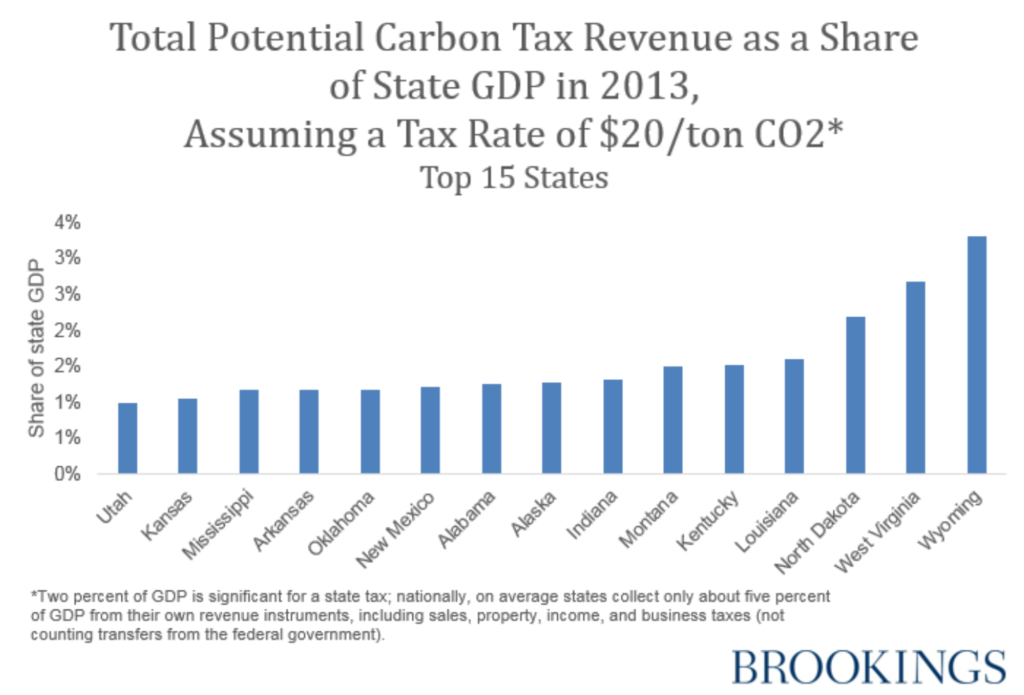
They find that “a $20 per ton tax on energy-related CO2 emissions could raise up to 2-3 percent of state GDP in the most emissions-intensive states.” That is significant, they say, because current state revenue instruments — sales, property, income, and business taxes — typically collect only about 5% of GDP. Moreover, contrary to the usual view that a carbon tax might be an unreliable revenue generator, if only because the revenue base of carbon emissions would shrink over time, the report concludes that carbon fees could prove less volatile than other state revenue sources.

Graphic is from Brookings issue brief (see link at end).
While carbon fees of $20/ton are almost certainly far lower than the levels needed to fully drive the transition of the U.S. economy to a low-carbon base, it’s a reasonable level for considering state taxes, given issues of leakage, interstate competition, and poorly diversified state economies. In any event, the report’s insights into state carbon tax implementation don’t depend on any particular tax level.
For all 50 states plus the District of Columbia, annual revenues from applying $20/ton state-level carbon taxes to all fossil fuel combustion would total $106 billion, based on 2013 emissions and assuming, for simplicity, zero price-responsiveness. That’s around two-thirds of one percent of combined state GDP. But the range is enormous, from a low of around 0.3 percent (for California, Connecticut, and Massachusetts; here we exclude DC, for which the tax revenue would equate to just 0.05% of GDP), to more than 2 percent for North Dakota and West Virginia and more than 3 percent for Wyoming. (See graphic; Wyoming was inadvertently omitted.)
Tellingly, of the 15 states with the highest shares of potential carbon tax revenues relative to GDP, 14 are “red” on the political map. Only New Mexico voted for a Democrat, President Obama, in 2012 (and 2008). The correlation of carbon-dependence with electoral conservatism underscores (and reflects) the political polarization over climate belief and carbon-reduction policy. And while organizing for state carbon taxing has been exclusively focused on low-carbon blue states such as Washington and Massachusetts, the sheer fiscal potential of carbon taxes in the states shown in the graphic suggests vast untapped potential to transform state economies from fossil-fuel extraction to a broader and more sustainable base.
The Brookings report is far richer than mere figures and graphs. It dives deeply but clearly into thorny questions like interstate transport of fuels and electricity, and harmonizing of state carbon fees with EPA Clean Power Plan requirements, that haven’t arisen at the federal tax level. Issues of federal pre-emption (e.g., for aviation fuels), compliance with the “dormant” Commerce Clause of the U.S. Constitution, and revenue usage are treated as well. The report is also richly referenced and annotated.
Whether or not the path to a U.S. carbon tax will need to wind from one or a few early-adopting states to Congress can’t be predicted. Regardless, the Brookings report is both a masterful summation of state carbon tax issues and a vital read for anyone pursuing carbon pricing in the United States.
Link to the full 32-page Brookings report: State-Level Carbon Taxes: Options And Opportunities For Policymakers
Link to the Brookings issue brief (contains graph shown above): What to consider when designing a state-level carbon tax
Elon Musk’s Powerful Case for a Carbon Tax
Nov. 2 addendum: Read Musk’s carbon tax pitch, transcribed from Leonardo DiCaprio’s new climate change documentry, Before The Flood, at bottom.
Visionary inventor-entrepreneur Elon Musk is constantly in motion. Last week he was in Nevada checking on his Gigafactory, which purportedly will be the world’s largest-footprint building (as big as 107 football fields) and make enough batteries each year to power 1.5 million Tesla Model 3s. Yesterday Musk revealed his intention to merge Tesla Motors and SolarCity — a $2.6 billion wager that Tesla owners will use those batteries to store power from SolarCity panels.
This is big business, big climate and big vision rolled into one. Large-scale deployment of batteries could let solar and wind resources dominate electricity production without need for carbon-emitting grid support by fossil fuel plants. Replacing gasoline-powered autos with electrics will almost certainly squeeze carbon emissions out of transportation faster than biofuels or other low-carbon liquid fuels.
In Nevada, Musk also spoke up for carbon taxes, though hardly for the first time. Four years ago, for example, at the Wall Street Journal’s ECO:nomics conference in Santa Barbara, CA, Musk disparaged tax credits for green cars and declared that “the best method for addressing climate change in the automotive industry is to impose a tax on carbon dioxide emissions,” according to the trade journal plugincars. But what he said last week was so richly detailed and articulated that it deserves to be quoted in full.

As reported by Benjamin Spillman in the Reno Gazette-Journal, Musk was asked whether the Gigafactory would have been economically viable without over a billion dollars in state incentives, plus federal tax credits for electric vehicles and solar panels. He replied:
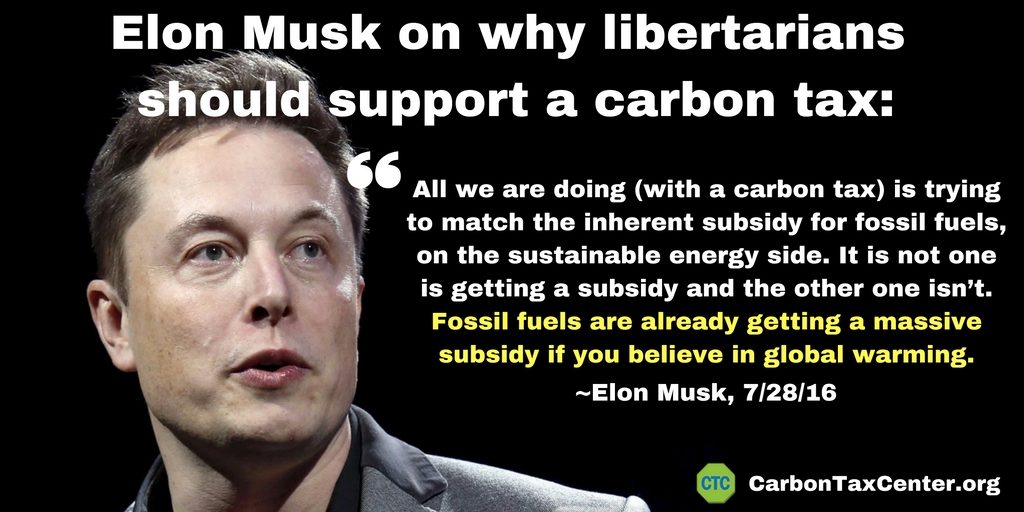
[I]f you accept the scientific consensus[,] every oil burning activity is subsidized, dramatically. If you believe there is a value to the CO2 capacity of the atmosphere and oceans and that CO2 capacity is not being paid for by the price at the gas pump or the coal that is being burned for electricity generation or whatever its use may be then every single fossil fuel burning activity is massively subsidized.
After reminding his Nevada audience that climate change “has become sort of an ideological issue because there are people who think that global warming is not true,” Musk continued:
[A]ll we are doing [with a carbon tax] is trying to match the inherent subsidy for fossil fuels . . . on the sustainable energy side. Fossil fuels are already getting a massive subsidy if you believe in global warming. If you don’t then [the subsidy] seems really unfair. If you do then it is like oh we are just trying to correct it.
But Musk was just warming up to the carbon taxing subject:
The real right way to correct [the subsidy] would be to establish a carbon tax. If you ask any economist they will tell you that is the obvious thing to do, put the correct price on carbon because we currently have an error in the economy which misprices carbon at zero or something closer to zero. It is a fundamental economic error.
He then turned to the supposed conflict between libertarian ideology and taxation:
For people that have a sort of libertarian bent they get a little confused. . . They need to appreciate the high level principle of why they are opposed to government intervention. They are actually opposed to government intervention because it causes false pricing. If the government says we are going to massively incent the production of corn, so that effectively corn gets mispriced and we make too much corn, that . . . does not benefit the country if you make too much of something because of a government driven pricing error . . . That is sort of what people with a libertarian bent are opposed to.
However if you have . . . an unpriced externality [with] the CO2 capacity of the oceans and atmosphere priced very close to zero then any government action to increase the price above zero reduces the error in the economy. [What libertarians] should actually be opposed to is anything that increases the error in the economy, a pricing information error. So pricing carbon, if you believe in global warming, does not increase the price of the error it decreases the price of the error.
Spillman tweeted these remarks, and Musk retweeted his approval:
The libertarian argument for a carbon tax https://t.co/WmbGp2YuUO
— Elon Musk (@elonmusk) July 29, 2016
Whether or not you identify as libertarian, you should savor Musk’s bracing clarity on (and for) carbon taxing. Maybe in time, other solar and wind advocates will bolster their customary pleading for subsidies with their own clarion call for carbon taxing.
Addendum, Nov. 2, 2016: Musk did a star turn in support of carbon taxes in the Leonardo DiCaprio climate docu, Before The Flood. This transcript is courtesy of EcoWatch. The film is up on YouTube through Nov. 6. Afterwards, only in theaters.
DiCaprio is in the Nevadan desert visiting the “gigafactory,” the latest project of Tesla founder Elon Musk. Once at full operation by 2020, the vast factory aims to be producing annually 500,000 electric vehicles and batteries/cells equal to 85 GWh/yr. Musk explains why this could be a game-changer:
Elon Musk: What would it take to transition the whole world to sustainable energy? What kind of throughput would you actually need? You need a hundred gigafactories.
Leonardo DiCaprio: A hundred of these?
Elon Musk: A hundred. Yes.
Leonardo DiCaprio: That would make the United States…
Elon Musk: No, the whole world.
Leonardo DiCaprio: The whole world?!
Elon Musk: The whole world.
Leonardo DiCaprio: That’s it?! That sounds manageable.
Elon Musk: If all the big companies do this then we can accelerate the transition and if governments can set the rules in favour of sustainable energy, then we can get there really quickly. But it’s really fundamental: unless they put a price on carbon…
Leonardo DiCaprio: … Then we are never going to be able to make the transition in time, right?
Elon Musk: Only way to do that is through a carbon tax.
Should We Care that Clinton Isn’t Pushing a Carbon Tax?
The conventions are over, the country is pivoting toward the Nov. 8 elections, and Dave Roberts, Vox’s energy and climate blogger, is out with a post insisting, yet again, that “a carbon tax is not some magical climate cure-all.”
Roberts has said this before, many times. We (CTC) even posted a point/counterpoint with him after he poured cold water on carbon taxes in 2012, after Hurricane Sandy. Now, with so much going on — a glass ceiling-shattering nomination by the Democrats, a civil society-threatening nomination by the Republicans — should we care?

Does it matter that neither candidate advocates a carbon tax?
We should. For one thing, Roberts is an influential journalist; here’s NY Times superstar columnist Paul Krugman linking to Roberts last summer. For another, a carbon tax shattered its own vault of silence in the Democratic primary season; after Bernie Sanders’ unapologetic calls in speeches and the debates, advocating a tax on carbon emissions isn’t necessarily a ticket to political oblivion. Moreover, Roberts’ post today raised questions about a carbon tax’s magnitude that are worth addressing.
What set Roberts off this time was a recent editorial in Technology Review that chided the Democrats for “ignoring the one thing that could best help curb carbon emissions.” That thing is, of course, a carbon tax. The TR editorial dutifully blasted Trump’s climate denialism and the GOP’s labeling coal a “clean energy source,” and then said:
But the Democratic platform might not be meaningfully better. Although Hillary Clinton has a climate change plan, and it is supportive of President Obama’s Clean Power Plan (which is held up in the courts), and makes broad promises to cut subsidies for the oil and gas industry, it leaves out one big thing: a carbon tax. (emphasis added)
That last bit was too much for Roberts. Clinton’s energy plan, he wrote, would
- expand solar and other clean alternatives.
- increase US energy efficiency by a third and decrease US oil consumption by a third within 10 years of her taking office.
- aim to meet or exceed the carbon reduction target Obama promised in Paris: 28 percent under 2005 levels by 2025.
Roberts continued:
Clinton has said exactly how much carbon her plan would reduce. Would a carbon tax reduce more? It obviously depends! A high carbon tax would. A low carbon tax wouldn’t. A revenue-neutral carbon tax that reduces the income tax would be different from a carbon tax that funds clean energy deployment… The effects of a carbon tax depend entirely on its size and implementation details.
There’s some truth there. But let’s go further.
To begin, saying how much carbon you hope to eliminate isn’t the same as having a plan to eliminate it. And unless we’ve missed something, Clinton hasn’t spelled out how she’s going to cut oil usage by a third.
Spurred by plunging prices, U.S. consumption of petroleum products in 2015 rose for the third consecutive year and is now within 7 percent of the 2005 peak. (To see for yourself, download the latest Monthly Energy Review and navigate to Table 3.5, “Petroleum Products Supplied by Type,” totals column.) Without a stiff carbon tax that not only steers purchases away from SUVs and pickups but also counteracts the resumed trend of more miles driven, there’s no way the ambitious (on paper) Obama-Clinton fuel-economy standards can bend the petroleum curve sharply downward, as we’ve written here.
Indeed, our own modeling suggests that even a robustly rising carbon tax that reached triple digits in its tenth year would only cut oil usage from the 2005 peak by a quarter.

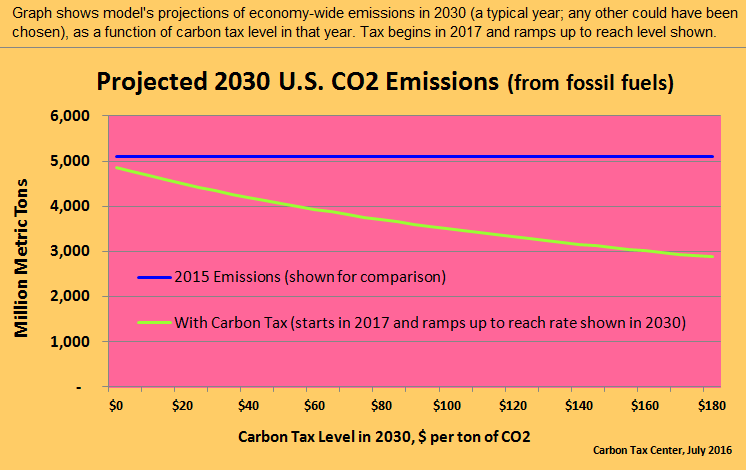
A briskly rising carbon tax can cut emissions fast and far.
The chances of achieving a 28 percent cut in economy-wide CO2 emissions by 2025 are brighter, partly because 2015 emissions were already 12 percent below the year-2005 benchmark. And our model predicts that a triple-digit carbon tax would, in its tenth year, be cutting CO2 emissions by 40 percent below emissions in 2005. As the Republican candidate remarked about a different type of performance, “I guarantee you there’s no problem” — provided the tax is high enough, as our graphic shows.
But that’s with a carbon tax. Without one — or some economy-wide carbon price — it’s difficult to see how the U.S. can progress from 12% below 2005 currently, to 28% below by 2025, as we wrote in 2014, following the announcement of the historic U.S.-China emissions pact. The picture is probably little different today, insofar as the positive changes since then — coal’s accelerated demise and the rapid uptake of ever-cheaper photovoltaics — are being undermined by the rise in usage of cheap oil.
There you have it: while the Clinton energy plan may be great for solar, it doesn’t map a path to deeply cut oil use and carbon emissions. In contrast, an economy-wide carbon tax — and here Dave Roberts is right, the tax must be robust, even steep — can do both.
Did Technology Review hyperventilate when it said that without a carbon tax, the Democratic climate stance in the election “might not be meaningfully better” than the Republican? Yes, somewhat. But let’s let the Pulitzer Prize-winning fact check site Politifact have the last word.
Two months ago, Politifact fact-checked this proposition: “Bernie Sanders says only he supports carbon tax and [an] ‘aggressive’ approach to climate change.” It rated Sanders’ claim — not just that he alone among the candidates supported a carbon tax but that his climate change approach was aggressive — “mostly true.”
That’s not to say we want Clinton to call explicitly for a robust carbon tax this fall. That’s a political calculation best left to others. But let’s be clear among ourselves of her climate plan’s shortfall vis-a-vis the task at hand.
Carbon and other greenhouse gases should be taxed at a rate high enough to spur the transition away from fossil fuels consistent with the temperature goals agreed to in Paris in 2015.”
Resolution by insurgent Democratic Party platform committee members led by Bill McKibben that was narrowly defeated in St. Louis in late June.
Only Climate Darkness at End of GOP Tunnel?
The Republican Convention is over. And it’s fair to wonder if the dream of a bipartisan carbon tax is over as well.
It’s not just the viciously hard-right emotions and ideologies so prominently on view in Cleveland. While those are disturbing enough, they could perhaps be written off as convention fever. But we can’t ignore the persistent absence of palpable climate concern in virtually the entire Republican Party.

These Trump fans in West Virginia in May were more decorous than most GOP delegates in Cleveland.
Consider A Cure for Trumpism, the high-minded essay by two leading “reform conservatives” that led the New York Times’ Sunday Review section on the eve of the convention. Stretching over 2,000 words, this blueprint for a revitalized Republican Party, by Times columnist Ross Douthat and National Review editor Reihan Salam, never mentioned climate change or global warming.
There’s also the strange case of Jay Faison, the plutocrat whose ClearPath Action Fund, the Times informed us in June, “will spend at least $2 million on digital media campaigns to defend [Republican] Senate incumbents running in two of the tightest races in the country, Rob Portman in Ohio and Kelly Ayotte in New Hampshire.” That’s in “recognition of the senators’ support for clean energy,” Faison told the Times. “ClearPath is also spending several hundred thousand dollars on digital advertising campaigns to support Representatives Carlos Curbelo of Florida and Tom Reed and Elise Stefanik of New York, all Republicans running for re-election in similarly tight races,” the Times noted.
Since Faison routinely lambasts the Obama Administration’s Clean Power Plan as too regulatory, you would think he backs invisible-hand approaches like taxing carbon. Not so, according to this account in the Daily Caller:
North Carolina philanthropist Jay Faison has come out against taxing carbon dioxide emissions as a conservative solution to both fighting global warming and promoting cleaner sources of energy.
“We don’t need more subsidies and top-down regulation,” Faison told reporters [on March 8] at the National Press Club. “[M]aking traditional energy sources, like coal and natural gas, more expensive is not the way to power innovation in green energy.” (emphasis added)
That’s a zinger, all right — correcting the massive market failure that is unpriced climate pollution means more “top-down regulation.”
So what climate solutions does the GOP’s great green hope support, if not a carbon tax or other price mechanism? Here’s the Daily Caller again:
Faison argued [that] more needs to be done to get rid of burdensome regulations on hydroelectric dams and nuclear power plants.
There you have it. Precious few Republicans are willing to publicly support carbon taxing, even in revenue-neutral form. Either climate pales beside real issues like immigration, family-friendly tax reform and foreign policy (Douthat & Salam), or we can cure it, somehow, without resorting to carbon taxes (Faison).
What about the Republican rank-and-file? Evan Lehmann of ClimateWire was at the GOP convention and he spoke about climate with some 51 GOP delegates. Here’s how he distilled their responses:
A Texas delegate tilted his hat back when asked about climate change and said, “Ew.” A delegate from Florida lamented his party’s inaction on warming. And one from Wyoming claims it’s a conspiracy to hide the government’s involvement in the spread of a damaging beetle.
The bad, the good, and the ugly, you might say. (That beetle infestation, by the way, which is devastating lodgepole pines throughout the Rockies, is itself largely a result of climate change.) Not exactly the stuff of a party steeling itself for taxing carbon emissions — or taking any concerted action on climate.
We could also cite the failure of even a single House Republican to vote against the Scalise Amendment denouncing a carbon tax. And that was in June, after any of them might have had to fear a primary challenge for veering from party orthodoxy.
Their rationale could be Koch Brothers money, or resentment of scientific elites, or, as writer Rebecca Solnit has suggested, an “ideology of isolation” that militates against grasping the interconnectedness at the heart of ecological thinking. Another factor, hinted at by former GOP House member Nan Hayworth in an interview with the Guardian this week, is that Republicans, having ceded the climate issue to Democrats, are now loath to be identified with it:
My former colleagues understand the importance of protecting the environment, but one of the problems is the political opposition from environmental groups and the left is so extreme in some cases, even when they try to move towards environmental points of view they get no credit for it politically.
Really? Republicans would get no political credit for backing effective climate action? With head-spinners like that, it’s hard to disagree with the suggestion last week by veteran Times columnist Tom Friedman that “the best thing that could happen to America [is] that Donald Trump is not just defeated, but is crushed at the polls.”
Friedman was envisioning a “sweeping victory” in which the Democrats not only keep the White House but retake Congress, giving them “a chance to put in place a revenue-neutral carbon tax” without needing a single GOP vote. Whether November goes that way is anybody’s guess, but today’s Republican Party is so tied up in anti-climate knots that it’s hard to see a bipartisan path to the only policy that can drive down emissions fast and far.
Carbon Tax Works: CTC’s New Carbon Tax Model
We’ve just posted the annual update to our spreadsheet model — our powerful but easy-to-use tool for predicting future emissions and revenues from possible U.S. carbon taxes. The model, which runs in Excel, accepts any carbon tax trajectory you feed it and spits out estimated economy-wide emission reductions and revenue generation, year by year.

Stiffer tax means steeper reductions. Our model quantifies the relationship.
Here’s what’s new:
1. A year of new data: The most obvious update is our incorporating 2015 baseline data on energy use, CO2 emissions and emission intensity for each of the model’s eight sectors.
2. Oil refining made explicit: We’ve added an eighth sector: oil refining. Until now, refinery emissions were lumped with “Other Petroleum Products,” which was too broad-brush, especially considering that they accounted for an estimated 6.4% of U.S. CO2 emissions last year. Refinery fuel use now has its own sector. This not only trims the catch-all “Other” category, allowing greater precision; it also ensures that future changes in use of gasoline, diesel, jet fuel and other petroleum products are carried through the supply chain to yield emission changes in the refining process, not just at the exhaust pipe.
3. Sharper graphics: The graphics in this post are among the dozen with which the spreadsheet conveys the rapid reductions from robust carbon taxes, especially vis-a-vis well-meaning but limited policies such as the Obama Administration’s Clean Power Plan.

Our updated model has lots of graphics.
4. Emissions consequences of cheap oil: While the model is baselined to official U.S. forecast energy prices (from the Energy Information Administration’s “Annual Energy Outlook”), the current version is the first in which the 2015-2016 oil price slump reverberates for many years. The lower baseline price projections for gasoline and other petroleum fuels don’t change the predicted impact of carbon taxes on demand for those fuels, but they do establish a higher usage trajectory than in previous years, underscoring the need for a robust carbon tax.
As a reminder, here are two key features we added last year:
1. Smoothing the carbon tax impact: The model can reflect lags in households’ and businesses’ adaptation to more-expensive fossil fuels. The user sets the adaptation “ceiling” rate; the model automatically carries over any excess to future years.) This feature is helpful for trajectories like the Whitehouse-Schatz bill, which kicks off with a bang at $45 per ton of carbon dioxide but then rises only slowly. Under our default setting, in which the economy is assumed to react in any year only to tax increments up to $12.50 per metric ton of CO2 ($11.34 per short ton), the reductions from that initial $45/ton charge are spread over four years rather than, unrealistically, assigned to the first year.

Results are for tax that rises annually at $12.50 per metric ton of CO2.
2. Demand impacts vs. Supply side impacts: At the bottom of the Summary page is a new section comparing the projected CO2 reductions from changes in fuels’ carbon intensities (“supply side”) versus reductions from reduced energy usage (“demand side,” e.g., lower electricity purchases, less driving or flying). Under our default carbon tax — the one proposed by Washington Rep. Jim McDermott — an estimated 58% of projected CO2 reductions are on the supply side (i.e., due to decarbonization); a large minority, 42%, come about through reduced demand, illustrating that subsidies-only policies miss out on huge CO2 reductions. Indeed, they undercut reductions from decarbonization by stimulating energy usage through lowered energy prices, as we pointed out in our 2014 comments to the Senate Finance Committee.
Please download the spreadsheet — here’s the link again — and run it in Excel. See for yourself the relative efficacy of a carbon tax trajectory that increases by a fixed amount each year, as does the McDermott tax, vs. one like Whitehouse-Schatz that starts high but rises only by small, percentage-driven amounts. See also how much more quickly emissions decline under either carbon tax scenario, compared to the Clean Power Plan and other regulatory policies forced on the Obama Administration by the recalcitrant Republican-controlled Congress.
As you work (play?) with the model, jot down your thoughts so you can tell us what works and what needs improving. Thank you.
Note: graphic at top has replaced similar graph that (confusingly) expressed carbon tax in terms of annual increments.
- « Previous Page
- 1
- …
- 26
- 27
- 28
- 29
- 30
- …
- 170
- Next Page »