
Canadian Prime Minister Justin Trudeau, in his Oct 3 address to Parliament in which he proposed a national carbon tax to start in 2018, quoted in Associated Press story posted later that day by Rob Gillies, Trudeau says Canada to implement carbon tax.
A Way to Expand the Carbon Dividend Tent
Should undocumented immigrants be entitled to the same regular payments that legal U.S. residents would receive under the fee-and-dividend form of a carbon tax? How would the payments be administered to people with little or no official status?
These are no small questions, given that as many as 12 million undocumented immigrants live within our borders, with the vast majority facing huge economic and social challenges. That’s why we at the Carbon Tax Center are intrigued by a new development in California, home to an estimated 2 million undocumented immigrants and a perennial incubator of innovative social and environmental policies.
Opening state healthcare exchanges to all could help make a path to universal fee-and-dividend.
The New York Times reported last week that California officials have petitioned the Obama administration to let undocumented immigrants purchase health insurance on the state’s public exchange. A bill signed into law in June by Gov. Jerry Brown directed the officials to seek a “state innovation waiver” under Section 1332 of the Affordable Care Act that lets local governments adopt alternative coverage strategies that don’t undermine the ACA’s cost-containment goals, according to The Hill newspaper.
With Republicans ready to pounce on any linkage of “Obamacare” with “illegal,” the White House may well turn a deaf ear to the request this fall. But a post-election Democratic administration should have no such qualms. Granting the waiver could be a transitional step that helps legitimize the status of undocumented immigrants and brings them closer to the federal apparatus that would issue the carbon dividends.
Winning access to California’s healthcare exchange wouldn’t mark the first admission of undocumented immigrants into government-administered systems. A dozen states and the District of Columbia already allow people residing here without papers to apply for and obtain driver’s licenses, according to the Website ProCon. But opening up a second front via the Affordable Care Act could help normalize the status of undocumented immigrants and eventually help fulfill pledges from advocates that a fee-and-dividend carbon tax will lift up rather than burden the most vulnerable among us.
In a post last week on Yale Environment 360, renowned climate advocate Bill McKibben coupled praise for fee-and-dividend with this warning:
[The dividends] shouldn’t overlook the estimated nearly 12 million undocumented Americans who contribute to the economy — and cause far less than their proportional share of emissions. Environmental justice would mean a truly “fair” system [that] compensated them for that history; it would also require policies to make sure that carbon pricing doesn’t perpetuate toxic “hot spots” in poor communities as companies look for least-cost ways to deal with the new reality.
We responded to Bill’s “hot spots” concern last week in our post, Carbon Tax Can Be a Remedy for Toxic Hot Spots. His fears that undocumented immigrants could be declared ineligible for the carbon dividends are harder to dispel, especially at a time much of the citizenry seems consumed with xenophobic rage.
That is why we’ll be watching what happens with California’s petition closely. Any policy action with even a chance of widening the dividend tent to include everyone living in the U.S. should be applauded. In an encouraging sign, the New York Times endorsed the petition in an editorial over the weekend.
If California’s petition to open its healthcare exchange to all proves successful, it could become an important instance in which social and economic fairness aligned with climate justice. And it would pave the path for a more equitable and inclusive fee-and-dividend carbon tax.
Carbon Tax Can Be a Remedy for Toxic Hot Spots
Thanks to the environmental justice movement, we know that big carbon emitters like power plants and oil refineries are disproportionately sited in poor and predominantly people of color communities. EJ pioneers like Robert Bullard and the Environmental Justice Resource Network began documenting this painful truth decades ago, and it continues to animate the EJ and climate justice movements.
So it’s not altogether surprising if, from time to time, concern is voiced that polluting companies will respond to carbon taxes by curbing carbon pollution elsewhere rather than in frontline communities like blighted urban neighborhoods, Appalachian hollows, or Native peoples’ lands. The pioneering climate activist Bill McKibben raised that possibility yesterday in a post on Yale Environment 360:
Environmental justice [in carbon taxing] would also require policies to make sure that carbon pricing doesn’t perpetuate toxic “hot spots” in poor communities as companies look for least-cost ways to deal with the new reality [in which carbon emitters now pay to dump into the atmosphere].
Not for the first time, we wrestled with that scenario overnight. And we have to report that we can’t picture any credible circumstance in which a carbon tax would lead to emissions lock-in in certain communities. Our conclusion arises from the fact that a carbon tax, by its nature, exacts a cost for each and every squandered opportunity to curtail carbon emissions. A company that perpetuated toxic hot spots in poor communities would incur costs that would weaken and might even destroy its bottom line.
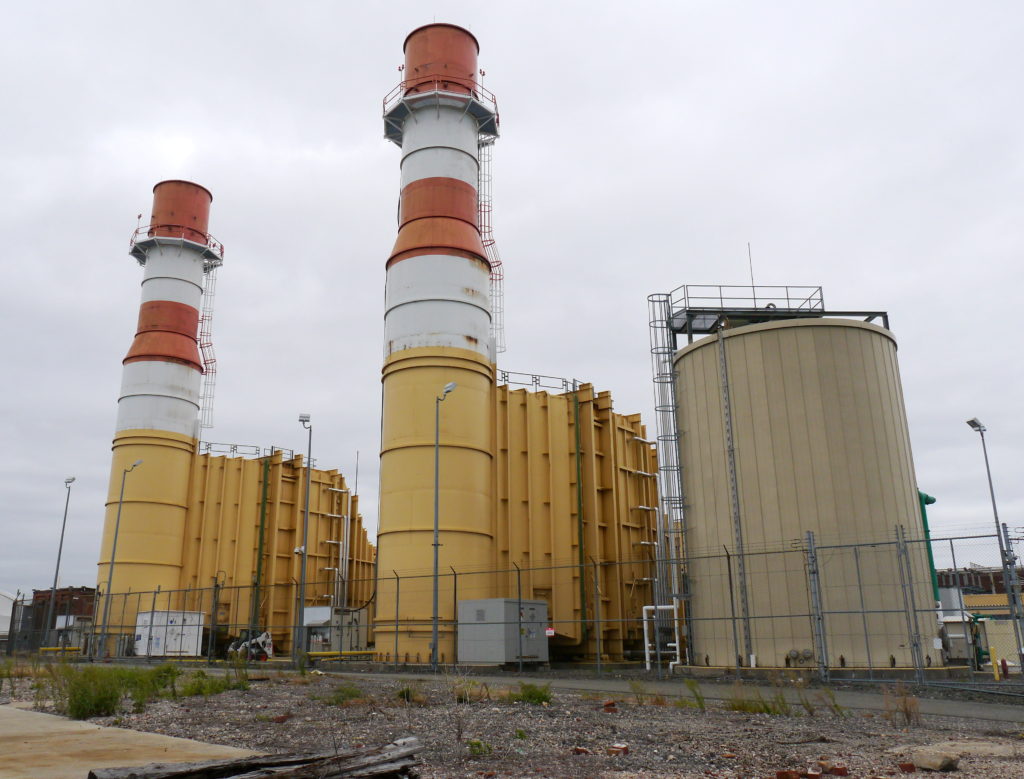
South Bronx vista. The 10 newest New York Power Authority turbines are all in EJ neighborhoods. Photo: Doug Goodman.
Consider an oil company that owns and operates 5 refineries in poor and/or minority communities and 5 in other locales. Under a carbon tax, any change in equipment or procedures that reduces carbon emissions at any of the 10 refineries reduces the company’s carbon tax bill. That makes it virtually certain that all 10 refineries will undergo some change leading to lower emissions.
Without knowing details on the 10 refineries, we can’t predict which changes the tax will stimulate at each, and how much each refinery’s emissions will go down vis-à-vis the others. It’s possible that logistical considerations would push the company to concentrate its reduction effort at its 5 “other” sites. But we can say with virtual certainty that no refinery will add to its emissions on account of the carbon tax.
Think of it this way: Each facility now has an array of potential capital and operating opportunities for reducing emissions. Some don’t “pencil out” today but will as the carbon tax kicks in. But why would emissions-increasing measures be taken up due to the tax, when all of the tax incentive goes in the opposite (emissions-reducing) direction?
Carbon taxing isn’t a zero-sum game. Charging for emissions opens up opportunities to cut emissions everywhere, simultaneously. The choice facing headquarters isn’t to pit potential reductions from Refineries 1-5 against reductions from Refineries 6-10, but to max out on the new opportunities to cut costs presented by the carbon tax by modifying (and possibly shrinking, as demand drops) Refineries 1 through 10.
To repeat: under a carbon tax, every pound or ton of CO2 eliminated from the waste stream yields equal savings. With no cap to game by manipulating emissions, every reduction is rewarded immediately and equally.
The vigilance by environmental-climate justice campaigners against policies that could lock in toxic hot spots can be traced in part to mainstream environmentalists’ push for carbon cap-and-trade legislation a decade ago. The Waxman-Markey bill that passed the House before dying in the Senate would have allowed U.S. polluters “to offshore” some emission cuts (e.g., by booking CO2 reductions from planting tropical tree plantations) instead of cutting their domestic emissions. That loophole was appalling and it tarnished the bill; but offsets have never been included in proposed carbon tax legislation.
For the record, other concerns raised in McKibben’s post weigh heavily here at CTC, including whether and how a carbon fee-and-dividend system would return revenues to “the estimated nearly 12 million undocumented Americans who contribute to the economy.” We agree that undocumented workers should receive a fair share of the revenue proceeds from carbon-taxing, and it’s incumbent on us carbon-tax proponents to come up with an ironclad way to ensure that.
Let’s also acknowledge that the frontline communities that have suffered historically and disproportionately from toxic emissions that invariably “co-pollute” with CO2 deserve to be compensated beyond the universal fee-and-dividend monthly check. But what if a revenue-neutral carbon tax like fee-and-dividend is the only approach with political legs to actually pass Congress sometime down the road? Given that fee-and-dividend is income-progressive (poor households get more in dividend checks than they spend for costlier energy) and will cut emissions across the board, including in frontline communities, doesn’t it merit support from EJ advocates, despite its limitations?
In short, we agree with Bill that “most of the damage from both climate change and air pollution has fallen on poor people, people of color, and Native nations, both in our country and around our world.” But it’s a stretch too far to say that the potential remedy of carbon dividends “come[s] with [an] obvious moral and intellectual flaw.”
To sum up: the carbon-tax “flaw” of locking in carbon hot spots isn’t well-founded. But the flaw of excluding undocumented Americans from the carbon dividends can and should be addressed and fixed.
It may be that the surest way to do that is for members of frontline communities to assume leadership positions in the carbon tax effort. What are the best ways to encourage and make that leadership possible?
If she beats climate-denier Donald Trump on Election Day . . . Clinton will not have the luxury of spending four or eight years taking baby steps toward carbon reduction.”
Nothing to Lose: A President Clinton Should Take Aggressive Climate Action, by David Atkins, in American Prospect, Sept. 12.
Berkeley’s soda tax works. Here’s why that matters.
A tax on sugary soft drinks in Berkeley, CA is cutting soda consumption, according to a new study. Should climate advocates care?
Absolutely. The study offers powerful real-world support for the economic principles underlying the idea that carbon taxes can and will cut use of carbon-based fossil fuels.
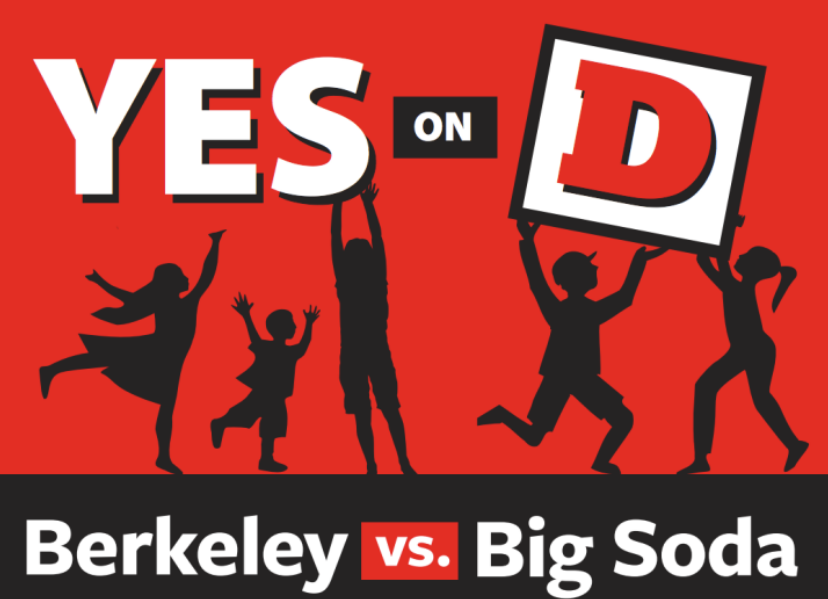
This framing helped pass Berkeley’s soda tax (on the 2014 ballot as Initiative D).
The soda study was conducted by five health specialists at the University of California’s Berkeley campus and a biostatistician-epidemiologist at U-C San Francisco. The study team distilled their findings in an article in the American Journal of Public Health this month, and last week the New York Times’ “Upshot” column reported on it under the headline, “More Evidence That Soda Taxes Cut Soda Drinking.”
Here’s the Times’ lede:
It may seem obvious that taxing sugary drinks causes people to drink less of them. But that’s actually controversial. Now a new study out of Berkeley, Calif., adds to the evidence that our intuition is right.
Berkeley’s fee on sugary soft drinks, the first in the U.S., was approved in a November 2014 referendum and took effect in March 2015. It charges distributors a penny per ounce of drink on so-called sugar-sweetened beverages (SSBs). Thus, a 12-oz. soda can or bottle is taxed 12 cents, though not all of the fee is passed along in the retail price. In earlier research the study team estimated that for sodas, 69% of the penny-an-ounce tax is passed through as higher retail prices, on average; whereas for all SSBs, including energy, sports, and fruit-flavored drinks along with sweetened water, coffee and tea, as well as soda, the pass-through average is 47%.
The U-C study measured changes in beverage consumption in low-income neighborhoods as of July 2015, eight months after the vote and four months after implementation. Similar districts in nearby Oakland and San Francisco were used as a control group. Data were drawn from in-person interviews with 990 people before the tax and 1,689 after.
Based on those surveys, the authors reported that consumption of SSBs decreased 21% in Berkeley and increased 4% in the comparison cities. Water consumption increased far more in Berkeley (+63%) than in the comparison cities (+19%). Both comparisons were statistically significant, signifying that the observed differences in beverage purchases between soda-taxing Berkeley and non-soda-taxing Oakland and SF are genuine and not a product of random chance.
As the Times’ Upshot piece suggests, the main takeaway is what some of us have known all along: raising the price of a good or activity leads people to demand and consume less of it. That’s the premise behind taxing carbon emissions. But the Berkeley study offers other lessons too:
- Just 2 percent of Berkeley residents said they bought sodas outside of the city to avoid the tax. Though a higher tax would likely raise the percentage, the propensity thus far to curb consumption rather than game the system is encouraging.
- Part of the reason for the steep (21%) drop in consumption of SSBs may be that “people became more aware of the health issue [from soda consumption] during the debate around the tax’s passage and the city’s efforts to discourage sugary drink consumption around the same time,” as the Times wrote. This demonstration of “tax salience” previously reported for British Columbia’s carbon tax confirms the merits of seeking a carbon price via a transparent fee or tax rather than by “hiding the price” through an opaque and convoluted cap-and-trade system.
- Berkeley residents didn’t need subsidies to raise their consumption of bottled water; the “price push” of costlier SSBs was sufficient. This finding lends support to making carbon taxes revenue-neutral (via tax swaps or dividends) rather than applying the funds to subsidize clean-energy measures like weatherization or solar installations.
As the Times notes, the Berkeley findings are consistent with research indicating that Mexico’s nationwide soda tax cut sales of sugary drinks among poor households by 17 percent after the first year. Next up, in January, is Philadelphia’s 1.5 cents per ounce soda tax, which passed the city council several months ago.
The parallels to carbon taxing aren’t perfect, of course. The benefits of reduced soda use — less obesity, diabetes and tooth decay — are considerably closer and more personal than the benefits of clean energy. That, along with the soda tax campaign’s intentionally combative framing of “Berkeley vs. Big Soda,” may account for the extremely strong price-elasticity — a value of (minus) 2 or more — indicated by the 21% drop in SSB consumption among the surveyed residents. In CTC’s carbon-tax model, we employ far lesser price-elasticities for electricity, gasoline and other fuels: between (minus) 0.35 and 0.70, reflecting the fact that energy and fuels are more deeply wired into our economy and our behavior than are soft drinks.
Rather than extrapolate directly from the Berkeley soda tax study results, it’s best to regard them as further confirmation of the precept that taxing “bads” is a direct and effective way to make them less prevalent.
The AJPH article, “Impact of the Berkeley Excise Tax on Sugar-Sweetened Beverage Consumption,” was published on August 23, 2016. Click here for the abstract. For those interested, we calculated the soda price-elasticity by applying an approximate price increase of 0.7 cents per ounce (based on the 69% average pass-through) to an estimated average base soda retail price of 5 cents per ounce. For a 14 percent price rise (0.7 divided by 5) to effect a 21% contraction in usage, the price-elasticity must be (minus) 1.8. [Let us know via comments if you’d like to see the math for that.] Higher elasticities would result from using the 25 percent consumption drop relative to the control cities, or from applying the lesser pass-through rates for non-soda SSB’s.
Addendum, March 7, 2017 (contributed by CTC intern Michael Kendall)
New data are in from Mexico and Philadelphia, with both jurisdictions affirming that taxing sodas and other sugary drinks reduces consumption. In 2015, Mexico’s second year with the tax, purchases of sweetened beverages continued to fall. A study published in Health Affairs in Feb. 2017 provided a widely reported update on the effect of Mexico’s sugar-sweetened beverage tax on beverage purchases between 2012 and 2015. In 2014 sales fell by 5.5 percent from 2013; the reduction from 2013 grew to 9.7 percent in 2015. The decreases were greatest among the poorest households.
Philadelphia’s tax on sugary drinks went into effect on Jan. 1, and evidence from the initial month points towards significant reductions in sales. Philadelphia supermarkets and beverage sellers are reporting 30-50 percent drops in January sales, though the media narrative is focusing on threatened reductions in workforces rather than reductions in purchases. (Google “Philly soda tax” to get a taste of these headlines.) What’s not yet clear is whether soda purchases have risen significantly outside city limits. We’re looking forward to February data from Philadelphia and we’ll be keeping an eye on similar soda taxes going into effect in San Francisco, Oakland, Boulder, and Albany.
Addendum, Jan. 14, 2017
A front-page New York Times story yesterday about heavy purchases of sodas and other sugary drinks by recipients of food stamps included this passage, near the end:
In 2014, a group of Stanford researchers studied 19,000 SNAP [Supplemental Nutrition Assistance Program] participants and compared whether banning sugary drinks or incentivizing fruits and vegetables would affect obesity rates. The researchers found that the incentive program would not. But banning sugary drinks from SNAP, they said, “would be expected to significantly reduce obesity prevalence and Type 2 diabetes incidence, particularly among ages 18 to 65 and some racial and ethnic minorities.”
In other words, raising the price of sugary drinks (the effective result of making those drinks ineligible for SNAP purchases) would be more effective in curbing use than subsidizing alternatives. That’s the carbon tax paradigm, in so many words: Making the “bad” (fossil fuel use) more costly through carbon taxes is more effective than lowering the price of alternatives to fossil fuels through subsidies.
Gary Johnson walks back his carbon-tax talk
The weed-growing, road-biking, jeans-wearing candidate for president won’t be endorsing a carbon tax after all.
Libertarian Party nominee (and former New Mexico governor) Gary Johnson had signaled his openness to a revenue-neutral carbon tax in an interview last week with the New York Times’ John Harwood. As Harwood reported:
He [Johnson] also distinguishes himself from most contemporary Republicans by accepting the reality of what he calls “man-caused” climate change. As a solution, he wants to explore taxing carbon — not for the revenue, but to provide a financial incentive to reduce emissions. “That may have the result of being self-regulating,” Mr. Johnson said. “The market will take care of it.”
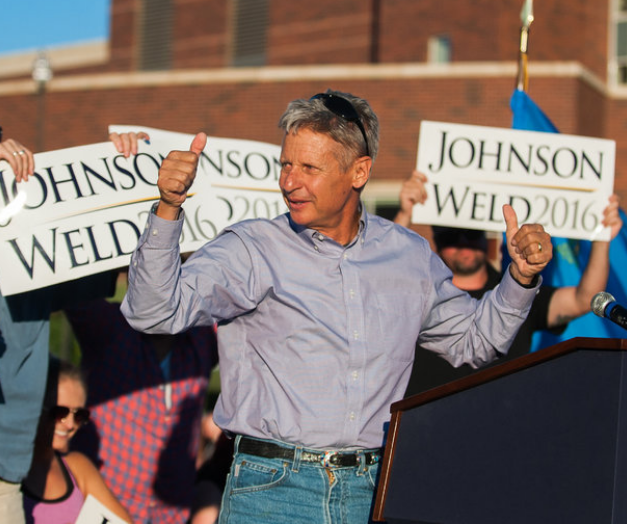
Libertarian presidential candidate Gary Johnson at a rally at the University of Nevada in Reno this month. Photo credit: NY Times.
Credit Harwood for hinting (“not for the revenue”) that Johnson was trying to align himself with a revenue-neutral carbon tax. Unfortunately, Johnson failed to spell out how the revenues from his carbon tax would be returned to U.S. households. While his use of the word “fee” (see below) suggests he had in mind the fee-and-dividend scheme advocated by the Citizens Climate Lobby (and backed by us at CTC), he never actually said so, leaving him open to charges from aggrieved libertarians that a Johnson administration was looking to increase their tax burden.
It didn’t take long for Johnson to walk back his carbon-tax talk, in this interview with Nick Gillespie, editor-in-chief of the libertarian Web site reason.com, last Friday:
NICK GILLESPIE: Earlier this week, you suggested you were in favor of a carbon tax or fee. Yesterday, at a rally in New Hampshire, you said you were against it. What is your position on carbon taxes?
GARY JOHNSON: [A carbon tax] sounds good in theory, but it wouldn’t work in practice. I never called it a tax. I called it a fee. As it was presented to me, this was the way to reduce carbon and actually reduce costs to reduce carbon. Under that premise—lower costs, better outcomes—you can always count on me to support that [sort of] notion. In theory it sounds good, but the reality is that it’s really complex and it won’t really accomplish that. So, no support for a carbon fee. I never raised one penny of tax as governor of New Mexico, not one cent in any area. Taxes to me are like a death plague.
GILLESPIE: You do believe that climate change is happening and that human activity adds to it. Does that mean it is an issue that should be addressed by government policy?
JOHNSON: Well, I’ll agree with the first two, but I’m a skeptic that government policy can address this. The United States contributes 16 percent of the contribution of carbon in the world…
GILLESPIE: So you would be against the United States unilaterally making any kind of move that puts a huge economic disadvantage that also wouldn’t really mitigate carbon?
JOHNSON: If there is any way we can address this issue without the loss of U.S. jobs, my ears are open.
Whew. Does Johnson have a reasoning deficit, or was he just trying to avoid having to explain himself to other libertarians? Who knows, but either way Johnson’s turnabout deprives U.S. voters of a chance to learn about the least complex way to tackle climate change: to charge an “upstream” fee on fossil fuels’ carbon content and “dividend” the proceeds equally to every American household, thus adhering to the spirit of “no new taxes,” while the resulting higher prices of fossil fuels spark a steady but relentless transformation of the U.S. energy system from dirty to clean energy.
What’s further disappointing in the exchange with Gillespie is Johnson’s apparent ignorance of the potential of a U.S. carbon tax — particularly the simple and transparent fee-and-dividend version — to spark parallel measures in other countries. That would have put the lie to two big canards about a U.S. carbon price: that it can only affect a fraction of global emissions, and that it would hobble U.S. industries, costing American jobs.
Johnson did leave himself a possible out by saying he might reconsider “if we can address this issue without the loss of U.S. jobs.” Still, his backtracking makes it harder for that oft-rumored but still unseen cadre of climate-concerned Congressional Republicans to come out for a carbon tax after the November elections.
Worse for himself, though, Johnson blew an opportunity to win over voters who want climate action but have been disinclined to vote for Clinton.
Then again, Johnson’s muddled talk about vaccination — further on in the Gillepsie interview he said he wants it left to individuals’ choice — might have repelled those voters anyway. At the least, it suggests a pervasive ignorance about externalities and “the commons,” about economics and ethics.
Whether Johnson and other libertarians like it or not, our vaccination decisions affect each other. So do unpriced carbon emissions.
Addendum: For you libertarians out there, Forbes contributor Tim Worstall’s post critiquing Johnson’s flip-flop is worth reading.
We’ve got the first carbon tax initiative on the ballot in the nation because enough of us made the leap. We left the house. We got out from behind the computer. We gave what we could, in signatures and dollars, to make this happen. We became participants in our democracy. We stopped waiting for someone else to get it done.”
Purple Haze, Yes on I-732 Campaign Update, Aug. 15.
Monthly heat records … have fallen so frequently that the news stories announcing them almost write themselves.”
Andrew Freedman, “Extreme summer: From wildfires to deadly floods, global warming is increasingly apparent,” Mashable, Aug. 19.
Washington Carbon Tax Ballot Initiative Picks Up Biggest Corroboration Yet
The Pacific Northwest’s leading ecology think tank, Sightline Institute, this week issued three linked papers intended to give Washington State voters an “impartial and informed” analysis of Initiative 732, the Nov. 8 ballot measure to establish the nation’s first statewide carbon tax.

Ruth Mountain in the North Cascades. Snow was deep when we summited it in late August 1972, before the onset of rising temperatures. Photo courtesy of peakery.com.
The takeaway is clear: the Sightline papers blow away the objections that for months have clouded perceptions of I-732 and threatened to capsize the extraordinary grassroots movement led by CarbonWA that last year collected 350,000 signatures and made the Evergreen State the epicenter of carbon tax organizing.
Here are key quotes from the Sightline papers:
- “We find I-732 a worthy policy to put Washington on a path to cutting pollution and encouraging clean energy while also helping low-income families by making Washington State taxes less regressive.”
- “I-732 would give Washington the continent’s, if not the world’s, most potent, persistent, and comprehensive incentive to move swiftly beyond dirty fossil fuels and to a carbon-free future.”
- “I-732 is revenue-neutral, to the best of anyone’s ability to forecast it… [The argument to the contrary] is a red herring… I-732 is likely to be much closer to revenue-neutral than the [State Department of Revenue’s] forecast suggests… Even if the Department’s estimates are correct, I-732 will still be a rounding error… I-732 will likely have less than a 1 percent impact on state tax revenue for decades.”
- “Initiative 732 does exactly what the scientists and economists prescribe: it sets a science-based, steadily rising price on pollution. The citizens’ initiative covers most of the state’s climate pollution, makes the tax code more progressive, and is administratively elegant.”
- “I-732 would be the biggest improvement in the progressivity of Washington’s state tax system in 40 years.”
Individually and collectively, these statements demolish the major criticisms that have been leveled against the carbon tax initiative.
#1 validates CarbonWA’s claim that the carbon tax is economically progressive — a result of dedicating the lion’s share of revenues to lowering the regressive state sales tax, with other funds allocated to funding the Working Families Rebate — an extension of the federal Earned Income Tax Credit.
#2 validates the precept that the most potent way to eliminate carbon pollution is to tax it, and confirms the organizers’ belief that establishing the first U.S. statewide carbon tax could be a climate breakthrough.
#3 refutes the assertion by state budget analysts that the I-732 revenues won’t fully pay for the tax cuts, calling it a “red herring.”
#4 and #5 are icing on the #1-#2-#3 cake.
(We admit to having grabbed the five points from a CarbonWA press release; it’s late Friday afternoon here on the East Coast and we’re trying to wrap the week. But we did confirm each quote from the Sightline reports.)
Read the Sightline reports and see for yourself the care they took with their analysis and the quality of CarbonWA’s work in devising and fine-tuning I-732. Then go to the Yeson732 Web site to learn how you can donate, network, agitate and support their ballot initiative which, hands down, is the boldest and best effort yet to establish carbon emissions pricing in the United States.
Sightline Report #1, Aug. 1, Weighing CarbonWA’s Tax Swap Ballot Initiative
Sightline Report #2, Aug. 2, Does I-732 Really Have a “Budget Hole”?
Sightline Report #3, Aug. 3, Weighing the Critiques of CarbonWA’s I-732
I-732 is revenue neutral, to the best of anyone’s ability to forecast it.”
Does I-732 Really Have a “Budget Hole”?, Sightline Institute report on the I-732 Washington State carbon tax ballot initiative, Aug. 2.
- « Previous Page
- 1
- …
- 26
- 27
- 28
- 29
- 30
- …
- 171
- Next Page »