
Cathy Crain, mayor of Hamburg, IA, referring to the role of climate change in increasing the frequency of extreme weather events, following two record-setting floods that devastated Hamburg in a single decade. — An Iowa Town Fought and Failed to Save a Levee. Then Came the Flood., New York Times, March 20.
Green New Congestion Pricing
On Monday, The Nation magazine posted “Congestion Pricing Is New York’s Green New Deal,” a piece I co-authored with fellow transit advocate Jeff Blum, casting congestion pricing in New York City as an initial foray of the Green New Deal. Following is the text of the piece, with an addendum instructing Carbon Tax Center subscribers and allies what they can do between now and March 31 — congestion pricing’s legislative deadline — to push the proposal across the finish line in Albany. — C.K.
While the Green New Deal basks in the national spotlight, a different but parallel policy idea is advancing in New York. That is Gov. Andrew M. Cuomo’s plan for congestion pricing, which will charge motorists to drive in the most car-jammed (and transit-rich) part of the city, Manhattan south of 60th Street.
At first glance the two appear more opposite than related. The Green New Deal is national, congestion pricing is New York-specific. One is expansive, a solar and wind energy-based revitalization of our society and economy. The other seems punitive, making drivers pay for what is now free.
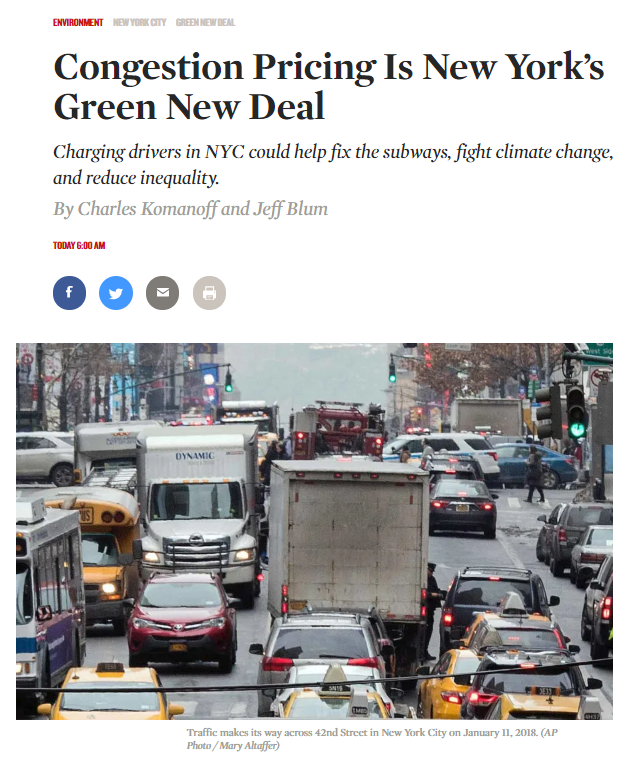
As posted in The Nation. See link at top of this post.
But we believe the two have a great deal in common, both practically and philosophically. Moreover, congestion pricing faces a March 31 legislative deadline to allow initial appropriations for the tolling apparatus to be included in the New York State budget due on that date.
And so we invite Green New Deal adherents — from Massachusetts Sen. Ed Markey and New York Congresswoman Alexandria Ocasio-Cortez to the legions of determined climate justice activists who have put the Green New Deal on the political map — to make congestion pricing in New York a stepping stone to the national fight.
To begin, any program to save the climate depends on having cities thrive. Urban residents use only a fraction as much fossil fuels as suburbanites or rural dwellers, not because they are virtuous but because cities, due to their compactness, are inherently lower-carbon. City residents drive less not just because they can take transit but because destinations are close by. Density also dictates that homes and offices use less power and heat. For cities to thrive and grow, automobile traffic must be tamed and restrained, which congestion pricing does with marvelous efficiency.
Congestion pricing shares DNA with the New Deal through emphasis on public investment. Federal spending in the 1930s strung electric wire and conserved the soil, and federally driven investment going forward can decarbonize our economy. In the same way, the congestion toll revenues in New York can pay to modernize the city’s buses and subways — as happened after London adopted congestion pricing in 2003. Thanks to massive transit investment and reappropriation of street space there, nearly 25% more people now enter the center of London daily, mostly on trains, buses and bikes, while car travel speeds have remained stable.
There’s more. Congestion pricing rests upon the Rooseveltian idea to care for the commons — rivers and forests and farmland. Streets and transit are cities’ commons, which America has allowed cars to plunder for a century.
After years of temporizing, transit advocates in New York have finally resolved that the antidote to broken subways and too many automobiles must include charging vehicles to drive in city centers. Both major transit coalitions, the more business-oriented Fix Our Transit and Fix the Subways, led by the impressive grassroots organizing group Riders Alliance, have put congestion pricing at the top of their political agendas. Before long, we predict, Green New Deal supporters will similarly acknowledge that fully unleashing green energy requires a robust carbon tax, not just as a source of funds but to re-set societal defaults, to re-orient incentives and to unlock innovation.
The Markey–Ocasio-Cortez Green New Deal resolution is adamant about labor rights and economic justice. So too is the movement for congestion pricing. New York City’s most venerable anti-poverty advocate, the Community Service Society, examined congestion pricing and found that for each low-wage New Yorker who regularly drives into Manhattan, nearly 40 will benefit from better trains and buses paid for with the congestion-toll revenues. In the same vein, the right-of-center Manhattan Institute concluded last year that extending New York’s decade-long jobs boom depends on massive and effective investment in mass transit to allow immigrant and other workers to access jobs.
 These considerations appear to have finally pushed New York’s Mayor Bill de Blasio off the political fence last month to proclaim support for congestion pricing.
The iconic New York progressive centrist Daniel Patrick Moynihan understood this thirty years ago. As a powerful Senate Committee chairman, he found a way to use a portion of federal gas taxes to decouple urban mobility from automobiles, spurring a rise in transit and bicycling and making cities cleaner and more dynamic.
There is this difference, however. Unlike the Green New Deal, which is open-sourced by design, congestion pricing for New York is being finalized by the state’s governor, who seems intent on keeping the toll levels and other key plan details under wraps till the last minute.
Attempts to toll the entrances to Manhattan’s central core have come up short so many times that any leader worth his Machiavelli might rightly presume that iron-fisted control is the only way to get it done. But that approach is out of step with both the current political era and the enormous momentum to pass congestion pricing in the state budget this month and finally cure the dysfunction of the city’s streets and subways that daily afflicts millions.
A fifth of the way into our new century, awareness is spreading of the folly of giving away for free a finite resource, whether it’s the atmosphere’s capacity to remain temperate or Broadway’s five travel lanes through Times Square.
A Green New Deal, like its illustrious antecedent, can start in New York. Today, congestion pricing can revitalize and unsnarl New York’s subways and streets. Tomorrow, a nationwide mobilization can turn our carbon economy green.
Komanoff, an energy and transportation economist, was “re-founder” of the bicycle advocacy group Transportation Alternatives. Blum was founding executive director of USAction and leader of multiple state and national pro-transit campaigns.
Whether you live in NY State or somewhere else, please visit the Fix The Subway campaign to find out how you can donate time, money or both to pass congestion pricing for New York City now. Or, text DELAY to 52886. Remember, the vote for the budget bill that will include initial allocations for congestion pricing is expected between Friday March 29 and Sunday March 31. Thank you.
“Popular understanding of climate change fails to fully appreciate its irreversibility. Every increment of heat, and every knock-on effect of that heat, is something our species will be dealing with, for all intents and purposes, forever. Can’t ‘get to it later.’ “
Climate blogger David Roberts (@drvox), via Twitter, March 11.
U.S. Climate Concern Is Trending Upward
Americans in record numbers now regard climate change not as an abstract possibility but a feature of the here-and-now, according to the latest polling by the highly regarded Yale Program on Climate Change Communication and George Mason University Center for Climate Change Communication.
Cover of the Yale-George Mason poll report — the 19th in the decade-long series.
Nearly half of Americans (46%) say they have personally experienced effects of global warming, and roughly the same proportion (48%) believe people in the U.S. are being harmed by global warming “right now,” the Yale-George Mason team reports. Both figures are roughly one-third (15-16 points) higher than in prior surveys and are drawn from interviews with 1,114 adults conducted between Nov 28 and Dec 11 — a period that followed on the heels of the “Camp Fire” that devastated the northern California town of Paradise, but months removed from broiling summer weather in most parts of the country.
More than six in ten Americans (62%) now understand that global warming is largely human-caused, a 10-point increase from March 2015, according to the poll, which may be downloaded in summary (HTML) or full (pdf). Nevertheless, only one in five (20%) recognize the vast agreement among climate scientists around that conclusion, suggesting that the decades-long media-abetted campaign to present “both sides” has obscured this vital scientific consensus.
Here’s how the poll authors reported their key findings:
Our latest national survey finds that a large majority of Americans think global warming is happening, outnumbering those who don’t by more than 5 to 1. Americans are also growing more certain that global warming is happening and more aware that it is caused by human activities. Certainty has increased 14 percentage points since March 2015, with 51% of the public now “extremely” or “very sure” that global warming is happening. Sixty-two percent of the public now understands that global warming is caused mostly by human activities, an increase of 10 points over that same time period.
It’s well-known that political change is driven not just by yes-or-no poll figures but by salience — how strongly voters care, and whether they feel an issue personally. The Yale-George Mason poll found a record 72 percent of Americans responding that the issue of global warming is “personally important” to them. That figure is up by nine points from the previous poll last March, and the first time since November 2008 that the percentage reached 70.
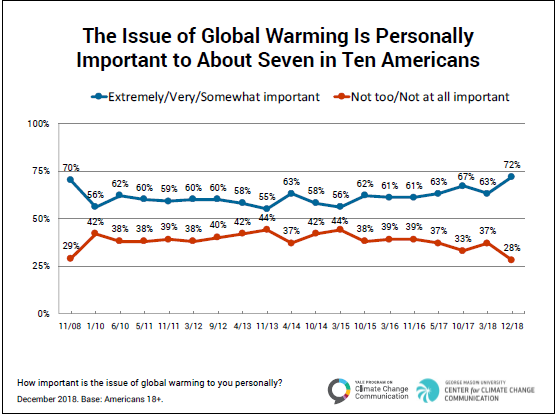
Record-high acknowledgment that climate matters, though still short of a slam-dunk. One of many striking charts in the Yale-George Mason report.
The downside to this figure is not just that 28 percent called global warming either not too important or not at all important, but that it took a full decade to regain the high ground of the 2008 poll. Though the report doesn’t include cross-tabs by political allegiance, it’s virtually certain that the persistent “not important” shares, especially from 2010 through last March, reflect the tendency of many Republicans, knowing that party identity is partly centered around extractionism and climate denialism, to reject the reality of climate change.
The poll did not ask policy questions, so it has no new data on carbon tax acceptance. This is probably just as well in light of the fluid state of opinion on carbon taxing, not just among the public but on the part of climate advocates. Whether or not a carbon tax is included among Green New Deal proposals being aired in the activist community and Democratic Party circles could help determine what future polling has to say about Americans’ acceptance of carbon taxes as denialism and unconcern lose their hold on public opinion.
Ocasio-Cortez Backs “Externality Pricing” During MLK Celebration
This post was has been updated to include a video link to Rep. Ocasio-Cortez’s extended conversation with writer Ta-Nehisi Coates and to provide the full quote of her endorsement of externality pricing.
Alexandria Ocasio-Cortez, the newly installed Congressmember from parts of Queens and the Bronx in New York City and the Democratic Party’s brightest new star in at least a generation, breathed fresh life into carbon taxing today from the stage of Manhattan’s fabled Riverside Church. Her remarks came during “MLK NOW,” a day celebrating Martin Luther King’s life and work combating militarism, materialism and white supremacy.
The commemoration was held six days after what would have been Dr. King’s 90th birthday, and more than a half-century after King ascended the Riverside pulpit to deliver his prophetic speech, Beyond Vietnam. Ocasio-Cortez alluded to the condemnation that rained down on King in the last year of his life for demanding the U.S. end the Vietnam War, saying “King didn’t just sacrifice his life; the way he lived his life was a sacrifice.”
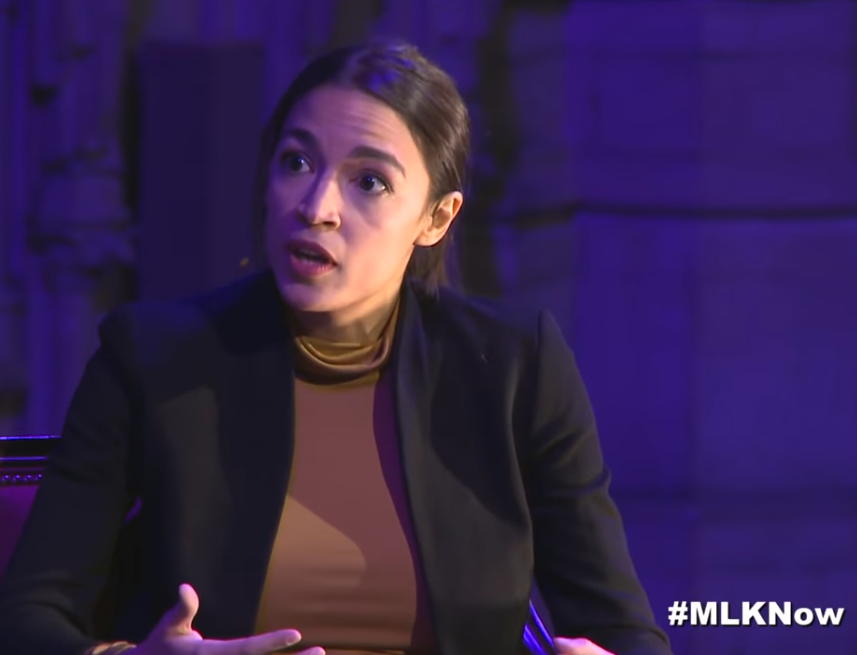
Alexandria Ocasio-Cortez, speaking at Riverside Church in New York City, Jan. 21, 2019.
Ocasio-Cortez spoke in an extended on-stage conversation with renowned author and public-intellectual Ta-Nehisi Coates. Their full, 51-minute conversation may be viewed on YouTube (from the 14:00 mark to 1:05:30). Covering a broad range, the two discussed her call to raise the marginal tax rate on high income to 70 percent; “the case for reparations” — a matter that Coates brought to prominence in his 2014 Atlantic Monthly article with that title; and her conviction that what’s immoral about billionaires is not them as individuals but the system that allows and valorizes them.
Toward the end, Ocasio-Cortez steered the conversation to the climate crisis and called for “structuring an economy that is sustainable, where “the externalities of the damage of some industries or markets get internalized.” (at 1:00:56, emphasis added) There, in a nutshell, is the polluter-pays principle that underlies the idea of taxing carbon emissions.
The remark is noteworthy given Ocasio-Cortez’s prominence in advocating a Green New Deal, the idea of a wartime-style mobilization of government and business to build a net-zero-carbon economy over the next decade. We at the Carbon Tax Center believe that a robust carbon tax must be a pillar in any Green New Deal, not just as a “pay-for” but as a means to incentivize the massive changes in behavior, investment and societal defaults necessary to move U.S. society off fossil fuels.
On a personal note, the Riverside Church event was my first time seeing Ocasio-Cortez in person and hearing her speak extemporaneously and at length. What I saw, heard and felt easily surpassed the hype. Throughout her 50 minutes on stage, she came off as grounded, determined, forceful, informed, fluent and thoroughly conversant with the history and vocabulary of U.S. popular protest and social movements. And, somehow, commanding yet modest.
Not long after Ocasio-Cortez began, I whipped out my pen and pad and jotted down some of her most telling sentences as best I could. Here are some, concluding with the “externality” quote.
Activism is part of governance.
People think of elective office as a leadership position [yet] the real leaders are the writers, journalists, activists and artists.
Marginal tax rates are an economic question, but they’re also a moral question.
“Where do we draw the line in material excess is a question that King asked, that Gandhi asked.” — Alexandria Ocasio-Cortez.
Where do we draw the line in material excess is a question that King asked, that Gandhi asked.
We think of reparations as repairing the damages of slavery, but it’s also the reparation of the damages from the [exclusionary] New Deal and redlining.
I use social media as much to listen as to speak.
We don’t have to compromise our values to find common ground with other people.
The world is going to end in 12 years [due to climate change] and you’re worried about how we’re going to pay for it?
Until we all start pitching in and holding people accountable, I’m going to let [our enemies] have it.
There was once almost a consensus among our great thinkers [including] Einstein and Dr. King that capitalism had an expiration date.
Democratic Socialism means introducing modes of democracy beyond just elections and throughout the economy . . . structuring an economy that is sustainable, where the externalities of the damage of some industries or markets get internalized.
In bookends to her remarks, Ocasio-Cortez explained why she’s not fearful about taking strong stands. As a Puerto Rican teen in a white suburban high school, she said, she learned not to pay attention when someone tried to put her down. Now, in Congress, she sees herself not as an individual seeking to rise in politics who must practice caution but as a participant in an unstoppable movement to advance democracy and create a just society.
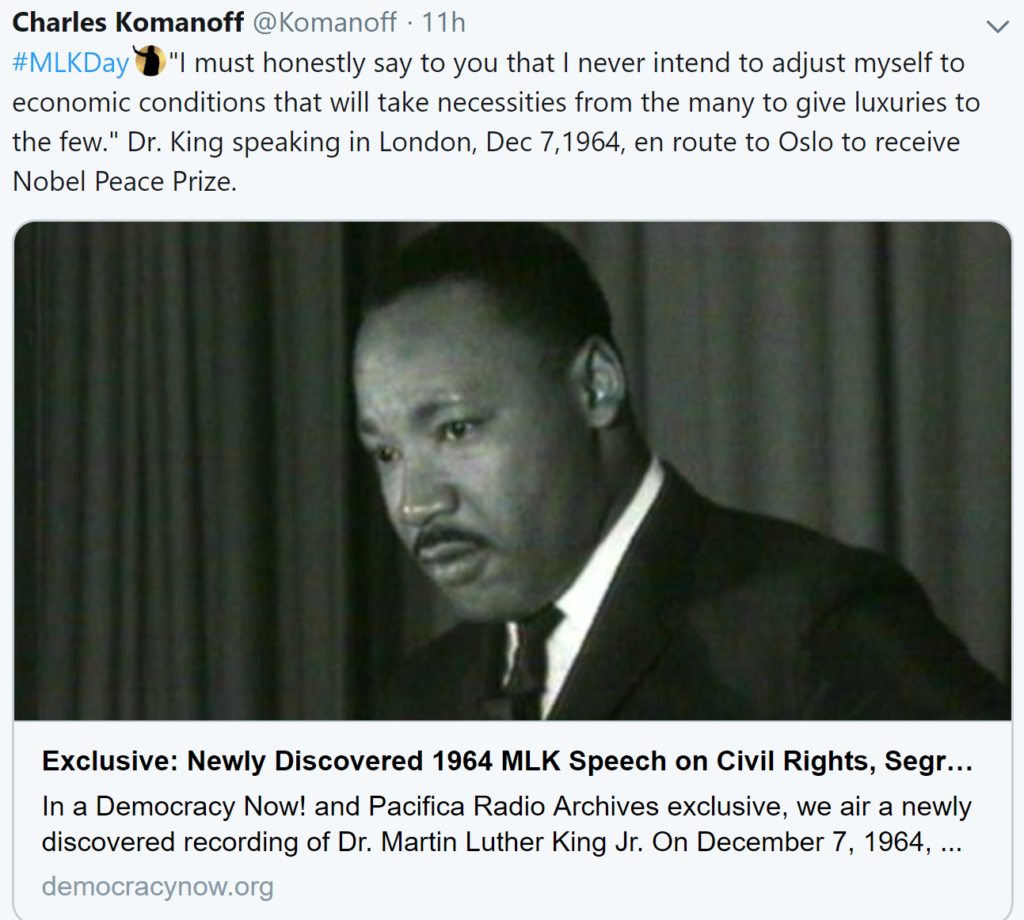
Note: Dr. King’s 1964 speech referenced in my tweet may be found here.
What a Climate Scientist’s New Toy Can Teach Us About Carbon Taxing
Texas Tech physicist Katherine Hayhoe is investing in a home studio. How do I know? She tweeted about it last night: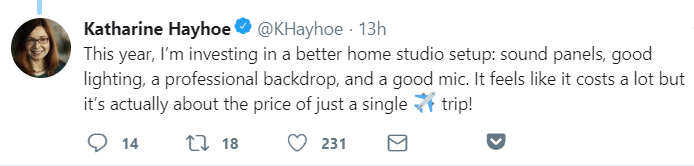
Why should we care? Because the professor’s studio upgrade is a microcosm of what a carbon tax — and only a carbon tax — can do for climate.
Some context: Prof. Hayhoe is a renowned voice for climate sanity. At Texas Tech, in Lubbock, she teaches atmospheric science and political science — a potent combination tailored to her dual repertoire of climate physics and climate communications.
These days Hayhoe is inundated with speaking requests, to the point that compelled her to face the tie between her air travel and greenhouse gas levels. Thus the studio upgrade. Now, she tweeted last night, “When I receive a speaking invite, my first question is: could I do a low-carbon video talk? Thanks to peoples’ willingness to give new-fangled tech a try, I now give about 3/4 of my talks this way!” [Click here for Prof. Hayhoe’s complete Twitter thread on the matter.]
Air travel is often trotted out as evidence that climate change is unstoppable — and not without reason. It’s already five percent of U.S. CO2 emissions (some put its climate impact higher, due to flying’s unique atmospheric interactions), a share that is rising, as befits air travel’s “luxury-good” status as an activity that rises faster than incomes. Schemes for lower-carbon propulsion systems, from biofuels or electric motors to hydrogen or high-tech dirigibles, are mostly still at the drawing boards. Packing more passengers into fewer and smaller seats is probably nearing its limit (though perhaps steeper baggage fees will push down per-passenger emissions a bit further).
At least for the immediately foreseeable future, the primary antidote to air travel’s escalating emissions must be to fly less. A carbon tax can bend flying’s demand curve downward, but alternatives like teleconferencing must be part of the process. The better the technology — in ease of use (on both ends), clarity and capability — the more people who will follow in Prof. Hayhoe’s footsteps. Before long, virtual presenting and meeting could grow from quirky to normal. Societal norms will reset, perhaps to the point where jetting to and fro will seem as odd as turning down a trip due to carbon appears today.

Three stages of air travel: physical / digital / something just beyond the horizon.
There are two strands here. One, just noted, is about resetting societal defaults: passing on your second cousin’s third wedding out in Reno not just because the carbon tax has made the trip costlier but because the reflexive, “Nothing could keep me away” has become “This time I’m going to pass” as society has adapted to higher ticket prices (and, perhaps, flying has lost some of its prestige).
The other is about innovation. To stick with our air travel example, ways to participate without physically showing up will inevitably grow more feasible and tantalizing as the carbon tax drives demand toward that direction. Some of the adaptive innovation will be along known paths like teleconferencing, but some will doubtless be along paths few of us can imagine — save for the innovators awaiting the market opportunity.
This stuff won’t be won by regulations, standards or subsidies, but it’s central to slashing emissions, in my opinion. It’s the reason that throughout 2019, as climate progressives brainstorm and settle on the elements of a Green New Deal, CTC will be fighting to ensure that robust carbon taxing is one of them: not simply to generate revenue to pay for green infrastructure but to incentivize the million and one innovations that, even if we can’t yet spell them out, will be key to crushing the structures of demand that still have us hooked on carbon fuels.
If you really want to innovate, there has to be a cost to carbon pollution. Without that, where is the incentive to innovate?”
U.S. Sen. Sheldon Whitehouse (D-RI), Taxing Carbon Emissions, letter published in The New York Times, Dec. 31.
The I.P.C.C. has sounded many alarms, and the world just keeps smashing the alarm and keeps on sleeping.”
Hans Joachim Schellnhuber, founder of the Potsdam Institute for Climate Impact Research, quoted in New York Times,
The Paris Accord Promised a Climate Solution. Here’s Where We Are Now., Dec. 14.
Expecting all working people and families to own and maintain a motor vehicle in order to participate in society is more regressive than a carbon tax.”
Tweet by Anthony Ryan (@printtemps), Dec. 9.
From Thomas Piketty: A Project to Save Europe . . . and the Climate
The following statement was published today in The Guardian under the headline, Our Manifesto to Save Europe from Itself, under the signature of Thomas Piketty, the French economist who rose to global renown with the 2013 publication of his scholarly work, Capital in the Twenty-First Century.
The statement, co-signed by over one hundred European economists, outlines a plan to revitalize the European Union with with a “new, sovereign European assembly capable of producing a set of fundamental public goods and services in the framework of a lasting and solidarity-based economy,” paid for by a suite of “four major [new] European taxes” including a carbon tax set at a minimum of 30 euros per metric ton (equivalent to around $31 per U.S. short ton).
While the proposal presumably was provoked by the ongoing “Gilets Jaunes” protests rocking France, its ambitions are far greater than simply responding to the current unrest. We are of course encouraged that the proposed program includes a carbon tax.
We are grateful to the editors of The Guardian for publishing the manifesto in full. The original version on The Guardian’s site includes a complete list of signatories. We have changed European syntax in some places to American style and have bolded passages deserving emphasis.
— Carbon Tax Center
Since the election of anti-European governments across the EU, and with Brexit looming, it is no longer possible to continue as before. We cannot simply wait for the next departures, or further dismantling without making fundamental changes to present-day Europe.
Our continent is caught between political movements whose program is confined to hunting down foreigners and refugees, on one hand, and on the other those who claim to be European but in reality continue to consider that hardcore liberalism and the spread of competition are enough to define a political project. They don’t recognize that this lack of social ambition is what leads to feelings of abandonment.
French “Gilets Jaunes” protesters in Paris Saturday, Dec 8.
There are some movements attempting to end this fatal dialogue and address the structural problems that have arisen after a decade of economic crisis. There is no lack of these specifically European-critical situations: structural under-investment in the public sector, particularly in training and research, a rise in social inequality, acceleration of global warming and a crisis in the reception of migrants and refugees. But these movements often have difficulty in formulating a coherent alternative project, and in describing precisely how they would like to organize the Europe of the future.
This is why we, European citizens from different backgrounds and countries, are today launching this appeal for the in-depth transformation of the European institutions and policies.
Our manifesto contains concrete proposals, in particular a project for a democratization treaty and a budget project – and we have made it all publicly available. Our ideas may not be perfect, but they do have the merit of existing. The public can access them and improve them.
They are based on a simple conviction: Europe must build a new model to ensure the fair and lasting social development of its citizens. The only way to persuade them is to abandon vague and theoretical promises.
If Europe wants to restore solidarity with its citizens it can only do so by providing concrete evidence that it is capable of establishing cooperation and by making those who have gained from globalization contribute to the financing of public-sector good. That will mean making large firms contribute more than small and medium businesses, and the richest taxpayers paying more than poorer taxpayers. This is not the case today.
Our proposals are based on the creation of a budget for democratization that would be debated and voted on by a new, sovereign European assembly. This will at last enable Europe to equip itself with a public institution capable of dealing with crises in Europe immediately and of producing a set of fundamental public goods and services in the framework of a lasting and solidarity-based economy. The promise made at the treaty of Rome of “harmonization of living and working conditions” will finally become meaningful.
This budget, if the European assembly so desires, will be financed by four major European taxes, the tangible markers of this European solidarity. These will apply to the profits of major firms, the top incomes (over €200,000 a year), the highest wealth owners (over €1m ) and carbon emissions (with a minimum price of €30 a tonne).
If it is fixed at 4% of GDP, as we propose, this budget could finance research, training and the European universities, an ambitious investment program to transform our model of economic growth, the financing of the reception and integration of migrants, and the support of those involved in carrying out this transformation. It could also give some budgetary leeway to member states to reduce the regressive taxation that weighs on salaries or consumption.
The issue here is not one of creating a transfer of payments across Europe – taking money from the “virtuous” countries to give it to those that are less so. The project limits the gap between expenditure deducted and income paid by a country to a threshold of 0.1% of its GDP – this could only be increased should there be consensus to do so.
This threshold can be raised in case there is a consensus to do so, but the issue is primarily of reducing the inequality within countries, not between them, and of investing in the future of all Europeans. But those calculations would exclude spending that benefits all countries equally, such as action on climate change. Because it will finance European public goods benefiting all countries, the budget for democratization will de facto also foster convergence between countries.
Because we must act quickly but we must also get Europe out of the present technocratic impasse, we propose the creation of a European assembly. This will enable these new European taxes to be debated and voted as also the budget for democratization. This European assembly can be created without changing existing European treaties.
The assembly would, of course, have to communicate with the present decision-making institutions (in particular the Eurogroup in which the ministers for finance in the eurozone meet informally every month). But, in cases of disagreement, the assembly would have the final word. If not, its capacity to be a locus for a new transnational political space where parties, social movements and NGOs would finally be able to express themselves would be compromised.
Equally its actual effectiveness, since the issue is one of finally extricating Europe from the eternal inertia of intergovernmental negotiations, would be at stake. We should bear in mind that the rule of fiscal unanimity in force in the European Union has for years blocked the adoption of any European tax and sustains the eternal evasion into fiscal dumping by the rich and most mobile, a practice which continues to this day despite all the speeches. This will go on if other decision-making rules are not set up.
Given that a newly created European assembly would have the ability to adopt taxes and to affect the very core of the democratic, fiscal and social compacts of states, national and European parliamentarians must be central. This is why we propose, in the democratization treaty available online, that 80% of the members of the European assembly should be from national parliaments, with 20% from the present European parliament.
This choice merits further discussion. In particular, our project could also function with a lower proportion of national parliamentarians (for instance, 50%). But in our opinion an excessive reduction of this proportion might detract from the legitimacy of the European assembly in involving all European citizens in the direction of a new social and fiscal pact, and conflicts of democratic legitimacy between national and European elections could rapidly undermine the project.
Thus national elections will de facto be transformed into European elections. National elected members will no longer be able to simply shift responsibility on to Brussels and will have no other option than to explain to voters the projects and budgets they intend to defend in the European assembly. By bringing together the national and European parliamentarians in one single assembly, habits of co-governance will be created which at the moment only exist between heads of state and ministers of finance.
We now have to act quickly. While it would be preferable for all EU countries to join the project without delay – especially the four largest countries in the eurozone (which represent more than 70% of the GNP and population) – it is designed so that it can be adopted and implemented by any set of countries that wish to do so. It enables those who wish to make immediate progress by adopting this project to do so right now.
We must all assume our responsibilities to participate in a detailed and constructive discussion on the future of Europe, lest our continent is left to sink further into damaging division.
Thomas Piketty is professor of economics at the Paris School of Economics.
Other signatories: Sébastien Adalid, Michel Aglietta, Nacho Alvarez, Julie Bailleux, Marija Bartl, Marie-Layre Basilien-Gainche, Myriam Benlolo Carabot, Loïc Blondiaux, Karolina Borońska, Andreas Botsch, Patrick Boucheron, Emmanuel Bouju, Begnina Boza-Kiss, Hauke Brunkhorst, Bojan Bugarič, Klaus Busch, Julia Cagé, Lucas Chancel, Christophe Charle, Christian Chavagneux, Amandine Crespy, Fabio De Masi, Anne-Laure Delatte, Donatella Della Porta, Yves Deloye, Paul Dermine, Brigitte Dormont, Guillaume Duval, Susanne Elsen, Emanuele Ferragina, Bastien François, Philippe Frémeaux, Diane Fromage, Miguel Gotor, Julien Grenet, Ulrike Guérot, Gabor Halmai, Pierre-Cyrille Hautcoeur, Stéphanie Hennette, Rudolf Hickel, Mario Hübler, Élise Huillery, Simon Ilse, Liora Israel, Michael Jacobs, Yannick Jadot, Luis Jimena Quesada, Christian Joerges, Kädtler Jürgen, Iphigénie Kamtsidou, Jakob Kapeller, Pascale Laborier, Justine Lacroix, Sylvie Lambert, Camille Landais, Sandra Laugier, Rémi Lefebvre, Steffen Lehndorff, Nicolas Leron, Ulrike Liebert, Pascal Lokiec, Philippe Maddalon, Mikael Madsen, Paul Magnette, Maria Malatesta, Francesco Martucci, Frédérique Matonti, Dominique Meda, Robert Menasse, Sophie Meunier, Zoltan Miklosi, Eric Millard, Robert Misik, Éric Monnet, Alberto Montero, Daniel Mouchard, Ulrich Mückenberger, Jan-Wener Muller, Olivier Nay, Sighard Neckel, Fernanda Nicola, Silke Ötsch, Walter Ötsch, Bruno Palier, Mazarine Pingeot, Martin Pigeon, Sébastien Platon, Thomas Porcher, Christophe Prochasson, Thomas Ribemont, Julie Ringelheim, Daniel Roche, Pierre Rosanvallon, Ruth Rubio Marin, Guillaume Sacriste, Emmanuel Saez, Gisele Sapiro, Francesco Saraceno, Thomas Sauer, Patrick Savidan, Frédéric Sawicki, Axel Schäffer, Alan Scott, Thomas Sterner,Julien Talpin, Stéphane Troussel, Laurence Tubiana, Boris Vallaud, Fernando Vasquez, Antoine Vauchez, Brigitte Young, and Gabriel Zucman
- « Previous Page
- 1
- …
- 16
- 17
- 18
- 19
- 20
- …
- 171
- Next Page »