
Could Returning All Carbon Tax Revenue Satisfy Conservatives? (Atlanta JC)
Search Results for: revenue
Green push can boost Obama tax deal
Obama Should Use Carbon Tax To Cut Payroll Tax (Financial Times)
Should Carbon Pricing Advocates Support the Cap-and-Dividend Bill?
Last month’s Pricing Carbon Conference at Wesleyan U. featured a debate over three competing approaches for pricing carbon emissions, each of which is embodied in bills introduced in the 111th Congress:
- Cap-and-trade with offsets (essentially the Waxman-Markey bill);
- Cap-and-dividend (essentially the Cantwell-Collins bill); and
- A stepwise shift from payroll taxes to carbon taxes (essentially the Larson bill).
The Conference also offered a workshop comparing two ways to return revenues raised by a carbon tax or by selling carbon emission permits:
- a regular “dividend” or “green check” sent to all U.S. households; vs.
- a series of periodic reductions in payroll taxes.

Cap-and-Dividend proponent Peter Barnes, flanked by NRDC's Dan Lashof (left) and Carbon Tax Center's Charles Komanoff (right), at the Wesleyan Pricing Carbon conference.
As hoped, the Conference has sparked a flurry of substantive and strategic discussions. For example, cap-and-dividend advocate Peter Barnes is imploring us to align the Carbon Tax Center with the CLEAR cap-and-dividend bill introduced in December 2009 by Senators Cantwell (D-WA) and Collins (R-ME).
The CLEAR bill is backed by a coalition of largely grassroots organizations, who view it as a way to achieve a guaranteed reduction in emissions without the political compromises and anti-consumer aspect of cap-and-trade with offsets. We hold Peter and his coalition partners in high regard. Their cap-and-dividend concept is certainly a quantum improvement over the cap/trade/offset model that some of the mainstream environmental groups rode to defeat (again) in 2009-2010. Yet both the concept and the particulars of the CLEAR bill fall far short of what we at CTC believe is required in carbon-pricing legislation.
In this post, we contrast the CLEAR bill with the approach taken by Rep. Larson (D-CT) and 12 co-sponsors in their carbon tax bill, America’s Energy Security Trust Fund Act, which Mr. Larson pledged at Wesleyan to re-introduce in the new Congress that convenes in January.
The CLEAR Bill at a Glance
Like all cap-based bills, the CLEAR bill relies on a declining “cap” in the number of carbon emission permits to be auctioned to emitters. In CLEAR’s case, the promised decline (relative to 2005 emissions) would be 20% in 2020, 30% in 2025, and so forth, finally reaching an 83% drop by 2050. CLEAR would return 75% of the revenues from the permit auctions to all U.S. residents, with each getting an identical amount. The remaining 25% of revenue would be placed in a “Clean Energy Reinvestment Trust Fund” (CERT) for appropriation by Congress, ostensibly to “green energy” investments, mitigation, adaptation and transition assistance.
As a brake on price volatility, and to provide a modicum of price predictability, CLEAR sets a floor and ceiling on the prices of the carbon emission permits: the floor is set at $7 per ton of CO2 rising at 6.5% annually plus the rate of general inflation, with the ceiling at $21/ton, rising at 5.5% plus inflation. The floor is intended to protect investments in low-carbon measures by ensuring that fossil fuel prices include at least a minimum charge for their carbon emissions, while the ceiling is intended to shield consumers from too-rapid price rises. When the ceiling is hit, a “safety valve” in the CLEAR bill triggers auctions of additional permits at the ceiling price; the revenue from these supplemental permits is added to the CERT fund.
CLEAR’s Biggest Problem: Its Cap Hides a Much-Too-Low Price
The Carbon Tax Center has modeled the price levels needed to achieve particular emissions reductions. Our conclusion, using historical energy price-elasticity data, is stark: the CLEAR bill’s emissions reductions targets cannot be achieved within the bill’s low price ceiling. When we conveyed this finding at a meeting with Sen. Cantwell’s staff in early 2010, the response was even more stark: “We don’t intend to use (CO2) prices to reduce emissions.” — a statement that appears to deny the fundamental role of prices in driving changes in behavior.
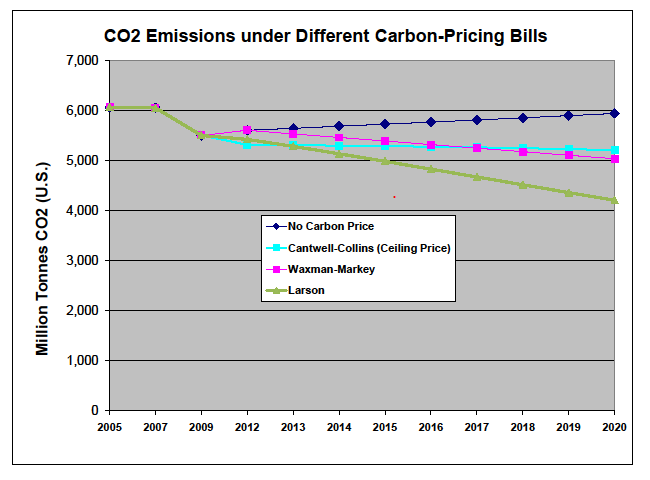 The apparent disconnect between CLEAR’s emission targets and its price ceiling means that the ceiling price would be hit frequently, perhaps even continuously. This in turn would open the safety valve and cause the auctioning of supplemental emission permits, whose revenue would fund CERT. In effect, then, as the cap tightened, CLEAR would function like a low carbon tax (with the level set at the safety valve auction price), an increasing share of whose revenues would flow to the CERT fund. The initial promise of returning 75% of revenue would recede as the cap tightened and an increasing share of revenue went to the CERT fund. In this respect, CLEAR might even come to resemble the “Breakthrough” proposal for a low carbon tax to fund RD&D, albeit with less specificity about which technologies Congress might choose to subsidize and less clarity about the expected CO2 prices.
The CERT Fund—Big Dogs Eat First, But Can They Reduce Emissions?
Needless to say, the same interests that wrote themselves free allowances under the Waxman bill would use their political muscle to divide up the CLEAR bill’s CERT fund. Thus, no one should be surprised if “clean coal,” ethanol and other “incumbent” energy interests garnered a lion’s share of the CERT fund’s supposed “clean energy investments.”
Nevertheless, CLEAR proponents appear to assume that the CERT fund would achieve near-miraculous reductions in carbon emissions. Our modeling indicates that because CLEAR’s price level is held so low, the bill would have to rely on the CERT fund to achieve more than half of its mandated 2009-2020 emissions reductions. Indeed, with its low (5.5%) annual increase rate, CLEAR’s $21 ceiling price would rise to only about $35 in a decade; that’s less than a third of the 2020 price in the Larson bill. No wonder Larson is projected to reduce emissions by 30% by harnessing the power of real price signals, whereas the CLEAR bill would have to rely on unspecified (and likely pork-laden) energy “investment” simply to achieve a reduction of 20%.
The Vast Costs of Hiding the Price
The main (political) appeal of a cap seems to be to hide the price. Yet hiding the price from investors and households guarantees that caps will be far less effective than direct pricing mechanisms at inducing investment in low-carbon energy and efficiency. The Brattle Group, a well-respected economics consultancy, studied the price volatility in the European Union’s Emissions Trading Scheme and concluded, first, that the noisy, hidden price signal there delayed investment in alternative energy by a decade; and, second, that the cap-derived CO2 price would have to rise roughly twice as high to get the same emissions reductions as an explicit tax.
Moreover, as we saw in the acrimonious and puerile debate over the Waxman bill, “hide the price” leaves everybody with an Internet link free to speculate on the cost of the legislation, with estimates ranging from astronomical (by those opposing action) to microscopic (by those claiming that “cost controls” such as offsets would avoid the need for significant CO2 prices). The result of “hide the price” in 2009-10 was a confused public and a stymied Congress. There’s no reason to expect a clearer discussion if cap systems continue to be the preferred way to price carbon emissions.
Hiding the price under a cap also complicates international harmonization. As we described in a post here in March 2009, and “Report from Copenhagen: Forget carbon targets, just set a price” an explicit carbon tax with border tax adjustments can be an effective incentive for other nations to enact their own carbon taxes to garner the tax revenue that their carbon-taxing trading partners will otherwise collect on imports at the border.
CLEAR’s Flimsy Wall Around Wall Street
The CLEAR bill seeks to avoid inducing speculative secondary markets by fiat: prohibiting entities that buy or sell emission permits from buying and selling carbon derivatives. It also would require CFTC, FERC and FTC to promulgate regulations on CO2 emissions trading. But as the Congressional Budget Office, Robert Shapiro and other economists have concluded: because of the energy industry’s need for insurance against wild price swings, the use of hedging instruments is unavoidable in the large and volatile CO2 markets that are inherent when setting a price indirectly using a cap. It appears inevitable that a secondary market would emerge overseas, if not illicitly onshore.
CLEAR’s Big Contribution: Revenue Return
The CLEAR bill did perform a great service by bringing revenue return via “dividends” into public discussion, at a time when Waxman-Markey proposed what amounted to a 40-year earmark of carbon revenues. (W-M would have allocated 85% of allowances, overwhelmingly to “incumbent” energy interests – effectively, a hidden, volatile and regressive tax.) CLEAR would at least start with 75% revenue return, although as discussed, that fraction would diminish as the cap tightened and the price ceiling was hit. Nevertheless, revenue return via a “dividend” or “green check” offers transparency and accountability that could help build political support for carbon emissions pricing.
On the other hand, returning revenue via reduced taxes on workers, as Rep. Larson proposes, would also avoid regressivity while offering the additional advantage of employment stimulus. This kind of tax-shifting seems to be a key ingredient in the continued political and economic success of the carbon tax in British Columbia and its effectiveness has been widely recognized here, too. Cutting payroll taxes has been praised by the Congressional Budget Office as one of the most cost-effective ways to reduce unemployment. The bipartisan “Hire Now” Act, co-sponsored by Senators Hatch and Schumer, effective in March 2010, eliminated the first six months of payroll taxes on employers that hire the unemployed.
While pro rata “dividends” offer appealing transparency and simplicity, the potential for a “job-creating carbon tax” to cut payroll taxes while de-carbonizing our economy seems no less attractive, particularly with officially-measured unemployment persisting above 10%. Though we conclude that CLEAR bill is too flawed to serve as effective carbon pricing legislation, it did at least jump-start the much-needed debate about revenue return. For that, Senators Cantwell and Collins and CLEAR’s supporters deserve high praise.
Photo: Wesleyan University
We Can Still Price Carbon With a Republican House
Could Returning Carbon Tax Revenue Garner Republican Support? (S Valk, Huff Po)
Help Make Our November Conference A Turning Point for Climate Action
Dear Friend —
A carbon tax was always going against the grain — against the presumption that the most straightforward and effective approach to carbon emissions pricing couldn’t prevail over America’s special-interest politics and tax aversion — and against the smart money that insisted on hiding the price and buying off the opposition.
Well, the insiders’ cap-and-trade strategy has crashed and burned, but we carbon tax advocates are still standing and still facing a headwind. But we see a shift on the horizon: we’re convening a national conference next month at Wesleyan University in Connecticut designed to rally public and political support for effective and fair carbon taxing. And we’re asking you to help us make the Nov. 19-21 Pricing Carbon Conference a turning point at which a growing coalition of U.S. climate advocates unites under the banner of a revenue-neutral carbon tax.
 It’s true that support for climate action is polling at near-record lows. But while part of that is due to the economy along with the highly orchestrated campaign of climate denialism, the spectacle of polluter giveaways under cap-and-trade has also convinced many that there’s no equitable way to price carbon emissions. We aim to turn that sentiment around, and show Americans that a national carbon tax with the revenues returned equally to U.S. households via “green checks” — carbon “fee-and-dividend,” as James Hansen terms it — can arrest the climate crisis while enhancing most families’ financial well-being. (Coupling those green checks with strategic “tax shifting” would be equally fair and effective.)
We’ve lined up an impressive and diverse roster of speakers for the conference, including Jim, Bill McKibben, Juliet Schor, Brent Blackwelder, Peter Barnes, Bill Shireman, two nationally known leaders from the environmental justice community, Cecil Corbin-Mark and Angela Johnson Meszaros, and members of Congress from both sides of the aisle. (A more complete list with links to speaker bios is here.)
As co-host of the conference, Wesleyan’s College of the Environment is providing additional experts including economist Gary Yohe along with world-class facilities for the conference presentations and discussion forums.
Now we need your help: to pay for speakers’ travel and lodging; for buses to bring delegates from New York, Boston and Washington; and for advertising and publicity to ensure that the halls are packed and the proceedings are communicated far and wide. We’re also eager to assist a growing number of young climate activists seeking “scholarship” assistance with travel and lodging. These are the people whom we will be counting on to take our mission forward. And they are also the people who will likely be most inspired by participating in the conference.
Your check, made out to “Wesleyan University” and mailed to The Price Carbon Campaign, P.O. Box 125, South Lee, MA 01260, will go entirely for conference organizing and will be tax-deductible. To contribute on-line, go to www.citizensclimatelobby.org. On the right, select the lower donate button (tax-deductible donation). Please fill out the form in its entirety. In the second address line, enter: pricing carbon, then hit continue. (Citizens Climate Lobby is a conference sponsor.) As always, you can contribute to the Carbon Tax Center via the “Donate Now” button elsewhere on this Web site.
Every successful revolution — in policy as well as politics — has begun with a small band of people who nurtured a new idea that went against the grain. A carbon tax that transparently and unmistakably builds the costs of climate damage into the price of fossil fuels is no different. This is our moment, and the Wesleyan “Pricing Carbon” conference is our vehicle for seizing it. Please write your check today and be as generous as you can.
Best wishes … and thanks!
Charles Komanoff (director, Carbon Tax Center)
PS: Of course, we’d love to have you join us at the conference. To register, click here: www.pricingcarbon.org or click the REGISTER NOW button higher up on this page. You can also call (413) 243-5665.
Photo: Flickr / Carlos Gotay Martínez
A Tragic Tale of "Hide the Price"
This week’s New Yorker (Oct 11) features an excruciatingly twisted tale. “As the World Burns, How the Senate and the White House missed their best chance to deal with climate change” reports how Senators Kerry, Graham and Lieberman took deal-cutting to new heights — or depths — to put across their carbon cap-and-trade-with-offsets bill. In pursuit of their holy grail — a cap to reduce U.S. CO2 emissions 17% by 2020 (but just 8% below last year’s level; and their cap would have relied heavily on unverifiable international and domestic offsets) — the “Three Amigos” offered deals to anyone who’d listen, including expanded offshore drilling (whose hazards inconveniently re-surfaced just weeks later in the BP disaster); more subsidies for nukes; de-regulation of toxic pollutants including heavy metals like mercury; special arrangements for the gas, coal and oil industries; and free “allowances” to help utilities buy their way out of the cap.
The fascinating and heartbreaking narrative can be read as an indictment of the Senate and the power of the fossil fuel industries. The scene of Sen. Kerry seeking a deal with natural gas baron T. Boone Pickens — who in 2004 “swiftboated” Kerry out of a possible presidential victory — is particularly pathetic. But there’s an ironic nugget missing from the story.
In February, at a meeting with Sen. Kerry, climate scientist Dr. James Hansen urged the Massachusetts Democrat to quit “hiding the CO2 price” under cap-trade-offset “gimmicks.” Instead, Hansen insisted, Kerry should propose a direct fee on CO2 pollution, assuring fairness and popular support by returning revenue via equal monthly “green checks” to every citizen. Kerry insisted, “I know what can pass the Senate.” As the New Yorker article’s title suggests, the Senator knew no such thing … and the result was tragic.
The tale of climate legislation isn’t over, though; people do learn from experience. Can we move beyond the mirages of cap-trade-offset to a transparent “carbon fee and green check” or “carbon fee with payroll tax cut”? With atmospheric CO2 at 388 ppm and rising, there’s no time to lose.
New Converts to Carbon Tax: Welcome Aboard, Now Start Rowing
(Note: NYT DotEarth blogger Andy Revkin linked to this post today in a piece that has more from Bill Gates on carbon pricing. Click here. – C.K., Sept 2.)
Last week, Bill Gates. This week, Bjorn Lomborg. With the world’s #1 software magnate and the man whom the Guardian labeled “the world’s most high-profile climate change skeptic” both endorsing a carbon tax, is the tide of influential opinion on climate policy and carbon pricing turning?
Yes and no.
- Bill Gates. Photo: Steve Jurvetson (flickr).

Let’s look at Lomborg first. The Danish policy analyst built a lucrative career lambasting climate-change advocates as scaremongers who would consign millions to early death by devoting resources to decarbonizing the world economy rather than fighting killer diseases like malaria. But in a new book to be published next month, the self-styled “skeptical environmentalist” reportedly will call global warming “one of the chief concerns facing the world today” and “a challenge humanity must confront.” According to the Guardian, Lomborg will urge investing tens of billions of dollars a year to tackle climate change, with the funds to be raised through a carbon tax.
In somewhat overheated prose, the Guardian called Lomborg’s new-found resolve to combat global warming “an apparent U-turn that will give a huge boost to the embattled environmental lobby.”
Gates, on the other hand, has long worried about climate change. But in an interview in Technology Review last week, he added a new wrinkle: criticism of cap-and-trade:
TR: [A]lmost everyone agrees that there needs to be a price on carbon–whether a Pigovian tax or a cap-and-trade system. Without a price, there’s going be very little incentive to do the kinds of research, or create the kinds of technologies, or build out the kind of infrastructure, that we need.
Gates: No, that’s not right. It’s ideal to have a carbon tax, not just a price on carbon, which is this fuzzy term that includes cap-and-trade.
TR: Well, ideally, you’d do a Pigovian tax —
Gates: No, not a Pigovian tax. A Pigovian tax is where you pay for the damage. Here, you’re not paying for the damage — you can’t pay for the damage. You’re using the tax to create a mode shift to a different form of energy generation.
TR: That sounds very rational, pragmatically feasible, and humane. It also sounds politically unlikely.
Gates: Which is more likely: a [hidden] carbon tax [Gates’ way of describing cap-and-trade] with all sorts of markets and options and uncertainties about prices, and traders in the middle, and confusion about who initially gets the most advantage? Or a regulatory thing that says you mark every coal plant in the country with when it has to be retired, and a 2 percent tax to fund the R&D so that utilities know they can buy a plant that’s emitting hardly any CO2?
Gates’ disparagement of cap-and-trade is striking. But neither his 2% carbon tax nor Lomborg’s, which appears to resemble Gates’ in magnitude and function ─ funding energy R&D ─ is going to end the reign of fossil fuels in the foreseeable future.

Bjorn Lomborg. Photo: Emil Jupin (Lomborg.com).
The notion of an R&D solution is alluring. Who doesn’t want there to be global warming antidotes lurking in garages and labs, waiting for funding to unlock them? But it’s a chimera. Even with unlimited research funding, no technological breakthroughs can dislodge carbon-based fuels from dominion over the world’s energy economy. Fossil fuels’ energy density is too great, and their positional advantages of infrastructure and institutions too powerful.
Yes, subsidies can help push renewables past the “hump” in the S-curve to where scale economies can kick in and take a few bites out of the fossil fuel pie. But as New Republic blogger Brad Plumer pointed out recently, “Government subsidies just don’t pack the same punch as a market price on carbon pollution.” When a commodity or activity causes harm, the surest way to reduce it isn’t to subsidize a thousand and one alternatives but to directly discourage the thing by internalizing the cost of the harm into its price.
Ironically, Barack Obama appeared to grasp this during his run for the presidency. In a February 2008 interview with the San Antonio Express he enthused over the idea of a carbon tax:
Q. Have you considered … taxing emerging energy forms, for example, say a penny per kilowatt hour on wind energy?
A. Well, that’s clean energy, and we want to drive down the cost of that, not raise it. We need to give them subsidies so they can start developing that. What we ought to tax is dirty energy, like coal and, to a lesser extent, natural gas. (emphasis added)
How big a carbon tax is needed? A lot more than 2%. Raising electricity prices by 2%, if that’s what Gates envisions, would reduce electricity usage by an estimated 1.4% over the long run. Assuming, as modeling at the Carbon Tax Center suggests (xls), that fuel substitution (gas and nuclear for coal, wind and solar for gas, etc.) contributes roughly two units of carbon reduction for each unit gained from demand destruction, the total impact of the Gates tax on carbon emissions from the electricity sector would be just 4-5%. Since other sectors are less price-elastic, the average economy-wide reduction would be even less, probably just a few percent.
Contrast this with the bill introduced by Rep. John Larson (America’s Energy Security Trust Fund Act of 2009, H.R. 1337), which has a first-year carbon tax of $15 per ton of CO2 increasing steadily and predictably at $10-$15/ton each year, that would cut (xls) U.S. carbon emissions by approximately 30% by 2020, or an order of magnitude more than Gates-Lomborg carbon taxes. And Larson would return the vast bulk of carbon revenues to workers’ paychecks while setting aside a fund for the sort of clean energy R&D that Gates and Lomborg espouse.
Why the 10-fold difference in impact? A large carbon tax like Rep. Larson’s would create profound incentives: on the demand side to use less energy (via billions of decisions at household and social levels), and on the supply side to shift fuels and power to low- and zero-carbon sources (via thousands of decisions by entrepreneurs, utilities and energy companies). A mere 2% carbon tax, even one with revenues allocated to R&D, would not.
In his Technololgy Review interview, Gates at least coupled his carbon tax with a notion of ordering utilities to shut down CO2-intensive plants at such and such a time:
And then you just take all the carbon-emitting plants, you look at their lifetime, and you say on a certain date this one has to be shut down, and when a new one is put in place, it has to be low-CO2-emitting.
But how this would come to pass in the absence of price signals and corrections justifying it financially is, to be charitable, unclear.
Both Gates and Lomborg deserve plaudits for their disavowals: of cap-and-trade by Gates, of climate-change denialism by Lomborg; and for embracing the idea of a carbon tax. They now need to see the next light: to have the necessary impact, a carbon tax can start modestly but must keep rising predictably. Fortunately, we have the example of British Columbia to show that an upward-trending carbon tax of the needed size can be politically popular if the revenue is returned to the public.
Arising from the Senate’s Ashes?
And now, ve may begin?
Readers of a certain age, and a certain literary bent, will recognize the words of Alexander Portnoy’s psychiatrist, spoken at the close of Philip Roth’s transgressive 1969 novel, Portnoy’s Complaint.
After lo these many years, they popped into my head today as I read that Senate Democrats had finally thrown in the towel on an energy bill that would have included a partial cap-and-trade provision for limiting carbon emissions from power plants. The bill, written by Senators John Kerry and Joe Lieberman, was touted by Washington insiders and some major environmental groups as this year’s last hope for federal climate legislation. Yet it would have relied on carbon offsets and other dodges to postpone the day of reckoning with true, visible carbon emissions pricing — the cornerstone of meaningful climate policy.
Instead, reported the New York Times, Senate Democrats will pursue a limited bill aimed at increasing oversight of oil drilling and tightening energy efficiency standards — with no direct assault on climate-destabilizing CO2. (For a later Times story amplifying the first, click here.)
 Yes, now, we may begin — “we” being Americans who care about climate, sustainability, and Earth — to unite around a climate approach that is effective, equitable and transparent enough to win the support of our fellow citizens and a Congressional majority.
I’m referring of course to the idea advanced by climatologist Jim Hansen as fee-and-dividend and by the Carbon Tax Center as a revenue-neutral carbon tax, by which fossil fuel extractors and importers pay the U.S. Treasury fees pegged to the carbon content of the coal, oil and gas they take from the ground or bring into U.S. ports, and the Treasury distributes the revenues to all Americans via equal monthly dividends (“green checks”), or by tax-shifting from regressive taxes such as payroll taxes.
The Senate’s antipathy to even the partial cap-and-trade proposed by Sen. Kerry will doubtless be spun as indicating that for the foreseeable future the well for climate legislation has been poisoned. The Carbon Tax Center says that the opposite may be true: with cap-and-trade out of the way at last, the political well can begin to be de-toxified so that the effective, equitable and transparent carbon fee-and-dividend can be seriously considered.
For this to happen, however, the Big Green groups like EDF and NRDC that for years have dominated climate discourse among environmentalists, and that convinced Congressional Democrats and the White House that the only way to “put a price on carbon” in America was via carbon cap-and-trade, will have to abandon that approach and allow others, and themselves, to try a fresh start.
It will be said that cap-and-trade failed because Fox News and other climate deniers branded it as “cap-and-tax” and, therefore, a carbon tax (or fee) cannot possibly succeed. And it is true that carbon cap-and-trade was looked to, years ago, as a way to build on the success of acid rain cap-and-trade, win over Republican free-marketers, and put a price on carbon without having to parade the dreaded t-a-x word before the public.
In the event, though, carbon cap-and-trade did none of these things.
Instead, Big Green’s pursuit of carbon cap-and-trade tethered the climate movement to complex financial instruments and branded us as servants of Wall Street elites. It opened the legislative floodgates to off-the-charts Beltway deal-making that rightly repulsed the public. Perhaps most importantly, the co-optation of climate advocacy by the cap-and-traders robbed us of the high moral ground we might have shared with abolitionists, suffragists, labor agitators and civil rights workers — true American heroes who fought to liberate our society of oppression and injustice.
If you’re in the climate movement, you recognize that fossil fuels’ assault on Earth’s climate is an ultimate form of oppression and injustice: of rich against poor, of the profligate against the frugal, of the present against the future. Ending this assault will require concerted action on many fronts; and it starts by internalizing the climate-damage costs of coal, oil and gas into their prices, so that the free ride for fossil fuels is ended and all of the alternatives, from energy efficiency, renewable energy and low-carbon fuels to conservation-based behavior and mindfulness toward energy consumption, may compete fairly and effectively.
Political action to accomplish this must be done in bright sunlight, not in Beltway shadows.
Cap-and-trade, let us hope, is dead. And now, we may begin!
Photo: Flickr / generica.
BC government increases carbon tax rate
BC Gov’t Boosts Both Carbon Tax Rate And Revenue Return (Oye!)
Spilled Oil
Oil Disaster Cries Out for Tax on Dirty Energy with Revenue Return (New Yorker)
- « Previous Page
- 1
- …
- 33
- 34
- 35
- 36
- 37
- …
- 43
- Next Page »