Influential liberal columnist (and Nobel economics laureate) Paul Krugman struck back today in his New York Times blog against critics of the Waxman-Markey bill who view cap-and-trade as an open invitation to massive new depredations by Wall Street. Michael Hoexter, Ph.D., a blogger and consultant on policy, energy efficiency and green marketing to businesses and government, and a previous contributor to this page, sent this reply, which we reprint, with Michael’s permission, in full. (The selections of bolded passages are ours. — Editors.)
Prof. Krugman —
I agree with you on many issues and also learn things from you as well. But sometimes you make purely political decisions that you vest with economic authority but not very careful thinking.
 I think this post is an instance of economics being shaped by politics rather than being the (maybe) science that it attempts to be. I am personally full-time committed to action on climate change but you seem to be simply throwing your prestige behind an instrument that I believe is flawed, and not only because of an inchoate fear of speculation.
Let’s say we invented a market mechanism that made “health” a tradable commodity. Would you support that? For some reason cap and trade has gotten a pass from so-called progressives for too long.
Here are some problems:
- Your analogy to wheat and other markets is flawed because these are pre-existing markets that unite multiple sources of supply with multiple sources of demand. A permit market has just one source for permits: the government. Inventing a market to distribute those permits is a needless layer of complexity. The fact that it is a planfully constructed market makes it a different species as well.
- Martin Weitzman, the MIT economics professor who in 1974 speculated (intellectually) that in certain circumstances one might be able to regulate quantities of emissions rather than tax them or regulate them directly, has said that taxation is better than quantity regulation in the case of carbon. He would recommend quantity regulations only where a particular precise amount of something needs to be achieved … taxation seems better if you want to go in one direction to zero.
- Price volatility and arbitrage are the inevitable result of markets. Wall Street and others like carbon markets because of the (needless) complexity of carbon trading and the potential to exploit information asymmetries. On the other hand, to reduce carbon emissions we need a lot of long-term investments that on the whole do not benefit from financial market fluctuations. Now try to calculate the NPV [net present value] of an investment with a volatile carbon price … that’s going to be difficult. Far easier if you know what the carbon tax rate will be within the next 5 or 10 years. Yes, there are mechanisms to dampen volatility and regulate the markets but these add still more complexity and sinecures for officials and representatives of market actors. It’s like buying a Cadillac and ripping off the badge, scratching the paint and deflating the tires … why invent the market in the first place?
- The regulators and actors on these carbon markets are inessential to cutting carbon emissions and will represent an interest group that will dampen and interfere with more serious efforts to cut emissions. All you need to cut emissions is a predictable price on carbon, positive government programs for infrastructure build-out, and/or “command and control” regulations that ban certain activities.
- Cap and trade is the unfortunate offspring of an era of tax phobia which is fast drawing to a close. We are going to have to raise taxes, including Pigovian ones. Why not a carbon tax? Much more transparent and along with direct regulation a much faster route to the goal.
For some reason, there is a blind spot with regard to cap and trade among so-called progressives … you seem to have fallen prey to it.
Photo: Flickr / daniel.gene
 Just as conventional wisdom was consistently proven wrong in the 2008 presidential election, it’s also proving wrong about the political infeasibility of a carbon tax. Just look at events over the past two days.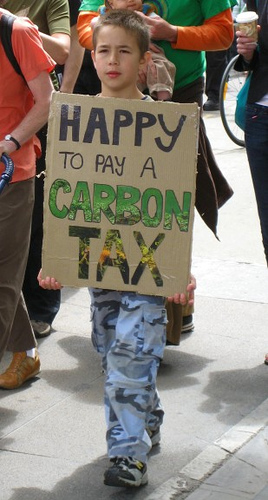
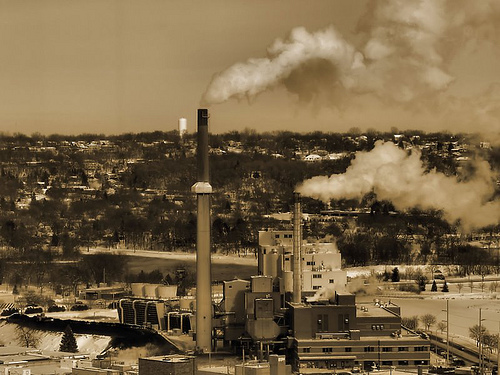 My paper demonstrates that the gloom and doom about America’s industries packing their bags and heading for low-cost countries in Asia or elsewhere at the first serious sign of a U.S. carbon price is grossly exaggerated. In fact, if carbon taxing leads the U.S. to reward labor and income more, and greenhouse gas emissions less, the opposite is more likely to occur. Placing a clear and certain price signal on carbon, which by the way is elusive with a cap and trade design for all the reasons described in an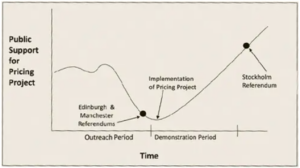
 True, what was on the ballot in Washington last week — making gasoline and other fossil fuels more costly to elevate lower-emission substitutes from smaller cars to electric cars and, best of all, less driving — isn’t the same as congestion pricing. But it’s a close cousin. What stands out is that a policy rejected by nearly 60 percent of voters in 2016 and again in 2018, won with around 60 percent in 2024. Attitudes can shift when facts warrant.
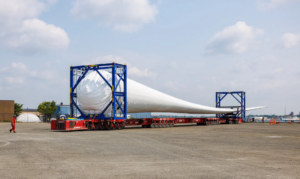
 This impressive scale-economy made sense — on paper. Costs tend to track equipment surface areas, while capacity is proportional to reactor volume, portending only a 60 percent rise in costs per doubling of capacity. (Mathematically, two raised to the two-thirds power is roughly 1.6. Why two-thirds? Because surface area rises with the square of length while volume rises with the cube.) This would dictate a 20 percent reduction in per-kW costs from doubling plant capacity. Other cost elements like siting, permitting, engineering, and project mangement would, it was thought, display steeper economies, lifting the overall per-kW cost reduction per doubling of capacity to around 25 percent.
 For Vineyard Wind, then, and perhaps for the Dogger Bank project as well, paper savings from going large have become a cruel joke, at least for the time being. Putting that aside, I’ve calculated the theoretical carbon price that would raise the sale price of wind electricity by the same amount that a halving of turbine capacity raised its all-in cost. Rephrased as a question: How big of a carbon price would have to be baked into the cost of prevailing fossil-fuel electricity — assumed to be from the mainstay of the U.S. power system, a combined-cycle power plant burning methane gas — to compensate for sticking with prior 6-7 MW sized offshore wind turbines and, thus, foregoing the assumed 25 percent per-kWh cost reduction from doubling turbine sizes to 13 megawatts?