Search Results for “revenue /page”

New York Times congestion-pricing table-setter bodes well for carbon taxing

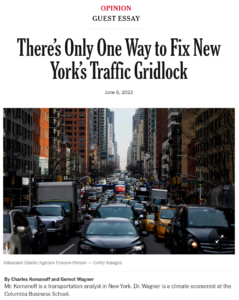
The New York Times yesterday published my op-ed, There’s Only One Way to Fix New York’s Traffic Gridlock, co-written with Columbia University climate economist Gernot Wagner.

Our essay is a meticulous and extensive (1,300 words) brief for making drivers feel the pocketbook costs of their vehicles’ traffic-jam causation, via the policy measure known as congestion pricing. In our telling, not only is this policy guaranteed to generate immense benefits for New Yorkers; as the title suggests, we declare it to be the only way to “free … drivers from the traffic snarls that pollute the air and crush the soul.”

From the Times’ home page, June 8, 2023.

The essay was nearly a month in the making and the product of extensive argument-shaping and fact-checking by the Times’ op-ed staff, bespeaking the paper’s commitment to presenting congestion pricing in a positive light. Its appearance broke the mold of the paper’s hesitant past coverage in two important respects:

1. It explicitly rests on the “comprehensive spreadsheet model” of New York traffic and transit I began developing in 2007 (coincidentally, the year I launched the Carbon Tax Center).

2. It let Gernot and me voice the inconvenient assertion that the regional transit agency charged with designing and administering congestion pricing — the Metropolitan Transportation Authority — “through a few fateful, faulty assumptions, underestimated drivers’ propensity to switch trips from cars to other transit options.” These flubs have tied congestion pricing advocates in knots, forcing us to rebut objections of environmental justice impacts that don’t stand careful scrutiny, although they understandably resonate with communities that historically have borne hugely disproportionate damages from highways, energy facilities and other polluting infrastructure.

It’s only a modest stretch to view the Times’ twin breaks with tradition as the Grey Lady’s version of Andrew Cuomo’s bombshell announcement in August 2017 that “congestion pricing is an idea whose time has come” — itself a rupture that set in motion passage of the state statute authorizing congestion pricing in March 2019.

They suggest that the Times may be lying in wait for the right political winds to let advocates of carbon pricing make a parallel case with respect to climate. Not that a carbon tax is “the only way to fix America’s carbon crisis” but, rather, that it’s a complementary policy tool to last year’s Inflation Reduction Act, and an essential one to ensure that green energy actually replaces rather than merely supplements use of fossil fuels.

For the benefit of non-subscribers blocked by the Times’ paywall, and also to enable comments as well as add a few graphics, we present Gernot’s and my op-ed in full.

— C.K., June 9, 2023

The plan to charge drivers to enter Manhattan south of 60th Street, which last month moved closer to federal approval, will deliver two notable gifts to New York and the region when it begins, perhaps as soon as next April.

The first is that congestion pricing will cut traffic not just within the so-called charging zone but on the hundreds of streets and highways that cars use to go to and from that zone. This reduction of almost two million miles traveled in the region each day will free many drivers from the traffic snarls that pollute the air and crush the soul.

Using a detailed benefit-cost analysis that assumes a pricing structure of $15 at peak times, $10 as traffic begins to thicken and $5 at off-peak times, we calculate that the value of those projected time savings to drivers and truckers amounts to nearly $3 billion a year, with time saved in the boroughs and counties surrounding Manhattan exceeding those on the island.

These estimates are based on a comprehensive spreadsheet model of the region’s traffic, developed by one of us (Mr. Komanoff). State officials used that model to write the statute authorizing congestion pricing, which the New York State Legislature passed in 2019.

The other gift will be the $1 billion a year in congestion pricing revenue that the Metropolitan Transportation Authority will use to secure $15 billion in bonds to pay for improvements to mass transit in the city. Those upgrades will reduce waiting times and onboard delays — and the precious time subway passengers lose as a result.

Either outcome would be a godsend. The combination has the potential to be transformational for New Yorkers.

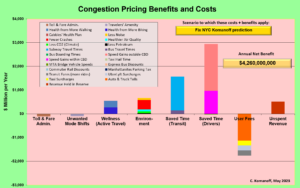
Our op-ed rests on the benefits and costs summarized in the chart.

Why, then, do many people seem anxious about, if not downright opposed to, congestion pricing? Entitlement plays a part: Why should we suddenly be forced to pay for something that had been free? Another reason surely is disbelief. Many people don’t believe that the revenues — the $1 billion a year from drivers — will actually improve mass transit services. The M.T.A. is a money pit, people say.

They may have a point. But the subway, bus and commuter rail services that the M.T.A. operates are also a marvel and a necessity. After the pandemic lockdowns, the system still delivers 2.5 times as many people a day into the Manhattan core as cars and trucks do, though that is down from four times as many before Covid struck. Still, the M.T.A. must build and manage far more effectively. The same political will that got congestion pricing written into law must be marshaled to eliminate layers of consultants, to bring work rules into the 21st century and to make design-build contracting, in which the project designer and the contractor work together under one contract from the beginning, the rule.

People are also unconvinced that congestion pricing will, in fact, cut congestion. Urban gridlock has come to appear immutable in the United States, perhaps nowhere more so than in the Manhattan core, where travel speeds were averaging a maddening 7 miles per hour before the pandemic. Why should congestion pricing succeed where a century of other remedies — like widening roads to only then narrow them again — has failed?

This question is even more salient after the M.T.A.’s environmental study of congestion pricing, released last summer, which concluded that Manhattan traffic will diminish only because trips that now pass through the city’s center would divert around the island, possibly adding traffic and air pollution to parts of the Bronx, Staten Island, Nassau County on Long Island and Bergen County in New Jersey.

We believe that the M.T.A., through a few fateful, faulty assumptions, underestimated drivers’ propensity to switch trips from cars to other transit options. We don’t say this idly — our estimation is based on decades of studying traffic in and around Manhattan and on basic economic principles.

How much traffic will diminish will depend on the toll design selected by the civic leaders who make up the city-state Traffic Mobility Review Board. They’ll be aiming for the same sweet spot that London, Stockholm and Singapore have attained through their successful congestion pricing programs: 15 to 20 percent fewer car trips into the zone, a cut big enough to reduce the many negatives traffic brings and enough to reap the targeted $1 billion a year in revenues to improve the subways, buses and commuter rail systems. (New Jersey Transit rail and bus and PATH would not share in these revenues.)

The congestion charges have not been set. But the M.T.A.’s model and ours agree that if exemptions are kept to a minimum, it could be as little as $15 for a rush-hour trip into Midtown and $5 to $10 during off-peak hours for E-ZPass holders. (In  London, drivers pay 15 pounds during the day, or nearly $19.)

The benefits of congestion pricing — faster, less stressful travel above and below ground and safer, healthier streets and communities — don’t negate the distress of drivers who understandably don’t want to pay where they now drive free, but they assuredly eclipse it.

In addition to the nearly $3 billion worth of saved time for drivers, we estimate that the myriad other benefits add up to an additional $2.5 billion. Those benefits include fewer crashes, better health from cleaner air and more walking and biking, and time saved for transit riders, thanks to improvements enabled by the congestion pricing revenue. Subtracting the $1 billion drivers will pay to enter the congestion zone, the result will be over $4 billion in annual net benefits, or almost $12 million each day.

Moreover, only a small slice of area residents habitually drive into the Manhattan core. Very few are among the working poor, as the Community Service Society of New York, one of the nation’s oldest antipoverty organizations, found when it endorsed congestion pricing in 2019 and again last year. Many drivers, too, may come to feel less of a sting from paying the toll once they actually experience the less-snarled roads.

Schroon River in New York’s Adirondack region on May 12, photographed moments before Gernot called to suggest we pitch an op-ed pegged to the week-earlier removal of a key hold-up to congestion pricing. Our first draft began there.

Last month, the Federal Highway Administration tentatively approved an M.T.A. report that identified how to alleviate possible harm to disadvantaged communities. Now the public has until Monday to review it.

To opponents of the plan, we say:

The M.T.A. is responding to public concerns. To hasten federal approval, the agency has committed to toll discounts for frequent low-income drivers into the zone and also to encourage pollution reductions such as electrifying diesel-powered refrigeration trucks at the Hunts Point Market in the South Bronx and expanding New York City’s clean trucks voucher program to help pay to electrify diesel trucks elsewhere. These commitments followed public feedback on earlier versions of the plan.

Every car is causing congestion. Stalled highways and jammed streets aren’t just the fault of Uber or U.P.S. or bike lanes or public plazas. Everyone driving to or in New York’s central business district (except in the wee hours) adds to congestion. We estimate that right now, a single round trip by car from Sheepshead Bay in Brooklyn to Radio City Music Hall in Midtown during most of the day causes $100 to $200 worth of additional delay for everyone else. That makes a prospective $15 or even a $20 peak congestion toll a downright bargain in comparison.

Congestion pricing is the only durable antidote to persistent traffic congestion. The Columbia University economist and Nobel laureate William Vickrey demonstrated 60 years ago that there’s no way out of gridlock without making drivers pay for taking up limited street space. Otherwise, there will always be more car owners wanting to use the available space than there is space to accommodate them.
Drivers all over the city and well beyond stand to gain from this plan. Yes, it will be painful to pay for something that has been free. But it is even more painful to spend hours idling in traffic, knowing that a better path beckons.

Charles Komanoff is a transportation analyst in New York. Gernot Wagner is a climate economist at Columbia Business School.

Carbon Tax Center Applauds Obama Oil Tax Proposal

Obama-oil

For Immediate Release:
February 5, 2016

Carbon Tax Center Applauds Obama Oil Tax Proposal

In response to President Obama’s proposal of a modest tax on every barrel of oil, Charles Komanoff, Director of the Carbon Tax Center, issued the following statement:

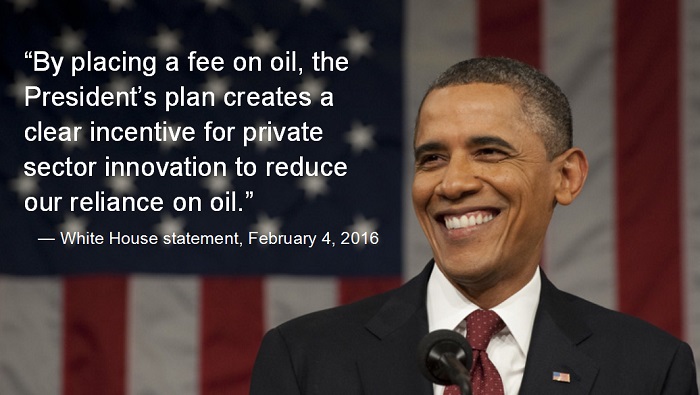
“President Obama kicked off a crucial conversation about the pricing of fossil fuels yesterday when he proposed a $10 per barrel oil tax. The president’s logic is compelling: today’s low oil prices provide a low-pain opportunity to begin building in some of the much higher real cost of burning petroleum.

“We and many others have proposed a modest oil tax as a good start toward an economy-wide carbon tax. Ten dollars per barrel (which translates to about 25 cents per gallon of gasoline) won’t cover the vast climate, health and traffic congestion costs of oil consumption, but it is a bold step in the direction of climate-friendly transportation and sound energy policy.

“While Obama’s proposed oil tax faces formidable obstacles in the Republican-controlled Congress, the public strongly supports public transportation infrastructure spending. Congress has failed to raise the 18 cents per gallon gasoline tax since 1993 (thus shifting the burden away from the heaviest users of our highways to taxpayers), and revenue now falls far short of its dedicated purpose of funding highways. We desperately need to update and transform our transportation infrastructure to meet the nation’s needs in a low-carbon future.

“We strongly urge members of Congress to approve President Obama’s modest and sensible request. A $10 per barrel oil tax is a positive step to putting the country on a path to a sustainable and prosperous future.”

###

The Carbon Tax Center launched in January 2007 to give voice to Americans who believe that taxing emissions of carbon dioxide and other greenhouse gases is imperative to combat global warming. CTC is a clearinghouse for research, analysis and advocacy to establish a carbon tax as the centerpiece of U.S. policy to combat catastrophic climate change. It has been the leading NGO advocating for carbon taxing as the key to unlocking low- and non-carbon investment and innovation to drive the global energy system away from fossil fuels to renewable wind, sunlight and efficiency.

“Clean Fuels” vs. Carbon Tax in the Pacific Northwest

Even in ecologically-minded Washington and Oregon, states where voters want government action on climate change, a divide among environmentalists threatens to undermine progress on the issue. A Carbon Washington ballot initiative to create a statewide carbon tax is gaining momentum, as we wrote last month. Yet several environmental groups are attacking the proposal as politically infeasible and socially regressive.

Instead, state and regional groups like Climate Solutions and the Alliance for Jobs and Clean Energy are pushing “clean” fuels standards. Their proposal, patterned on regulations in California and British Columbia, would mandate a mere 10% drop in the carbon intensity of transportation fuels over 10 years ― a small fraction of the deep reductions needed.

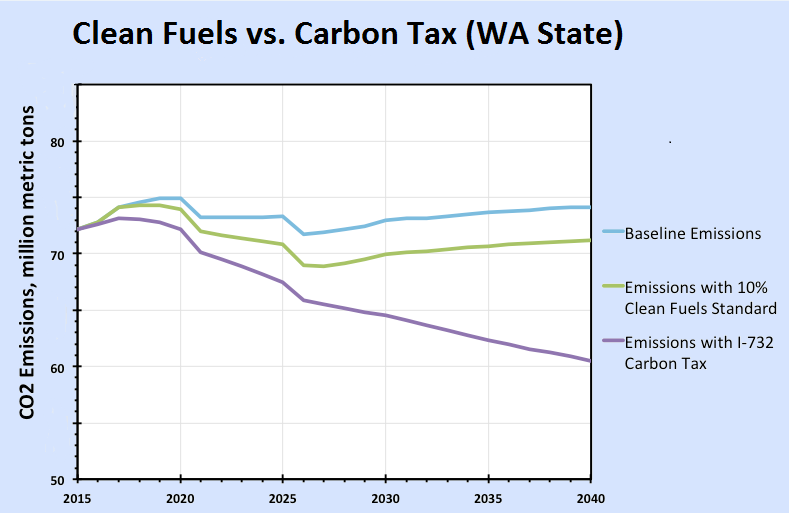
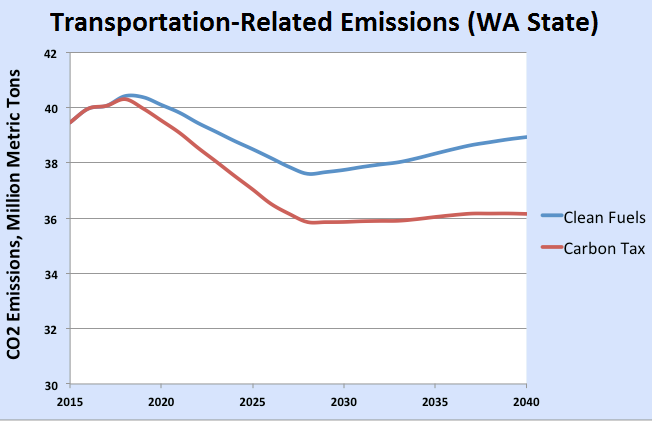
The carbon tax sought by Carbon Washington would cut emissions 4-5 times as much as the proposed WA Clean Fuels Standard (Source: CTAM).

The carbon tax sought by Carbon Washington would cut CO2 4-5 times as much as the proposed WA Clean Fuels Standard (Source: CTAM).

Their course is difficult to fathom. Carbon taxes would cut emissions more and cost less than clean fuels regulations. And dividing environmentalists in order to pursue a lesser policy makes no sense strategically. Here are three reasons why a clean fuels standard doesn’t stack up:

1. Clean fuels standards won’t be effective

A model used by the Washington State Department of Commerce allows us to compare projected emissions reductions from the clean fuels standard with the carbon tax proposed by Carbon Washington in a measure known as I-732. (The tax would start at $10/ton of CO2, rise to $25 in year two, then increase 3.5% annually plus inflation.)

The 10% clean fuels standard would lower overall Washington CO2 emissions only 4% by 2040, not even a quarter as much as the 18% reduction projected from the I-732 carbon tax.

The reason is simple: a clean fuels standard only attacks emissions from the supply side of one sector, albeit an important one, transportation. In contrast, a carbon tax works across the entire economy, influencing every carbon-related decision about both supply and demand in every sector ― manufacturing, heating, electricity, etc. This means that, while a clean fuels standard only affects the carbon content of liquid fuels, a carbon tax also incentivizes less fuel usage, period. This transforms economies, cutting pollution and congestion through a vast array of actions encompassing urban density, freight logistics, walking, cycling, transit, and more mindful decision making.

clean fuels transport graph _ snippedIn short, the difference in emissions between a carbon tax and a clean fuels standard is the difference between a society that takes current levels of automobile dependence as a given, and one that seeks to support a myriad of ways to transition to something different.

2. Clean fuels standards are more expensive

The Oregon Environmental Council writes:

The Clean Fuels Program costs the state virtually nothing. The burden of responsibility for reducing pollution is placed on the oil industry.

This conspicuously ignores how the oil industry passes down its costs of compliance to consumers in the form of higher prices. The Oregon Department of Environmental Quality (DEQ) has said gas prices will rise between 4 and 19 cents per gallon. An industry lobby group, the Western States Petroleum Association, is garnering support to repeal clean fuels by highlighting this not-so-hidden price increase.

Consumers aren’t stupid, they generally realize more regulations mean higher prices. A carbon tax raises fossil fuel prices too, of course ― that’s the point; but the revenue it generates can be disbursed to consumers as income or sales tax cuts, or via a straight-up “dividend” check, as Oregon Climate has proposed. [Read more…]

Recommended Policy Journals and Papers

Economists

This is one of half-a-dozen pages compiling expressions of support for carbon taxes (or more targeted taxes, e.g., on gasoline) by notable individuals and organizations. To access other pages with different supporter categories, click on the Progress link on the navigation bar and move to the desired category.

Economists comprise the most vocal — even vociferous — community of carbon-tax supporters. This is unsurprising, insofar as “one of the first principles of economics — perhaps the most important — is that people respond to incentives,” and a carbon tax is the embodiment of incentives, provided its level is sufficiently robust.

The quote above is taken from Harvard economics professor Greg Mankiw, whom we designate below as one of the two most persistent and persuasive pro-carbon-tax economists. The other is Cornell economics professor Robert H. Frank.

We begin by referencing the 68-page Report of the High-Level Commission on Carbon Prices composed by a 13-member council of luminaries supported by the Carbon Pricing Leadership Coalition and published in May 2017 by the World Bank.

A strong carbon price is essential to meeting the goals of the Paris Climate Agreement, according to this new (2017) report.

The 13-member council was chaired by Nobel Laureate Joseph Stiglitz (U.S.) and Lord Nicholas Stern (U.K.) and was drawn from seven other countries as well: Brazil, France, China, India, Indonesia, Mali and South Africa.

The report “identif[ied] the range of carbon prices that, together with other supportive policies, would deliver on the Paris climate targets agreed by nearly 200 countries in December 2015,” according to the council’s press release, which was issued under the title, Leading Economists: A Strong Carbon Price Needed to Drive Large-Scale Climate Action. It found that “meeting the world’s agreed climate goals in the most cost-effective way while fostering growth requires countries to set a strong carbon price, with the goal of reaching $40-$80 per metric ton of CO2 by 2020 and $50-100 per metric ton by 2030.”

The report stated that “a well-designed carbon price is an indispensable part of a strategy for efficiently reducing greenhouse gas emissions while also fostering growth [and] that a strong and predictable carbon-price trajectory provides a powerful signal to individuals and firms that the future is low carbon, inducing the changes needed in global investment, production, and consumption patterns.”

“Specific carbon price levels will need to be tailored to country conditions and policy choices,” said Commission member, Professor Harald Winkler of the University of Cape Town, South Africa. “Carbon pricing makes sense in all countries, but low-income countries, which may be more challenged to protect the people vulnerable to the initial economic impacts, may decide to start pricing carbon at a lower level and gradually increase over time.”

Other broad expressions of economists’ support for carbon taxing

In an April 1, 2012 column in The New York Times, Prof. Richard H. Thaler of the U-Chicago Booth School of Business aptly summed up the near-unanimity among economists that carbon taxing is the optimal way to reduce CO2 emissions: “Consider a recent poll of a panel of economists conducted by the University of Chicago Booth School of Business, where I teach… [Forty-one] economists in [a poll conducted by the] University of Chicago … were asked whether they agreed with this statement: ‘A tax on the carbon content of fuels would be a less expensive way to reduce carbon-dioxide emissions than would a collection of policies such as ‘corporate average fuel economy’ requirements for automobiles.’ On this question, there was just a single negative vote.” (Why Gas Prices Are Out of Any President’s Control).

In 2011, The Economist asked, Do All Economists Favour a Carbon Tax?

Carbon emissions represent a negative externality. When an individual takes an economic action with some fossil-fuel energy content—whether running a petrol-powered lawnmower, turning on a light, or buying bunch of grapes—that person balances their personal benefits against the costs of the action. The cost to them of the climate change resulting from the carbon content of that decisions, however, is effectively zero and is rationally ignored. The decision to ignore carbon content, when aggregated over the whole of humanity, generates huge carbon dioxide emissions and rising global temperatures.

The economic solution is to tax the externality so that the social cost of carbon is reflected in the individual consumer’s decision. The carbon tax is an elegant solution to a complicated problem, which allows the everyday business of consumer decision making to do the work of emission reduction. It’s by no means the only economically sensible policy response to the threat of climate change, but it is the one we’d expect economists to embrace.

Economists overwhelmingly support a well-designed national carbon tax. In 2012, a University of Chicago survey asked 40 prominent economists from across the political spectrum whether they would prefer the government to raise revenue through traditional income taxes or via a national carbon tax. Not one chose the income tax approach.

Finally, we have: A majority of economists polled by the Wall Street Journal during Feb. 2-7, 2007:

The government should encourage development of alternatives to fossil fuels, economists said in a WSJ.com survey. But most say the best way to do that isn’t in President Bush’s energy proposals: a new tax on fossil fuels. Forty of 47 economists who answered the question said the government should help champion alternative fuels. “Economists generally are in favor of free-market solutions, but there are times when you need to intervene,” said David Wyss at Standard & Poor’s Corp. “We’re already in the danger zone” because of the outlook for oil supplies and concerns about climate change, he said. A majority of the economists said a tax on fossil fuels would be the most economically sound way to encourage alternatives. A tax would raise the price of fossil fuels and make alternatives, which today often are more costly to produce, more competitive in the consumer market. “A tax puts pressure on the market, rather than forcing an artificial solution on it,” said Mr. Wyss. (WSJ, Is It Time for a New Tax on Energy?, Feb. 8, 2007; the foregoing text is lifted directly from the article.)

Two standout pro-carbon-tax economists: Greg Mankiw and Bob Frank

Two Ivy League university economics professors occupying somewhat opposing positions on the usual left-right spectrum are arguably their profession’s most ubiquitous advocates for taxing carbon emissions.

Gregory Mankiw (Harvard), a proud centrist (or right-of-centrist), is a distinguished pedagogue and political adviser. He chaired President George W. Bush’s Council of Economic Advisers (2003-2005) and was senior economic advisor to the 2012 Romney for President campaign.

Robert H. Frank (Cornell), author of The Winner-Take-All Society and The Darwin Economy, and, in 2020, Under the Influence: Putting Peer Pressure to Work ranks with Mankiw in his unceasing and imaginative advocacy of carbon and other “Pigovian” taxes. He also carries on Thorstein Veblen’s critique of “conspicuous consumption,” framing it as an argument for sharply higher taxes on wealth.

Mankiw

In a Sept 2020 column in the NY Times Sunday business section, Pay People to Get Vaccinated, Mankiw used carbon taxing as a template to support the proposal by Brookings Institution economist Bob Litan for the U.S. government to achieve high Coronavirus vaccination rates by paying Americans to take a prospective vaccine. Mankiw wrote:

Immunology, meet economics. One of the first principles of economics — perhaps the most important — is that people respond to incentives. Applying this principle to the case at hand, Mr. Litan recommends that the government pay $1,000 to whoever gets the vaccine. With a large enough incentive, most Americans are likely to get vaccinated.

This proposal is textbook economics. (I’ve written some of the textbooks.) As all economics students learn, when an activity has a side effect on bystanders, that effect is called an externality. In the presence of externalities, the famous theorems of economics that justify laissez-faire do not apply. Adam Smith’s vaunted invisible hand can no longer work its magic.

A classic example of a negative externality is pollution, and the simplest and least invasive policy solution is a tax on emissions. In economics-speak, such a tax internalizes the externality: It induces polluters to take the cost of pollution into account by giving them a financial incentive to cut emissions. That’s why I have written here many times that a tax on carbon emissions is the best way to deal with global climate change.

Vaccination confers a positive externality. When you get vaccinated, you benefit not only yourself but also your fellow citizens by helping society take a step toward herd immunity. In this case, internalizing the externality requires not a tax but a subsidy, as Mr. Litan suggests.

(emphases added)

In 2019, announcing his switch of party affiliation from Republican to independent in The New York Times (‘Republican Economist’ Sheds a Party Label, Nov. 17, 2019 print edition), Mankiw spelled out what he wanted in political candidates’ platforms:

A Market-Based Approach to Climate Change: The consensus of scientists is that climate change is a serious threat. We need to respond but in a way that avoids rigid government regulation. The solution is a carbon tax, with all revenue rebated as carbon dividends. Putting a price on carbon would give everyone an incentive to reduce their carbon footprint.

In late 2012, Mankiw wrote in a NY Times op-ed, Wishful Thinking and Middle-Class Taxes (Dec. 29, 2012):

Ultimately, unless we scale back entitlement programs far more than anyone in Washington is now seriously considering, we will have no choice but to increase taxes on a vast majority of Americans. This could involve higher tax rates or an elimination of popular deductions. Or it could mean an entirely new tax, such as a value-added tax or a carbon tax. (emphasis added)

While that was only a mild endorsement of a carbon tax, the timing was noteworthy, coming in the late stages of the “fiscal cliff” negotiations and less than two months after Romney’s defeat in an election campaign in which he had belittled concerns over climate disruption.

Years earlier, Mankiw powerfully made the case for a carbon tax in an op-ed, One Answer to Global Warming, in the Sept. 16, 2007 NY Times Sunday Business Section (see our blog for excerpts and discussion). His 2006 Wall Street Journal op-ed pieces (Jan. 3 and Oct. 20) are among the many lively pieces available on Mankiw’s pro-fuel-tax blog, The Pigou Club Manifesto. (Economist Arthur Pigou, 1877-1959, developed the concept of economic externalities along with corrective “Pigovian” taxes.) On the last day of 2006 Mankiw reiterated his 2006 New Year’s Resolutions from his Jan. 3, 2006 WSJ piece, including:

I will tell the American people that a higher tax on gasoline is better at encouraging conservation than are heavy-handed CAFE regulations. It would not only encourage people to buy more fuel-efficient cars, but it would encourage them to drive less, such as by living closer to where they work. I will tell people that tolls are a good way to reduce traffic congestion — and with new technologies they are getting easier to collect. I will advocate a carbon tax as the best way to control global warming.

In a Sept. 16, 2006 post to his blog, Rogoff Joins the Pigou Club, Mankiw listed some three dozen other economists and pundits who have publicly advocated higher Pigovian taxes, such as gasoline taxes or carbon taxes. The list includes, in addition to several individuals mentioned here, such notables from economics, finance and journalism as Alan Greenspan, Gary Becker, William Nordhaus, Richard Posner, Anthony Lake, Martin Feldstein, Gregg Easterbrook and Lawrence Summers. (Links are included.)

In a June 1, 2008 NY Times column, The Problem With the Corporate Tax, Mankiw wrote:

I have a back-up plan for [Sen. McCain]: increase the gasoline tax. With Americans consuming about 140 billion gallons of gasoline a year, a gas-tax increase of about 40 cents a gallon could fund a corporate rate cut, fostering economic growth and reducing a variety of driving-related problems. Indeed, if we increased the tax on gasoline to the level that many experts consider optimal, we could raise enough revenue to eliminate the corporate income tax. And the price at the pump would still be far lower in the United States than in much of Europe.

In early 2012, Mankiw wrote in his NY Times column, A Better Tax System (Instructions Included):

Tax Bads Rather Than Goods: A good rule of thumb is that when you tax something, you get less of it. That means that taxes on hard work, saving and entrepreneurial risk-taking impede these fundamental drivers of economic growth. The alternative is to tax those things we would like to get less of. Consider the tax on gasoline. Driving your car is associated with various adverse side effects, which economists call externalities. These include traffic congestion, accidents, local pollution and global climate change. If the tax on gasoline were higher, people would alter their behavior to drive less. They would be more likely to take public transportation, use car pools or live closer to work. The incentives they face when deciding how much to drive would more closely match the true social costs and benefits. Economists who have added up all the externalities associated with driving conclude that a tax exceeding $2 a gallon makes sense. That would provide substantial revenue that could be used to reduce other taxes. By taxing bad things more, we could tax good things less. (Jan. 22, 2012)

Frank

We present this sampling from Prof. Frank’s columns in the NY Times Sunday business section:

Reducing CO2 emissions would actually be surprisingly easy. The most effective remedy would be a carbon tax, which would raise the after-tax price of goods in rough proportion to the size of their carbon footprint. Gasoline would become more expensive, piano lessons would not. The functional equivalent of that — a cap-and-trade system — worked spectacularly well when Congress required marketable permits for discharging sulfur dioxide (SO2) in 1995. Acid rain caused by SO2 emissions quickly plummeted, at about one-sixth the cost predicted. Once people have to pay for their emissions, they find ingenious ways of reducing them. (Shattering Myths to Help the Climate, Aug. 2, 2014)

Although an effective solution will take global coordination, America’s inaction has been a major barrier to progress. If the United States and Europe each adopted a steep carbon tax, they could elicit broader cooperation through heavy tariffs on goods produced in countries that failed to do likewise. India and China need access to our markets, giving us enormous leverage. (Shattering Myths to Help the Climate, Aug. 2, 2014)

NO one enjoys paying taxes — and no politician relishes raising them. Yet some taxes actually make us better off, even apart from the revenue they provide for public services. Taxes on activities with harmful side effects are a case in point. (Heads, You Win. Tails, You Win, Too., Jan. 5, 2013)

[W]e could insulate ourselves from catastrophic [climate] risk at relatively modest cost by enacting a steep carbon tax. Early studies by the Intergovernmental Panel on Climate Change estimated that a carbon tax of up to $80 per metric ton of emissions — a tax that might raise gasoline prices by 70 cents a gallon— would eventually result in climate stability. But because recent estimates about global warming have become more pessimistic, stabilization may require a much higher tax. How hard would it be to live with a tax of, say, $300 a ton? If such a tax were phased in, the prices of goods would rise gradually in proportion to the amount of carbon dioxide their production or use entailed. The price of gasoline, for example, would slowly rise by somewhat less than $3 a gallon. Motorists in many countries already pay that much more than Americans do, and they seem to have adapted by driving substantially more efficient vehicles. (Carbon Tax Silence, Overtaken by Events, Aug. 25, 2012)

Taxes are … a far cheaper and less coercive way to curtail [harmful] behavior than laws or prescriptive regulations. That’s because taxes concentrate harm reduction in the hands of those who can alter their behavior most easily. When we tax pollution, for instance, polluters with the cheapest ways to reduce emissions rush to adopt them, thereby avoiding the tax… Every dollar raised by taxing harmful activities is one dollar less that we must raise by taxing useful ones. The resulting revenue would enable us to reduce not only the federal deficit, but also the highly regressive payroll tax. And cutting that tax would stimulate hiring and help low-income families meet the burden of new taxes on harmful activities. (Find the Taxes That Do Double Duty, Feb. 18, 2011)

In 2012, Frank used the Obama-Romney presidential race to argue for both carbon emissions pricing and congestion pricing as ways to improve economic efficiency and well-being by taxing the externalities of carbon pollution traffic and traffic congestion. In Nation’s Choices Needn’t Be Painful (Sept 22, 2012), Frank pushed back against the then-prevailing view that “the nation face[d] difficult economic choices:

Consider highway congestion. Because drivers can generally enter a congested highway without charge, they often do so — thus adding to the crowding. But many drivers would willingly pay a fee for using that road if it resulted in fewer delays. A modest congestion fee, administered with E-ZPass-style technology, would raise needed revenue and provide an incentive to use crowded roads only when the benefits outweigh the social costs.

Critics object that such fees would harm low-income households. But because the gains far exceed their price, we can redistribute them so that everyone comes out ahead. Some of the new revenue, for example, could support tax relief for low-income households.

Similar spillover effects pervade the economy. People have little incentive to consider the danger of carbon emissions, for example, or the risks that the heavy vehicles they drive are posing to others. Taxing carbon emissions and taxing vehicles by weight would expand the economic pie by curtailing activities that do more harm than good. And because some of the resulting revenue could help low-income families, these taxes, too, needn’t be painful.

In the same 2012 op-ed, Frank ingeniously  parried the concern over raising taxes, even through externality pricing, at a time of economic stagnation:

Approving [externality taxes] now and scheduling them for phase-in only after the economy rebounds would serve two objectives. First, anxious credit markets would be reassured about the nation’s capacity to pay down government debt. And second, the delayed new taxes would speed the recovery by encouraging immediate increases in private spending.

With a carbon tax on the horizon, businesses would rush to develop technologies for adapting to higher energy prices. And consumers would accelerate major purchases to escape the looming consumption tax. The economy would get just the infusion of spending it needs — without the government’s having to spend a penny.

More recently, in August 2020, Frank took dead aim at “the fear that emissions would fall too slowly in response to a carbon tax” in another Times Sunday business column, Behavioral Contagion Could Spread the Benefits of a Carbon Tax:

[C]ritics are correct that a carbon tax alone won’t parry the climate threat. It is also true that as creatures of habit, humans tend to change their behavior only slowly, even in the face of significant financial incentives. But even small changes in behavior are greatly amplified by behavioral contagion — the social scientist’s term for how ideas and behaviors spread from person to person like infectious diseases. And if a carbon tax were to shift the behavior of some individuals now, those changes would quickly spread more widely.

Frank invoked social science data on cigarette smoking (and avoidance), homeowners’ installation of solar-photovoltaic panels, and, in this passage, meat eating (and avoidance), to argue that taxes on carbon emissions will reverberate more powerfully than is generally assumed:

Behavioral contagion also has been shown to influence dietary choices. People often eat meat because they grew up with, and continue to live among, people for whom substantial meat consumption is the norm. Because meat has a large carbon footprint, a carbon tax would make it more expensive relative to plant-based foods.

The direct effect of this price change would be small. But as some people shifted the composition of their diets, others would find it easier to shift as well. In short order, these positive-feedback effects would produce more widespread shifts in eating habits. Behavioral contagion would similarly amplify initial responses to a carbon tax in virtually every other energy-intensive activity. (emphases added)

Behavioral contagion is the primary subject of Frank’s latest (2020) book, Under the Influence: Putting Peer Pressure to Work. From the publisher’s blurb:

Under the Influence explains how to unlock the latent power of social context. It reveals how our environments encourage smoking, bullying, tax cheating, sexual predation, problem drinking, and wasteful energy use. We are building bigger houses, driving heavier cars, and engaging in a host of other activities that threaten the planet—mainly because that’s what friends and neighbors do.

Frank describes how the strongest predictor of our willingness to support climate-friendly policies, install solar panels, or buy an electric car is the number of people we know who have already done so. In the face of stakes that could not be higher, the book explains how we could redirect trillions of dollars annually in support of carbon-free energy sources, all without requiring painful sacrifices from anyone.

Other economists, listed alphabetically

Alan Blinder, Federal Reserve vice-chairman 1994-1996 and Princeton Professor of Economics and Public Affairs.  In “The Carbon Tax Miracle Cure,” Blinder suggested on the editorial page of the Wall Street Journal (Jan. 31, 2011):

[A] carbon tax… should be enacted now [but] set at zero for 2011 and 2012. After that, it would ramp up gradually… What’s critical is that we lock in higher future costs of carbon today.

Once America’s entrepreneurs and corporate executives see lucrative opportunities from carbon-saving devices and technologies, they will start investing right away—and in ways that make the most economic sense… I can hardly wait to witness the outpouring of ideas it would unleash. The next Steve Jobs, Bill Gates and Mark Zuckerberg are waiting in the wings to make themselves rich by helping the environment.  Jobs follow investment, and we need jobs now.

Blinder recommends using carbon tax revenue to reduce the deficit and underscores the advantages of a carbon tax over other deficit reduction strategies:

[E]very realistic observer knows that closing our humongous federal budget deficit will require a mix of higher taxes and lower spending as shares of GDP. Forget about value-added taxes and other new levies you may have heard about. A CO2 tax trumps them all… reducing our trade deficit, making our economy more efficient, ameliorating global warming, and showing the world that American capitalism has not lost its edge.

Tyler Cowen, economics professor at George Mason University. Cowen also directs the Mercatus Center, “which studies how societies become and stay prosperous, and is coauthor of the blog Marginal Revolution.”

Phase out all forms of capital income taxation, including the corporate income tax, and replace them with a carbon tax, including a gasoline tax. “Savings and investment boost economic growth, but when it comes to energy, global warming threatens as a major problem and our dependence on Middle Eastern oil damages our foreign policy.  (Cowen’s “Economic Idea #4 that voters need to hear”; from Economic Ideas for Republicans, U.S. News & World Report, Oct. 18, 2006; however, that link was inactive as of August 2014.)

Herman E. Daly, professor in the School of Public Policy at the University of Maryland, foremost U.S. ecological economist, author of Ecological Economics, Steady-State Economics, Valuing The Earth, among other works:

Is it hard to come up with a reasonable [climate] policy? Not really — a stiff severance tax on carbon, levied at the well head, mine mouth, or port of entry, would go a long way by both reducing carbon use and giving an incentive for developing alternative carbon-free technologies. Yes, but how do we know what is the optimal tax rate, and wouldn’t it be regressive, etc.? … [T]ax the resource throughput (that to which value is added) and stop taxing value added. Tax bads (depletion and pollution), not goods (income). Does anyone imagine that we tax income at the optimal rate? Better first to tax the right thing and later worry about the “optimal” rate of taxation, compensation for regressivity, etc. People don’t like to see the value added by their own efforts taxed away, even though we accept it as necessary up to a point. But most people don’t mind seeing resource rents, value that no one added, taxed away. And the most important public good served by the carbon tax would be climate stability, brought about by the consequent reduction in use of carbon fuels and the incentive to invent less carbon-intensive energy sources. And much of the revenue from the carbon severance tax could be rebated to the public by abolishing other taxes, especially regressive ones. Climate Change: From ‘Know How’ to ‘Do Now’, Grist, Aug. 14, 2007.

Gilbert Metcalf, Tufts University economist, was appointed in March 2011 by President Obama to head the energy office at the Treasury Department. Metcalf is a prominent and effective advocate of revenue-neutral carbon taxes. In August of 2007, the World Resources Institute and the Brookings Institution jointly published a policy brief by Prof. Metcalf, outlining a national carbon tax paired with a partial refund of the payroll tax. The brief assesses the expected emissions reductions from a tax starting at $15 per metric ton of carbon dioxide whose revenue would be used to rebate the federal payroll tax on the first $3,660 of earnings per worker. This tax swap is both revenue-neutral and distributionally neutral. (Video of Prof. Metcalf’s 2008 presentation.)

With Prof. David Weisbach (Univ. of Chicago Law School), Prof. Metcalf authored “The  Design of a Carbon Tax”  (Harvard Environmental Law Review, 2009) addressing carbon tax design issues: the tax rate (including distributional issues, the use of the revenues, and tax rate changes), the tax base, and international trade concerns.

Paul Portney, Dean, Eller College of Management, Univ. of Arizona (and president, Resources for the Future, 1995-2005):

[W]e’re nuts not to have instituted gradually increasing controls on CO2 and other greenhouse gases. The worst-case scenario, especially for future generations, is too scary not to be taking some preventative measures now. A carbon tax is obviously the best way to deal with this problem. It would raise revenues the government will badly need to pay for Social Security and Medicare as old fogies like me begin to retire, as well as create incentives for energy conservation, emissions reductions, and clean technology innovation. (What Are the Biggest Environmental Challenges Facing the United States?, RFF Weekly Policy Commentary, Sept. 10, 2007)

Robert Reich, Professor of Public Policy at the Goldman School of Public Policy at the University of California at Berkeley, former Secretary of Labor and co-founder of The American Prospect :

What’s needed is a carbon tax — a tax on all fossil-based fuels that reflects their true social, political, and environmental costs. That should remain the goal, but as a practical matter it’s not going to happen any time soon. Republicans won’t enact a tax hike for any purpose. And right now congressional Democrats don’t have the intestinal fortitude, or the votes, to enact it on their own. (American Prospect Online Edition, Inherit the Windfall Feb. 7, 2007)

Economist Jeffrey Sachs, director of the Earth Institute at Columbia University:

The changeover to a sustainable energy system will take decades and will require carbon taxes and emission permits to create market-based incentives for companies and individuals to switch to new kinds of electrical power plants, new kinds of automobiles and ‘green buildings.’ (Miami Herald, We Must Reverse Global Warming, Feb. 23, 2007)

The world’s producers and consumers currently regard the air as a free dumping ground for carbon dioxide and other climate-changing greenhouse gases. We need to correct market forces—for example, by taxing carbon emissions that are offset by tax reductions elsewhere—in order to create the right incentives. (Time Magazine, March 24, 2008; direct link unavailable, but full text was published later that year in Petroleum World).

[T]here is a much better strategy than tradable [emission] permits. Each region of the world should introduce a tax on CO2 emissions that starts low today and increases gradually and predictably in the future. Part of the tax revenue should be channeled into subsidies for new low-carbon energy sources like wind and solar, and to cover the costs of developing CCS (Carbon Capture & Sequestration). These subsidies could start fairly high and decline gradually over time, as the tax on CO2 emissions rises and the costs of new energy technologies fall with more experience and innovation. With a long-term and predictable carbon tax and subsidy system, the world would move systematically toward low-carbon energy, greater energy efficiency, and CCS. (Economy Watch, Towards A Global Carbon Tax – A Better Way To Fight Climate Change?, March 4, 2013).

Robert J. Shapiro, former Undersecretary of Commerce for Economic Affairs

Mr. Shapiro, Commerce Undersecretary in the Clinton Administration, authored the American Consumer Institute’s Feb. 2007 report, Addressing the Risks of Climate Change: The Environmental Effectiveness and Economic Efficiency of Emissions Caps and Tradable Permits, Compared to Carbon Taxes. From the Executive Summary:

Carbon taxes would be a better response to the risks of global warming than emissions caps and tradable permits (commonly referred to as cap-and-trade)… [Carbon taxes] are much less vulnerable to evasion and market manipulation, providing a more stable and transparent system for consumers and industry alike. [Carbon taxes] do not create the price volatility and administrative problems associated with cap and trade.

In a June 2008 follow-on study, Addressing Climate Change Without Impairing the U.S. Economy: The Economics and Environmental Science of Combining a Carbon-Based Tax and Tax Relief, Shapiro calls for a federal carbon tax starting at $14 per metric ton of CO2 in 2010 and rising steadily to $50 in 2030 (equivalent to $82 with inflation). Shapiro concludes that the nearly revenue-neutral carbon tax would reduce CO2 emissions by 30% below non-taxed levels while shaving only eight-tenths of one percent off future (2030) GDP. The report was published by the U.S. Climate Task Force, a project of Shapiro’s Sonecon economic advisory company.

Joseph E. Stiglitz, Nobel laureate in economics and University Professor at Columbia University; formerly Chairman of President Bill Clinton’s Council of Economic Advisers and Senior Vice President and Chief Economist of the World Bank:

Not paying the cost of damage to the environment is a subsidy, just as not paying the full costs of workers would be… American firms are being subsidized—and massively so. There is a simple remedy: other countries should prohibit the importation of American goods produced using energy intensive technologies, or, at the very least, impose a high tax on them, to offset the subsidy that those goods currently are receiving. (A New Agenda for Global Warming, Economists’ Voice, July 2006)

Economic efficiency requires that those who generate emissions pay the cost, and the simplest way of forcing them to do so is through a carbon tax. There could be an international agreement that every country would impose a carbon tax at an agreed rate (reflecting the global social cost). Indeed, it makes far more sense to tax bad things, like pollution, than to tax good things like work and savings. Such a tax would increase global efficiency. Of course, polluting industries like the cap-and-trade system. While it provides them an incentive not to pollute, emission allowances offset much of what they would have to pay under a tax system. Some firms can even make money off the deal. Moreover, Europe has grown used to the concept of cap-and-trade, and many are loathe to try an alternative. Yet, no one has proposed an acceptable set of principles for assigning emission rights. (Showdown in Bali, Project Syndicate, Dec. 2007)

More recently, Stiglitz has decried the stalled UN climate negotiations as a “charade.”  Stigliz feels that the 2 decade-long attempt to allocate responsibility for reducing emissions among nations is doomed; he instead urges negotiators to shift to a price-based negotiation to set a global carbon tax:

Stiglitz’s plan is to set a single, global price for carbon dioxide, the most important greenhouse gas. The idea is to make it so expensive to use carbon that consumers and businesses voluntarily use less of it. Countries could raise the price of carbon either with a tax or with a domestic cap-and-trade system, Stiglitz says. In his vision, if a country didn’t set its carbon price high enough, hoping to gain a pricing advantage, other countries would be allowed to charge tariffs on its exports. He would throw in a green fund to compensate hard-hit poor countries. (Stiglitz Calls Climate Talks a ‘Charade,’ Pushes Plan C, Bloomberg, 7/10/15)

Lawrence Summers, Charles W. Eliot university professor (and former president), Harvard University (and Former Treasury Secretary):

[T]he U.S. must engage in an energy efficiency program that takes effect without delay and has meaningful bite. As long as developing countries can point to the U.S. as a free rider there will not be serious dialogue about what they are willing to do. I prefer carbon and/or gasoline tax measures to permit systems or heavy regulatory approaches because the latter are more likely to be economically inefficient and to be regressive.” (Financial Times, Practical Steps to Climate Control, May 28, 2007)

Paul Volcker, chairman of the U.S. Federal Reserve, 1979-1987: See discussion on our “Public Officials” page.

Janet Yellen, co-chair, G30 Working Group on Climate Change and Finance; chairman of the U.S. Federal Reserve, 2014-2018, vice-chair, 2010-2014:

Carbon pricing is key. All firms across our economy need to pay the price of polluting the planet. It will certainly affect the economics of fracking and coal — the idea is to drive that stuff out of business over time. Maybe it doesn’t sound pleasant to say, but that’s what has to happen. (The 39 Things Biden Should Do First on Climate Change, Bloomberg Green, Nov. 11, 2020)

Gary Yohe, IPCC “Fourth Assessment” chapter editor and Professor of Economics at Wesleyan University. Prof. Yohe presented on the economic rationale for carbon pricing at the Wesleyan “Pricing Carbon” Conference in Nov. 2010, and was profiled on this point in Yale 360 in Dec. 2008.

Regional Differences

Some members of Congress have voiced concern that measures to impose a price on carbon emissions will disproportionately burden energy users in their district or state. “We’re looking for some type of regional equity in whatever they propose,” said Rep. Marcy Kaptur (D-OH) during Energy and Commerce Committee deliberations over the Waxman-Markey climate bill, as reported in  the New York Times on May 8, 2009. At a Senate Finance Committee hearing on proposed cap-and-trade legislation, Senator Orrin Hatch (R-UT) complained that a $50/ton CO2 price would increase electric rates by 70% in his state, which relies heavily on coal for electricity.

Screen Shot 2016-07-01 at 3.52.03 PM

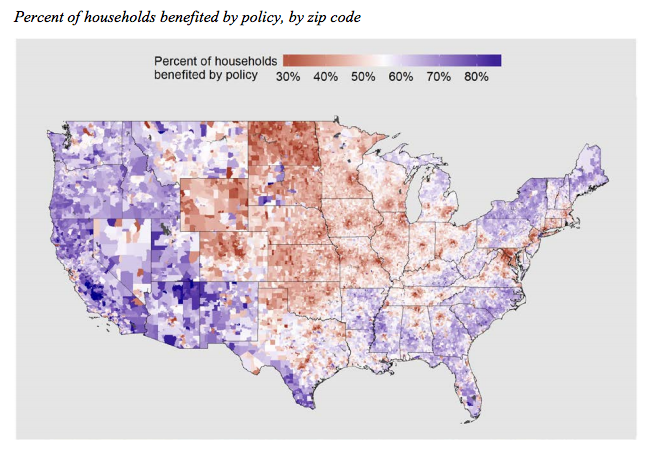
Effects of a simulated ‘carbon fee-and-dividend’ system.

The root of the issue is variations in regional fuel mix, compounded in some instances by variations in levels of energy use. Electricity rates in the Pacific Northwest, which is generously endowed with hydro-electric power, should scarcely be affected by carbon emissions pricing  through either a tax or cap-and-trade system. In contrast, the Plains states, which primarily employ coal for electricity generation, and the Northeastern states, which rely heavily on fuel oil for heating, could face disproportionate impacts. In addition, people in rural areas tend to drive longer distances than city-dwellers, so their transportation costs would be expected to rise more.

Are these regional differences significant? What if any steps should be taken to address them in designing a carbon tax and the accompanying revenue-recycling measures?

A thorough analysis of these questions is “The Incidence of a U.S. Carbon Tax: A Lifetime and Regional Analysis” (January  2008). In this AEI working paper, economists Kevin A. Hassett, Aparna Mathur and Gilbert E. Metcalf estimated the incidence of a carbon tax of $15 per metric ton of CO2 imposed “upstream” on fuel producers and importers. They defined the direct component as the increased cost of gasoline, home heating and electricity. The indirect component is the increased cost of other goods, ranging from air travel to food purchases, resulting from the higher cost of fuel used in their provision. The two components are of similar magnitude, but the indirect component doesn’t vary much across the U.S., reflecting our national market for consumer products.

Hassett et al. chose the household as the unit of consumption and considered the lifetime incidence of the tax. Taking both direct and indirect impacts into account, Hassett et al. calculated that in 2003 the largest variation between regions was less than 0.37% of household income. (This was less than the maximum regional differences in the two other years chosen for the analysis — 0.42% in 1987, and 0.89% in 1997.) They concluded:

Carbon taxes are… thought to have uneven regional effects. We … find that the regional variation is at best modest. By 2003 variation across regions is sufficiently small that one could argue that a carbon tax is distributionally neutral across regions.

The U.S. Census Bureau reports that the median U.S. household income in 2006 was $48,201. Thus, the 0.37% difference represents a difference of just $178 per year between typical households in the most affected and the least affected regions. The average interregional difference is much less.

Nevertheless, aggregated over millions of households this difference could be significant, especially if, as we and some others urge, a carbon tax (or cap-and-trade system) quickly attains and surpasses the relatively modest carbon emissions price level assumed in the Hassett analysis.

More recently, in “The Incidence of U.S. Climate Policy: Alternative Uses of Revenues from a Cap-and-Trade Auction” (Resources for the Future, April 2009), Dallas Burtraw, Richard Sweeney, and Margaret Walls examined income and distributional effects (across eleven regions) of an emissions cap with auctioned permits that resulted in a price of $20/ton CO2. (The regional incidence of a carbon tax would mirror that created by pricing carbon emissions using a cap.) They considered distributional effects on an annual basis which tends to magnify disparate impacts between income groups (and may also magnify regional differences) in contrast to Hassett et al.’s lifetime incidence analysis which tends to minimize them.

Burtraw et al. found that “putting a price on CO2 emissions can distribute costs unevenly across income groups and regions, and that revenue allocation decisions can either temper or exacerbate these distributional effects.” They found that, compared to revenue recycling via reduced payroll tax rates, a direct “dividend” approach would result in slightly larger net regional differences, especially in the lowest income groups. Yet even those differences would amount to no more than 2% of total annual income, assuming the $20/ton CO2 price.

Disparate impacts on households across regions can be compounded by regional differences in impacts on energy-intensive industries and their workers. For example, while energy consumers in coal-mining states might be affected only slightly more than those in other states, workers who mine, process or transport coal would face far larger impacts as a carbon tax (or cap) shifted employment and investment from coal to low-carbon alternatives. The flip side, of course, is that the same carbon tax or cap would benefit workers in areas with abundant renewable resources. A state like Montana, with both coal and wind resources, might be a net employment gainer under a carbon tax as construction and operation of wind generation facilities increased; but its coal workers would still need transition assistance.

Policy Options

Prof. Metcalf suggests a way to mitigate distributional disparities: adjust the amounts of revenue recycled according to the average regional carbon tax burden. For instance, if households in the Pacific Northwest would indeed pay less in carbon taxes than the national average, individuals or households in that region would receive proportionately lesser payroll tax reductions or direct distributions of revenue. Households in the Plains states might receive a correspondingly greater share of the recycled revenue. In this way, a revenue-neutral carbon tax could be regional-neutral as well.

To address disparate impacts on energy-intensive industries, Congressman Larson’s proposal designates 1/12 total of initial carbon tax revenues to assist affected workers and industries. (This “transition assistance” would be phased out over a decade.) A different approach in cap-and-trade legislation introduced by Reps. Inslee and Doyle — granting free allowances to “energy-intensive, trade-exposed” industries — would appear to mute the very price signal that such industries require to reduce emissions.

Other regional and affected-industry adjustments — hopefully temporary — could be made under either a carbon tax or cap-and-trade. We believe that under an explicit carbon tax they would be far simpler, more transparent and less likely to undermine carbon reduction incentives.

A Contrasting Analysis

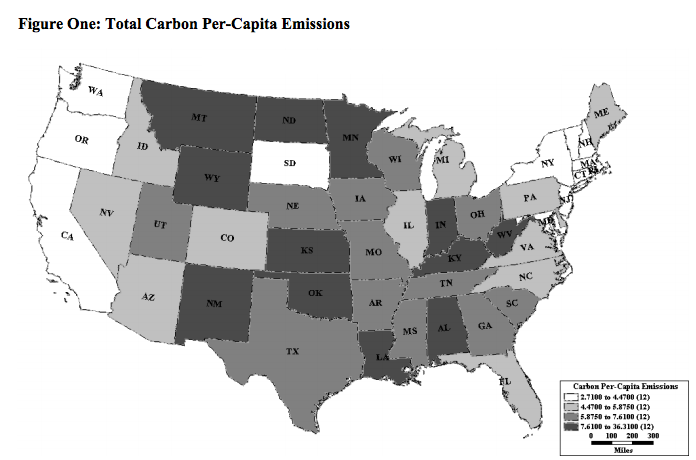
In May 2009, economists Michael Cragg (UCLA) and Matthew E. Kahn (The Brattle Group) published a fascinating analysis correlating county-level CO2 emissions with the political beliefs and climate-policy voting records of Members of Congresss. Their paper, Carbon Geography: The Political Economy of Congressional Support for Legislation Intended to Mitigate Greenhouse Gas Production, finds that:

[C]conservative, poor areas have higher per-capita carbon emissions than liberal, richer areas. Representatives from such areas are shown to have much lower probabilities of voting in favor of anti-carbon legislation. In the 111th Congress, the Energy and Commerce Committee consists of members who represent high carbon districts. These geographical facts suggest that the Obama Administration and the [Energy & Commerce] Committee will face distributional challenges in building a majority voting coalition in favor of internalizing the carbon externality.Screen Shot 2016-07-01 at 3.22.40 PM

The Cragg-Kahn analysis appears to have been prescient, with the Waxman-Markey bill laden with free allowances, “clean coal” RD&D funds, and other emoluments that won just enough support from Democrats representing high-carbon districts to win the bill’s passage in June 2009. However, unlike the AIF and RFF papers discussed above, the Cragg-Kahn paper is not an “incidence” analysis. This is because its unit of analysis (statistically, the “dependent variable”) was carbon emissions rather than carbon consumption.

Thus, the analysis assigned 100% of carbon emissions from power plants to the counties and districts where the plants are located, rather than allocating them to end-use customers — the households, offices and facilities that purchase the electricity and will pay the carbon tax or emission permit fees as they are passed through the supply chain. It therefore could not depict precisely how carbon emissions pricing will add differently to expenditures in one county or state versus another. Nevertheless, we commend the Cragg-Kahn paper as a provocative piece of political economy, along with John Kemp’s Reuters column, Carbon Geography of the United States, that brought the paper to our attention.

Another Thoughtful Analysis

A Nov. 3, 2009 post on The New Republic’s Vine blog, Cap and Trade Costs: Place Matters, featured a map that grouped U.S. metropolitan areas into quintiles according to the per-household cost impact of proposed cap-and-trade bills. The authors noted:

The household costs of cap-and-trade compliance … depend quite a bit on what metro you live in. Ranging above and below the average $160 cost to a household nationally in 2020, the average metro figures range from a high of $277 per household in Lexington, KY to a low of just $96 in Los Angeles. Low costs are registered all across the West’s metros and in Northeastern metros like New York, Boston, and Rochester. Much higher costs will be borne by households in metros all across the upper South and Ohio Valley—places like Cincinnati, and Indianapolis, and Nashville. So once again, as we keep saying: Place matters.

The map, credited to the Brookings Institution, is worth studying. Also worth pondering is the authors’ conclusion:

[R]egions that want to do well for their citizens might want to manage growth a little better, provide transportation options, and think about cleaning up their energy sourcing.

Last, a report published by Resources for the Future in October 2013, by Daniel F. Morris and Clayton Munnings, Designing a Fair Carbon Tax, argues that regional disparities in the incidence of a federal carbon tax may be less than commonly thought.

Ensuring equity

The essence of carbon taxes is to make fossil fuels more expensive. That will motivate electricity providers to decarbonize their fuel mix and incentivize businesses and households to become more energy-efficient. However, it will also add financial stress, particularly for lower-income families and coal-dependent areas, unless some of the revenues are directed to those groups and places.

It bears repeating that carbon taxes, to be fully effective, must rise quickly and high — to the point that they will raise large sums of revenue. But generating new government dollars isn’t their primary purpose; indeed, distributing revenues from carbon taxes as “carbon dividends” or using them to cut onerous taxes like payroll taxes in revenue-neutral “tax shifts or swaps,” has been built into many carbon tax proposals.

Rather, the intent of robustly taxing carbon emissions is to cut those emissions by making burning fossil fuels convincingly costlier than conservation, efficiency and renewable energy. Rather than needing more tax revenue to cut CO2 emissions, we need to shift more of the total tax burden onto dirty energy, without harming low- and middle-income families.

Different effects of carbon taxes across the income range point toward carbon dividends

Most middle- and low-income households spend a higher percentage of their income on gasoline, other fuels and electricity than do higher-income households. In 2019, for example, the wealthiest 20% U.S. households spent just 2% of their after-tax income on gasoline; the percentage for the lowest quintile, 8%, was four times as high. Clearly, imposing a gasoline tax or, by implication, a carbon tax, without tax-shifting or dividends will disproportionately burden lower-income families.

Over the past decade, the wealthiest U.S. household quintile has spent 3.3 times as much on gasoline as the poorest.

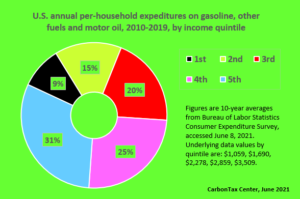
But expressing energy expenditures in absolute dollar terms is a different and arguably more meaningful measure. Averaged over the 10-year period 2010-2019, the top-echelon quintile spent an average of $3,509 on gasoline, or 3.3 times as much as the $1,059 spent by the poorest 20% of households. Put differently, when all household outlays for gasoline are apportioned among quintiles, the highest-earning quintile accounted for 31% of the total, while the lowest quintile contributed just 9%. (The middle quintile, true to its name, spent exactly 20% of total outlays — see chart.)

What’s true for gasoline applies to energy in general, as the Citizen’s Climate Lobby confirmed in a 2016 report analyzing the short-term financial impact of its fee and dividend idea set at a level of $15 per ton of carbon dioxide. The report painstakingly captures wide geographic variations in the carbon contents of fuels used to generate electricity, among other variables, giving it a finer grain than many previous analyses of carbon tax incidence. It found that households in the top quintile would pay an on average additional $319 per month, directly and indirectly, through higher fossil fuel prices associated with the carbon fee; that’s more than three times the additional $96 per month that households in the lowest quintile would pay. (The middle three quintiles would pay $116, $143, and $183, respectively.)

Although the lowest quintile would bear the greatest burden of the carbon fee as a percentage of household income, it would pay the least in absolute terms. This makes possible a “progressive” outcome through rebates such as CCL’s proposed dividends, or via appropriate tax-shifts. Significantly, the report found that 53% of households (58% of individuals) would receive more through monthly rebates than they would incur from the carbon tax. Even better, the majority of these benefits would be reaped by the most vulnerable, with nearly 90% of households below the poverty line benefiting in net terms from the carbon “fee and dividend” plan.  Monthly dividends, in other words, could ensure an equitable and progressive carbon tax.

The bulk of carbon taxes will be paid by families of above-average means

The upward skew in carbon use over the income range comes about because higher-income households don’t just drive more, they also fly more (burning jet fuel), they tend to own bigger (and sometimes multiple) houses to heat and cool, and they buy and use more products that require electricity or industrial fuels to manufacture, deliver and use. This means that the bulk of carbon taxes will be paid, directly or indirectly, by families of above-average means. For the gasoline part of carbon taxes, we estimate that around two-thirds will be paid by above-average-income households (calculated by summing: the first and second quintiles’ shares of gasoline expenditures in the pie chart above, plus half of the middle quintile’s share, yielding a total of 66%; data are from the Bureau of Labor Statistics’ Consumer Expenditure Survey, 2014).

Using carbon tax revenues to cut corporate taxes is problematic

Conservatives who support, or at least are willing to consider, taxing carbon emissions (yes, there are some) fall into two camps on revenue treatment: backing the carbon dividend plan proposed by the Climate Leadership Council (which in turn draws on the fee-and-dividend approach espoused by the Citizens Climate Lobby); or urging that the carbon revenues be applied to reduce the U.S. corporate income tax.

Expert analysis published several years ago by Resources for the Future (which we summarize and link to on our Tax Shifting page) suggested that using carbon tax revenue to reduce corporate income tax rates would benefit middle- and upper-income households but not lower-income families, relatively few of whom own stocks whose share values would rise as corporate tax rates were reduced. Political deals (sometimes dubbed “grand bargains”) to win Republican support for carbon taxes, such as the proposal by Democratic Senators Sheldon Whitehouse (RI) and Brian Schatz (HA) therefore risk alienating labor, low-income advocates and economic-justice activists, many of whom are already tepid at best about carbon tax legislation that doesn’t directly invest considerable carbon revenues in a “just transition.”

Earlier analyses of carbon tax incidence

In 2010, four leading economists released a report detailing the impacts on different income groups of various cap-and-trade carbon pricing proposals. The following is an excerpt from the abstract of Distributional Implications of Alternative U.S. Greenhouse Gas Control Measures by Sebastian Rausch, Gilbert E. Metcalf, John M. Reilly, and Sergey Paltsev, published by the MIT Joint Program on the Science and Policy of Climate Change:

[W]e find that carbon pricing by itself (ignoring the return of carbon revenues through allowance allocations) is proportional to modestly progressive. This striking result … stands in sharp contrast to previous work … The main reason is that lower income households derive a large fraction of income from government transfers and, reflecting the reality that these are generally indexed to inflation, we hold the transfers constant in real terms. As a result this source of income is unaffected by carbon pricing, while wage and capital income is affected.

As the authors suggest, their finding runs counter to conventional economic thinking that consumption taxes (including carbon taxes) are necessarily regressive when revenue treatment is ignored.

Last, a report published by Resources for the Future in October 2013, by Daniel F. Morris and Clayton Munnings, Designing a Fair Carbon Tax, provides a succinct guide to issues of fairness and efficiency in crafting a federal carbon tax.

Inter-Generational Issues

In 2016 the Citizens’ Climate Lobby commissioned a paper analyzing the effects on households of a $15/ton carbon “fee and dividend” plan in which the impacts of higher fossil fuel prices are at least somewhat offset by monthly “dividend” distributions. While the paper’s main thrust was the different impacts on rich, middle-class and poor households (summarized here), it also examined the financial effect by age group.

Percentage of Households Benefitted by Age Group

Percentage of Households Benefitted by Age Group

The CCL paper found that around 2/3 of very young and very old households – ages 18-35 and 80 and above – would experience a net benefit after the monthly dividend payments, compared to 44% of households aged 50-65. These findings reflect the fact that younger and elder households typically have smaller carbon footprints through lower levels of consumption, relative to households in the middle-age groups. Moreover, younger households tend to be relatively larger and thus would receive larger dividends, under the CCL plan.

In a similar vein, economists at the Washington, DC think-tank Resources for the Future considered the generational impacts of a $30/ton carbon tax in a 2013 paper, “Deficit Reduction and Carbon Taxes: Budgetary, Economic, and Distributional Impacts.” Writing at a time when so-called “deficit hawks” still held some sway in public discourse, they concluded that dedicating the carbon tax revenues to deficit reduction would offer particular benefits to the young by reducing tax burdens that might otherwise carry into the distant future.

On the other hand, asking today’s middle-aged and elder Americans to allow carbon tax revenues to be used to shrink the national debt risks compounding the difficulty of passing a carbon tax whose benefits already accrue largely to future generations. If the objective is to assemble a political majority that can pass a robust carbon tax, it may be best to leave deficit reduction off the table in favor of either tax-shifting or revenue return a la fee-and-dividend.

Regional Differences

Members of Congress repeatedly voice concern that measures to impose a price on carbon emissions will disproportionately burden energy users in their district or state. “We’re looking for some type of regional equity in whatever they propose,” said Rep. Marcy Kaptur (D-OH) during Energy and Commerce Committee deliberations over the Waxman-Markey climate bill, as reported in  the New York Times on May 8, 2009. At a Senate Finance Committee hearing on proposed cap-and-trade legislation, Senator Orrin Hatch (R-UT) complained that a $50/ton CO2 price would increase electric rates by 70% in his state, which relies heavily on coal for electricity.

Screen Shot 2016-07-01 at 3.52.03 PM

Effects of a simulated fee-and-dividend carbon price.

The root of the issue is variations in regional fuel mix, compounded in some instances by variations in levels of energy use. Electricity rates in the Pacific Northwest, which is generously endowed with hydro-electric power, should scarcely be affected by carbon emissions pricing  through either a tax or cap-and-trade system. In contrast, the Plains states, which primarily employ coal for electricity generation, and the Northeastern states, which rely heavily on fuel oil for heating, could face disproportionate impacts. In addition, people in rural areas tend to drive longer distances than city-dwellers, so their transportation costs would be expected to rise more.

Are these regional differences significant? What if any steps should be taken to address them in designing a carbon tax and the accompanying revenue-recycling measures?

A thorough analysis of these questions is “The Incidence of a U.S. Carbon Tax: A Lifetime and Regional Analysis” (January  2008). In this AEI working paper, economists Kevin A. Hassett, Aparna Mathur and Gilbert E. Metcalf estimated the incidence of a carbon tax of $15 per metric ton of CO2 imposed “upstream” on fuel producers and importers. They defined the direct component as the increased cost of gasoline, home heating and electricity. The indirect component is the increased cost of other goods, ranging from air travel to food purchases, resulting from the higher cost of fuel used in their provision. The two components are of similar magnitude, but the indirect component doesn’t vary much across the U.S., reflecting our national market for consumer products.

Hassett et al. chose the household as the unit of consumption and considered the lifetime incidence of the tax. Taking both direct and indirect impacts into account, Hassett et al. calculated that in 2003 the largest variation between regions was less than 0.37% of household income. (This was less than the maximum regional differences in the two other years chosen for the analysis — 0.42% in 1987, and 0.89% in 1997.) They concluded:

Carbon taxes are… thought to have uneven regional effects. We … find that the regional variation is at best modest. By 2003 variation across regions is sufficiently small that one could argue that a carbon tax is distributionally neutral across regions.

The U.S. Census Bureau reports that the median U.S. household income in 2006 was $48,201. Thus, the 0.37% difference represents a difference of just $178 per year between typical households in the most affected and the least affected regions. The average interregional difference is much less.

Nevertheless, aggregated over millions of households this difference could be significant, especially if, as we and some others urge, a carbon tax (or cap-and-trade system) quickly attains and surpasses the relatively modest carbon emissions price level assumed in the Hassett analysis.

More recently, in “The Incidence of U.S. Climate Policy: Alternative Uses of Revenues from a Cap-and-Trade Auction” (Resources for the Future, April 2009), Dallas Burtraw, Richard Sweeney, and Margaret Walls examined income and distributional effects (across eleven regions) of an emissions cap with auctioned permits that resulted in a price of $20/ton CO2. (The regional incidence of a carbon tax would mirror that created by pricing carbon emissions using a cap.) They considered distributional effects on an annual basis which tends to magnify disparate impacts between income groups (and may also magnify regional differences) in contrast to Hassett et al.’s lifetime incidence analysis which tends to minimize them.

Burtraw et al. found that “putting a price on CO2 emissions can distribute costs unevenly across income groups and regions, and that revenue allocation decisions can either temper or exacerbate these distributional effects.” They found that, compared to revenue recycling via reduced payroll tax rates, a direct “dividend” approach would result in slightly larger net regional differences, especially in the lowest income groups. Yet even those differences would amount to no more than 2% of total annual income, assuming the $20/ton CO2 price.

Disparate impacts on households across regions can be compounded by regional differences in impacts on energy-intensive industries and their workers. For example, while energy consumers in coal-mining states might be affected only slightly more than those in other states, workers who mine, process or transport coal would face far larger impacts as a carbon tax (or cap) shifted employment and investment from coal to low-carbon alternatives. The flip side, of course, is that the same carbon tax or cap would benefit workers in areas with abundant renewable resources. A state like Montana, with both coal and wind resources, might be a net employment gainer under a carbon tax as construction and operation of wind generation facilities increased; but its coal workers would still need transition assistance.

Policy Options

Prof. Metcalf suggests a way to mitigate distributional disparities: adjust the amounts of revenue recycled according to the average regional carbon tax burden. For instance, if households in the Pacific Northwest would indeed pay less in carbon taxes than the national average, individuals or households in that region would receive proportionately lesser payroll tax reductions or direct distributions of revenue. Households in the Plains states might receive a correspondingly greater share of the recycled revenue. In this way, a revenue-neutral carbon tax could be regional-neutral as well.

To address disparate impacts on energy-intensive industries, Congressman Larson’s proposal designates 1/12 total of initial carbon tax revenues to assist affected workers and industries. (This “transition assistance” would be phased out over a decade.) A different approach in cap-and-trade legislation introduced by Reps. Inslee and Doyle — granting free allowances to “energy-intensive, trade-exposed” industries — would appear to mute the very price signal that such industries require to reduce emissions.

Other regional and affected-industry adjustments — hopefully temporary — could be made under either a carbon tax or cap-and-trade. We believe that under an explicit carbon tax they would be far simpler, more transparent and less likely to undermine carbon reduction incentives.

A Contrasting Analysis

In May 2009, economists Michael Cragg (UCLA) and Matthew E. Kahn (The Brattle Group) published a fascinating analysis correlating county-level CO2 emissions with the political beliefs and climate-policy voting records of Members of Congresss. Their paper, Carbon Geography: The Political Economy of Congressional Support for Legislation Intended to Mitigate Greenhouse Gas Production, finds that:

[C]conservative, poor areas have higher per-capita carbon emissions than liberal, richer areas. Representatives from such areas are shown to have much lower probabilities of voting in favor of anti-carbon legislation. In the 111th Congress, the Energy and Commerce Committee consists of members who represent high carbon districts. These geographical facts suggest that the Obama Administration and the [Energy & Commerce] Committee will face distributional challenges in building a majority voting coalition in favor of internalizing the carbon externality.Screen Shot 2016-07-01 at 3.22.40 PM

The Cragg-Kahn analysis appears to have been prescient, with the Waxman-Markey bill laden with free allowances, “clean coal” RD&D funds, and other emoluments that won just enough support from Democrats representing high-carbon districts to win the bill’s passage in June 2009. However, unlike the AIF and RFF papers discussed above, the Cragg-Kahn paper is not an “incidence” analysis. This is because its unit of analysis (statistically, the “dependent variable”) was carbon emissions rather than carbon consumption.

Thus, the analysis assigned 100% of carbon emissions from power plants to the counties and districts where the plants are located, rather than allocating them to end-use customers — the households, offices and facilities that purchase the electricity and will pay the carbon tax or emission permit fees as they are passed through the supply chain. It therefore could not depict precisely how carbon emissions pricing will add differently to expenditures in one county or state versus another. Nevertheless, we commend the Cragg-Kahn paper as a provocative piece of political economy, along with John Kemp’s Reuters column, Carbon Geography of the United States, that brought the paper to our attention.

Another Thoughtful Analysis

A Nov. 3, 2009 post on The New Republic’s Vine blog, Cap and Trade Costs: Place Matters, featured a map that grouped U.S. metropolitan areas into quintiles according to the per-household cost impact of proposed cap-and-trade bills. The authors noted:

The household costs of cap-and-trade compliance … depend quite a bit on what metro you live in. Ranging above and below the average $160 cost to a household nationally in 2020, the average metro figures range from a high of $277 per household in Lexington, KY to a low of just $96 in Los Angeles. Low costs are registered all across the West’s metros and in Northeastern metros like New York, Boston, and Rochester. Much higher costs will be borne by households in metros all across the upper South and Ohio Valley—places like Cincinnati, and Indianapolis, and Nashville. So once again, as we keep saying: Place matters.

The map, credited to the Brookings Institution, is worth studying. Also worth pondering is the authors’ conclusion:

[R]egions that want to do well for their citizens might want to manage growth a little better, provide transportation options, and think about cleaning up their energy sourcing.

Dividends

Carbon Dividends (“Green Checks”)

Another approach for handling carbon-tax revenues, one that is clearly income-progressive and appealingly straightforward, is to return the revenues equally to all U.S. residents. This  so-called “dividend” would be a national version of the Alaska Permanent Fund, which since the 1970s has annually sent all state residents identical checks drawn from earnings on investments made with the state’s North Slope oil royalties. (For a federal carbon tax, the “dividend” checks should be provided quarterly or monthly to keep households ahead of the budget treadmill.)

The dividend approach was so attractive and elegant that the nation’s (and perhaps the world’s) most energetic and active advocacy organization for carbon taxes has organized around it. That’s the Citizens’ Climate Lobby, which calls its approach carbon fee-and-dividend.
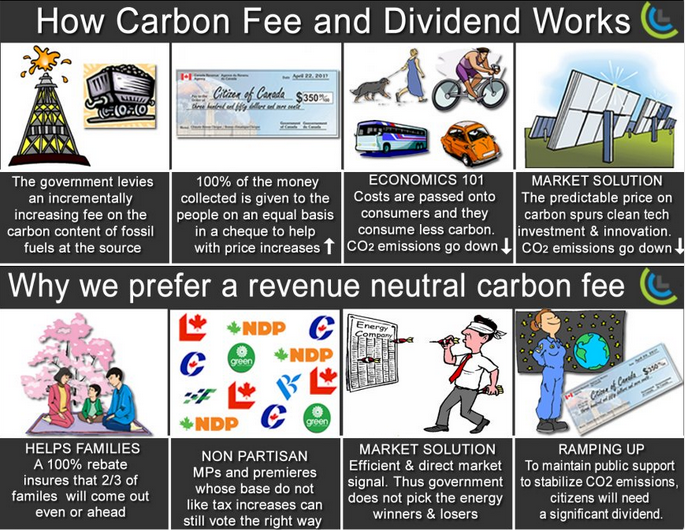
Fee-and-dividend explained, Canadian style. Hat tip to @scottsantens.

Fee-and-dividend explained, Canadian style. Hat tip to @scottsantens.

Nevertheless, it seems fair to say (and important to acknowledge) that by 2018, the second year of the Trump administration, fee-and-dividend has run out of political room. Not a single “sitting” (i.e., still in office) Republican member of Congress has publicly endorsed fee-and-dividend, even as a concept, let alone an actual bill. Yet the premise of fee-and-dividend has always been bipartisanship, since Democrats, with their preference for activist government, would accept a revenue-neutral carbon tax such as fee-and-dividend only if it delivered Republican votes.

For a decade, we wrote glowingly about fee and dividend — most recently in 2017 articles in The Nation and the Washington Spectator. We also praised the Climate Leadership Council’s “carbon dividend” proposal and advocacy in those two pieces and in numerous blogs (herehere, and hereinter alia). But as we wrote in June 2018, we believe that the time for carbon dividend proposals has probably passed. We wrote:

The [political] center to which Baker-Shultz (CLC) and fee-and-dividend (CCL) were designed to appeal barely exists. It’s not just that no sitting Republican has endorsed Baker-Shultz or indeed fee-and-dividend in any form. It’s also that the Democratic majority that will be needed to pass a carbon tax bill appears unlikely to rally around a revenue-neutral carbon tax, whether it’s organized as fee-and-dividend or some form of tax swap.

Economic Progressivity of Fee-and-Dividend

In 2016 CCL released a detailed paper examining how a carbon fee-and-dividend would impact U.S. households. The study took into account geographic variations in electricity sources and gasoline use and drew on a database of carbon intensity of expenditures for 5.8 million households to analyze the net effect of returning revenue to households on a modified per capita basis. Here are the major results:
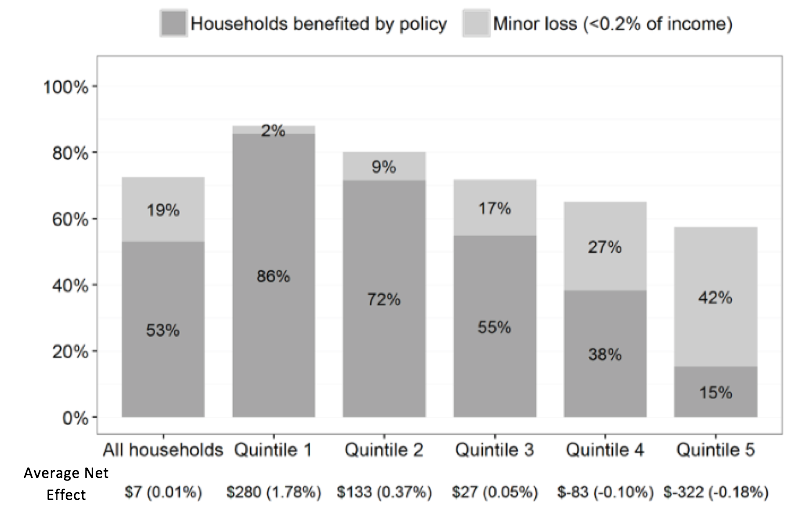
Percentage of Households Benefitted by Income Quintile

Percentage of Households Benefitted, by Income Quintile

  • 53% of households (and 58% of individuals) would receive more in dividend payments than they would spend due to higher fossil fuel prices.
  • Another 19% of households would incur only a slight loss, defined as a net loss no larger than one-fifth of one percent of pre-tax income.
  • Nearly 90% of households below the poverty line would benefit an average of $311, an increase of roughly 2.8% of pre-tax income.
  • In contrast, the net loss for the top quintile of households would average $-322 or only -0.18% of pre-tax income.

Notably, these findings support a dividend plan’s ability to transform a carbon tax into a progressive policy that neutralizes the burden that lower-income households would otherwise face, directly and indirectly, due to higher fuel prices. CTC advocates a progressive distributional outcome for both pragmatic and ethical reasons: pragmatically, because a carbon tax will require broad, sustained, public and political support; and ethically, because it’s not tenable to solve the climate crisis on the backs of those who can least afford it.

A Caveat — CBO’s “haircut”

The non-partisan Congressional Budget Office routinely “scores” members’ bills for their prospective impact on tax revenues. To streamline its analyses, CBO long ago settled the so-called “CBO haircut” by which it assumes that one-quarter of indirectly raised revenues would need to be allocated from the tax proceeds in question in order to make up for reduced tax revenues collected from conventional sources such as personal or corporate income taxes. But modeling of carbon tax proposals consistently finds that when revenue is strategically returned by reducing other taxes that tend to slow down economic activity, the net negative impacts are much lower than CBO’s 25% assumption and in some cases may be eliminated altogether. While returning revenue as “dividends” (which economists call “lump-sum rebates”) offers less potential to reduce economic drag than tax shifts, CBO’s assumption still seems like an over-estimate.

In any event, rigid application of the 25% CBO haircut could, on paper at least — and, likely, in Congressional deliberations — limit the carbon tax revenue perceived to be available for “dividends” to 75%. Yet even with this reduced fraction of revenue, returning carbon tax revenue via a direct dividend represents a simple and income-progressive means to make carbon taxes distributionally fair; though with the haircut, the share of households reaping a net benefit via an equal 75% dividend would be lower than the 58% of individuals mentioned above.

Related CTC blog posts:

Related news reports and opinion pieces:

Tax Shifting

The distribution of carbon tax burdens creates an opportunity for “progressive tax-shifting,” in which a portion of carbon tax revenue is dedicated to reducing regressive taxes such as the payroll tax (at the federal level) or sales taxes (at the state level). An early proponent of such a carbon tax shift was Al Gore, with his exhortation to “Tax what we burn, not what we earn.” Shifting taxes away from payroll and/or sales taxes and onto carbon pollution could raise, not lower, the after-tax incomes of a majority of below-median-income households, giving this approach a net progressive effect.

In addition to this potential progressive effect of tax shifting, a wide range of economists, [including Lawrence Goulder, Roberton Williams & Ian Parry, Gilbert Metcalf & David Weisbach, Alan Viard, Robert Shapiro, Donald Marron & Eric Toder] have concluded that use of revenue to reduce other taxes would improve the overall efficiency of the economy, for example, by removing burdens on work.

In October 2007, the Brookings Institution published a A Proposal for a U.S. Carbon Tax Swap — An Equitable Tax Reform to Address Global Climate Change by Tufts University economics professor Gilbert E. Metcalf, describing a national carbon tax paired with an income tax credit for payroll taxes paid. Metcalf assessed the impact of a tax of $15 per metric ton of carbon dioxide and five major greenhouse gases. Revenues would be used to credit payroll tax paid on the first $3,660 of earnings per worker. Metcalf showed that such a tax swap would be both revenue-neutral and distributionally-neutral. (Harvard professor and former Bush Administration economist Gregory Mankiw mentioned the Metcalf paper in a Sept. 2007 New York Times op-ed, discussed on our blog.) Rep. John Larson (D-CT) adopted Metcalf’s framework for his “America’s Energy Security Trust Fund Act,” discussed on our Bills page.
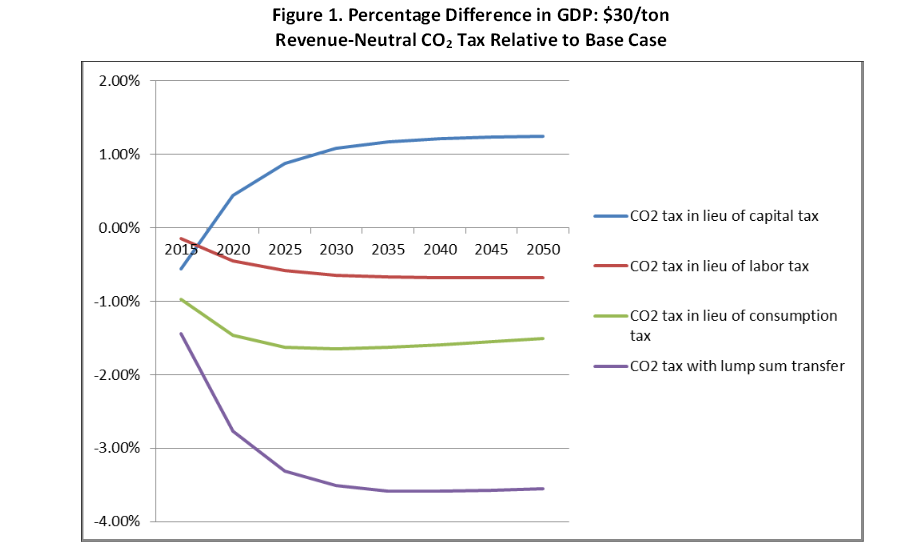
C tax revenue efficiency -- RFFMore recent analysis has confirmed the importance of carbon tax revenue wisely; using it to reduce other “distortionary” taxes can offer large enough efficiency benefits to reduce or even possibly eliminate the economic drag that a carbon tax would otherwise create. In Deficit Reduction and Carbon Taxes: Budgetary, Economic, and Distributional Impacts (2013) researchers from Resources for the Future found that using carbon tax revenue to reduce corporate income tax rates offers large enough efficiency benefits to more than overcome the efficiency loss of a carbon tax. The next best option is using revenue to cut wage taxes, while using revenue to cutting other consumption taxes is somewhat less efficient. Finally, refunding carbon tax revenue in a “lump sum rebate” (dividend) offers the least economic efficiency benefit.

Reducing the top marginal corporate income tax rate has been articulated as a goal by leaders of both major political parties. In an effort to attract Republican interest, Rep. John Delaney (D-MD) has introduced a carbon tax measure that would devote half its revenue to corporate income tax reduction.

Nevertheless, the growing economics literature on carbon taxes suggests a strong a tradeoff between the efficiency benefits of using carbon tax revenue to cut taxes on capital (as the Delaney proposal would do) and the distributional benefits of cutting taxes on labor (as Rep. Larson’s proposal would).

Related CTC blog posts and articles:

Related journal articles and papers: