Times editorial: "Start charging for depositing CO2 … A carbon tax is one approach." (NYT)
When Snow Won’t Fall
We’re forever on the lookout at the Carbon Tax Center for new and outsized ways in which Americans are using energy. Too often, today’s novelty item is just a clever marketing campaign away from tomorrow’s sizeable carbon emitter. Witness high-definition televisions, or Jet Skis.
If history is a guide, efficiency standards to govern new devices’ fuel consumption won’t be promulgated until after they have proliferated — if ever. Carbon taxes, in contrast, could help rein in new products’ energy requirements from the git-go, i.e., in the design stage. Where a product has little redeeming social value, the price signals from a carbon tax might even keep it from gaining a toehold in the culture.
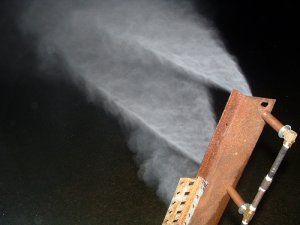
These thoughts came to mind when we read an article in The New York Times last week about suburbia’s latest must-have energy-guzzlers: home snowmaking machines.
“Since Nature can no longer keep to her early deadlines,” The Times reminded us in a veiled nod to climate change, dads from Darien to Denver “are taking matters into their own hands, and creating their own seasons, at least when it comes to winter.”
They’re doing it with snowmakers — machines named “Backyard Blizzard” and “Snow at Home” that feed on water and run on electricity, lots of it. According to the manufacturer, the Blizzard Sport model uses 2 kilowatts. The Times article gave a lower figure — which didn’t appear until the nineteenth paragraph and came with the curious note that “a clothes dryer guzzles more power.”
Of course, most clothes dryers aren’t left on for two days straight. That’s how long a snow-loving Greenwich, CT developer profiled in The Times story had been running his two snowmakers when the reporter dropped by.
Another two-machine man, owner of a boat repair business owner near Atlantic City, NJ, made this admission: “My neighbors are going to work at the casinos at 3 a.m. and I’m out there, too, messing with the guns. It’s really hard to turn the guns off.”
Hmm, what did Miles Davis tell Coltrane when the saxophonist said he sometimes didn’t know how to end a solo? “John, just take the horn out of your mouth.” In this case, given the large helpings of fossil fuels that go into powering snowmakers, a carbon tax might provide a strong incentive to users to turn them off, or to refrain from buying them in the first place.
We calculate that using two snowmakers — one evidently isn’t enough — twice a month, for two days straight, over four months of the year consumes around 3,000 kWh — enough to pump out 1,220 pounds of CO2, based on the national average mix of fuels used in making electricity. On that average, the $370/ton carbon tax that CTC proposes (after a 10-year phase-in) would add
$225 a year in operating costs.
Based on the high price-elasticities for many luxury goods, the tax might be expected to reduce sales of home snowmakers by around a third. That’s a nice hit, though admittedly it’s far from the 75% market shrinkage that is probably needed to strangle the snowmaker industry in its cradle. (Achieving that through a tax disincentive alone would require a carbon tax five times larger than the one CTC is seeking.)
Which suggests that by itself a carbon tax won’t determine the outcome every time. But it would nudge some of us away from making certain climate-damaging choices. And at least the polluter — whether it’s a giant factory or, as in this case, dear old snowmaker dad — would be made to pay.
Photo: el moose / Flickr
Stern: Carbon Price Must Include Climate Cost (ENS)
Cap vs. Tax — Debate Sharpens (CTC)
Volcker: Climate Inaction Will Be Costly (IHT)
Don't Trade Carbon, Tax It
Yesterday Gristmill ran a curious article by Bill Chameides of Environmental Defense, attacking a carbon tax strawman that no one is advocating, least of all the Carbon Tax Center.
Chameides stated that the "government would use additional tax dollars to subsidize the development of selected low-carbon technologies." We invite him to look at CTC’s proposed carbon tax, which is revenue-neutral. Revenues will go to reduce regressive taxes or to finance progressive, equal rebates to all U.S. residents. Contrary to Chameides’ charge, we have never advocated targeting tax revenues to any technology, privileged or otherwise. Nor, to our knowledge, have the Washington Post‘s Anne Applebaum, whom he also took to task, or the dozens of columnists, economists, scientists, and other public figures who support taxing carbon.
Chameides and ED are throwing their weight behind a carbon cap-and-trade system, on the premise that the successful sulfur cap-and-trade model can be extrapolated to carbon. We believe this is flirting with disaster. A model that worked when the parties were limited to a few dozen electric utility companies is ill-suited when the stakeholders — essentially every business and household in the country — number 100 million or more. Moreover, electric generators seeking to reduce sulfur emissions had a variety of technological alternatives available. There are no comparable methods available to reduce carbon emissions other than fuel-switching and, perhaps sometime in the future, sequestration.
Chameides claims that the "marketplace does a better job of developing new technologies, and a tax takes money out of the marketplace." That argument was pertinent when the alternative to cap-and-trade was "command and control" regulation of NOx and SO2 emissions, but it’s irrelevant to a comparison with a carbon tax. Both a cap-and-trade and a carbon tax provide price signals that encourage polluters to look for ways to avoid the cost of emitting CO2.
A carbon tax actually provides more precise price signals, provides them sooner, and provides them in a more understandable and transparent fashion. To attack global warming, every energy-critical decision needs to be predicated on a trajectory of rising energy prices. A phased-in carbon tax allows this, whereas cap-and-trade will do little to mitigate the price roller-coaster that discourages emissions-minimizing investment.
Not only would a carbon cap-and-trade system provide less effective price signals, it would do so only after considerable delay consumed by protracted negotiations, making a mockery of Chameides’ claim that a cap will guarantee climate-stabilizing cuts. Compounding the problem, once a cap-and-trade system is finally implemented, we’re likely to be locked into the approach for years, with industry insisting, "Don’t change it until we see how it works." Carbon taxes will require no new administrative structures, can be implemented now, and can be adjusted as necessary.
Another serious drawback to cap-and-trade is that its inherent complexity leaves it open to exploitation by special interests, not to mention perverse incentives to "bank" pollution now against future credits. Carbon taxes are relatively immune to manipulation.
Ironically, Chameides’ hesitancy about trusting the government with tax dollars applies more aptly to his cap-and-trade proposal. Since the tax proposed by CTC and most other carbon tax proponents is revenue-neutral, there are no tax dollars to spend and potentially misuse. In contrast, even an optimal cap-and-trade system such as the Northeast’s Regional Greenhouse Gas Initiative, in which emissions allowances are auctioned, would saddle end-users with the functional equivalent of a tax, along with the same conundrum Chameides raised about how to spend the money. Except worse, because the cap-and-trade model necessarily requires that a chunk of the "tax revenues" be used to provide market participants with a profit paid by consumers.
And that’s under a relatively benign cap-and-trade, in which the allowances are auctioned. The alternative, giving polluters the
allowances outright, combines the worst of both worlds: a hidden tax on energy users, with all the increased energy costs given to the polluters or other market participants. An explicit tax that offsets other taxes is preferable to a covert tax that goes into someone else’s pocket.
Finally, we reject Chameides’ defeatism over the chances of Congress passing a carbon tax. On the contrary, the stars are aligned as never before to actually do something about carbon emissions. There is now a general acceptance of the need for action (even Exxon concedes there’s a problem), and no less than Wall Street demigod Paul Volcker
called last week for taxing CO2. The question is what will work best. For reasons discussed in more detail on our website, we believe that a carbon tax coupled with progressive tax-shifting can be a winner politically.
The last thing we want to do is lock in a suboptimal solution and then have to wait years before the stars are again aligned. Now is the time to work for a real solution that maximizes environmental gains and minimizes hardships.
This article was written with CTC co-director Dan Rosenblum. It appeared first on Gristmill. Dan and I invite commenters to post there as well as here.
Majority of Surveyed Economists Favor a Carbon Tax to Encourage Develoment of Alternatives to Fossil Fuels
According to the Wall Street Journal’s Monthly Economic Forecasting Survey; February 2007, 85% of the surveyed economists believe the government should encourage development of alternatives to fossil fuels. When asked "what is the most economically sound way for the government to encourage development of alternatives to fossil fuels," 54% responded with "taxes that raise the cost of purchasing fossil fuels." The next largest category was "other" at 28%, followed by "subsidies for producers of alternative fuels" at 13%.
According to former Fed Chairman Paul Volcker, as quoted in the International Herald Tribune, taxes either on emissions or on petroleum could be effective in
reducing global warming, that it would be wiser to impose a tax on oil
than wait for the market to force prices up, that measures to reduce
global warming would not be economically devastating and, putting the
issue in perspective:
"What may happen to the dollar, and what may happen to
growth in China or whatever," he said, raising his voice, "pale into
insignificance compared with the question of what happens to this
planet over the next 30 or 40 years if no action is taken."
(Economist Paul Volcker Says Steps to Curb Global Warming Would Not Devastate an Economy, Feb. 6)
IPCC – "Warming of the Climate System is Unequivocal"
“Feb. 2 will be remembered as the date when uncertainty was removed as to whether humans had anything to do with climate change on this planet,” declared Achim Steiner, executive director of the United Nations Environment Program. Steiner was quoted in the New York Times’ Feb. 3 front-page lead story on the release of the Intergovernmental Panel on Climate Change’s (IPCC) Fourth Assessment Report of the drivers of climate change, observed changes in climate and projections for future climate change.
The Summary for Policymakers released with the IPCC report states:
“Warming of the climate system is unequivocal, as is now evident from observations of increases in global average air and ocean temperatures, widespread melting of snow and ice, and rising global mean sea level…
“At continental, regional, and ocean basin scales, numerous long-term changes in climate have been observed. These include changes in Arctic temperatures and ice, widespread changes in precipitation amounts, ocean salinity, wind patterns and aspects of extreme weather including droughts, heavy precipitation, heat waves and the intensity of tropical cyclones…
“For the next two decades a warming of about 0.2 deg C per decade is projected for a range of … emission scenarios. Even if the concentrations of all greenhouse gases and aerosols had been kept constant at year 2000 levels, a further warming of about 0.1 deg C per decade would be expected…
“Continued greenhouse gas emissions at or above current rates would cause further warming and induce many changes in the global climate system during the 21st century that would very likely be larger than those observed during the 20th century…
“Anthropogenic warming and sea level rise would continue for centuries due to the timescales associated with climate processes.”
Urgent action is required. As set forth elsewhere on this site, charging American businesses and individuals a price to emit carbon dioxide (CO2) is essential to reduce U.S. emissions quickly and steeply enough to prevent atmospheric concentrations of CO2 from reaching an irreversible tipping point.
"A Carbon Tax Is Inevitable" — Chirac
The New York Times reported today that French President Jacques Chirac has demanded that the United States sign both the Kyoto climate protocol and a future agreement that will take effect when the Kyoto accord runs out in 2012.
According to The Times, Chirac warned that if the United States did not sign the agreements, a carbon tax across Europe on imports from nations that have not signed the Kyoto treaty could be imposed to try to force compliance. The European Union is the largest export market for American goods.
“A carbon tax is inevitable,” Mr. Chirac said. “If it is European, and I believe it will be European, then it will all the same have a certain influence because it means that all the countries that do not accept the minimum obligations will be obliged to pay.”
French officials have recently floated the idea of imposing carbon-equivalent tariffs on imports from countries that do not tax or otherwise regulate carbon emissions. These tariffs would help level the playing field for early adopters of carbon controls.
At Davos, Stern Calls for Carbon Tax
"Humankind’s failure to pay for damaging the environment is the "biggest market failure ever seen," declared Sir Nicholas Stern, the author of last year’s groundbreaking report on climate change and former adviser to Tony Blair.
Sir Nicholas called for higher taxes on fuel to combat environmental damage yesterday at a summit of business and political leaders in Davos, Switzerland.
As reported by The Guardian (U.K.), the issue of global climate change dominated the agenda of the first day of the
World Economic Forum’s annual meeting.
Making the environment pay is one of 17 sessions focusing on climate
change this week. According to The Guardian, a majority of attendees at a standing room-only
session yesterday backed Sir Nicholas’s contention that carbon taxes
were a force for good and twice as many of the high-level attendees
said environmental protection should be a priority for world leaders as
did a year ago.