

Carbon Tax Bill to Peg Fuel Bills (TimesOnLine – UK)
Media Maturity Smoothing Carbon Tax Path
Match the statement with the "green" source:
- Statement 1: Expensive energy is a powerful medicine. It may hurt when taken, but it brings long-term cures for a host of ills.
- Statement 2: Willingness to advocate an explicit carbon tax is the real test of whether either [presidential] candidate is ready to confront [global warming].
- Statement 3: Pricey gas is mostly just economic pain. But beyond the agony at the pump, life is getting a little better in ways we may not notice.
- Source 1: Sierra (Club) magazine
- Source 2: Al Gore
- Source 3: Greenpeace
Answer: None. The statements are real, alright (though elided slightly here), but none is from a certified greenie. All three are from articles in mainstream magazines: Business Week (The Real Question: Should Oil Be Cheap), National Journal (How to Get Serious About Energy Policy), and Time (10 Things You Can Like About $4 Gas), respectively. All three appeared in the past month.
Nor were the quotes chosen selectively. Almost any sentence picked at random from the articles would say the same thing: Expensive energy, though painful for a nation built on cheap fuels, is
an absolute necessity for dealing with oil dependence and global warming.
 Clearly, a change is in the air. America is growing up, as I argued in an article in Gristmill in May reporting public rejection of the gas-tax "holiday" proposed by Senators Clinton and McCain.
Naturally, not everyone in the media has gone adult. Rush Limbaugh, for one, dismissed the Time article as yet another attempt to "tell you how to live ’cause you’re too stupid to know, by effete-snob Drive-By Media leftists." But a new consensus is emerging among mainstream media: "There’s no faster mechanism than high prices for oil to change behavior… You suddenly are reminded how the economy works." (Time, quoting author Eric Roston) "Expensive energy, in many ways, is good." (Business Week) "A revenue-neutral package of a carbon tax and cuts in other taxes is
surely within the bounds of domestic political salesmanship." (National Journal)
Of course, the recent rise in energy prices is neither sufficient nor optimal. Higher energy prices are best delivered via tax policy so the increased revenues can be socially invested or, better, returned to individuals and families, rather than lining the pockets of obscenely wealthy Saudis, Russians and Texans. A rising trajectory of prices also needs to be locked in. (Business Week: "What really drives behavior is not the actual price, but the perception of where costs will be over the long term.") A host of market barriers still impede energy efficiency. And tackling carbon emissions requires a carbon tax; coal’s abundance ensures that the market can’t manage alone.
The National Journal article, by veteran political reporter Clive Cook, is notably upbeat on the last possibility. The subhead reads, "Politicians of both parties take it for granted that the American voter cannot tolerate an explicit tax on carbon," a notion that the article calls into serious question. We close with these excerpts:
The country’s mood on global warming has changed — most people now seem to take the danger seriously — but public opinion on energy policy has two contradictory strands. People are worried about rising temperatures and changing climate; but they are also worried about expensive gas. If you are serious about reducing carbon emissions, expensive gas is not a problem; it is an unavoidable part of the solution.
Politicians of both parties take it for granted that the American voter cannot tolerate an explicit tax on carbon, which would be the best way to curb greenhouse gases. This supposedly immovable resistance is why the presidential candidates advocate a system of tradable emission permits instead. But if cap-and-trade binds tightly enough to make a difference, it will necessarily make carbon-releasing fuels more expensive. The system cannot work any other way: It can succeed only by attaching an implicit tax to carbon.
As it happens, I think the political toxicity of a carbon tax as against cap-and-trade–assuming we are serious about this, and contemplating a cap-and-trade system that makes a difference–is exaggerated. A revenue-neutral package of a carbon tax and cuts in other taxes is surely within the bounds of domestic political salesmanship. But also bear in mind the decisive international advantage of a straightforward carbon tax.
Yes, America should lead on global climate change, but it cannot solve the problem alone. Its efforts will be futile unless other big emitters — especially China and India — join in. Reaching agreement on a global cap-and-trade regime, and coordinating each country’s efforts within it, would be fantastically difficult. Think about Europe’s problems with Kyoto, and multiply by 10. It would be far, far simpler to organize international efforts around a harmonized carbon tax. Why strive to coordinate a million quantities, when you can gradually coordinate a single price?
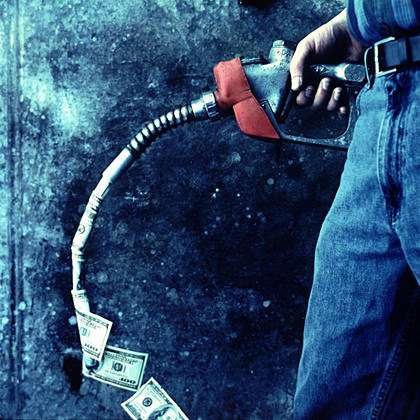
Photo: Flickr / J.A. Campbell
Shipping Costs Start to Crimp Globalization
How to Get Serious About Energy Policy
What Obama Electricity Tax?
The Cost of Oil Subsidies
GM Cuts SUV, Truck Production, Citing Low Demand
Funds for Highways Plummet as Drivers Cut Gasoline Use
Fuel Subsidies Overseas Take a Toll on U.S.
B.C. Carbon Tax Backlash: How Real?
 For months we’ve been touting the British Columbia carbon tax, and for good reason. Not only is BC’s carbon tax the highest by far in North America ($10 per metric ton of CO2 this year, rising stepwise to $30 in 2012), but the rollout of the tax has seemed to be handled with great intelligence. The Liberal Party provincial administration took pains to make the tax revenue-neutral (mostly via reductions in personal and business tax rates), a feature it underscored by sending B.C. residents $100 carbon tax dividend checks as a down payment in the week before the tax went into effect on July 1.
So we were dismayed to read in mid-July of a poll showing a clear majority of B.C.’ers opposed to the tax. Even the $100 dividends came off badly in the poll, with at least one respondent complaining that her check only served to remind her of the loathsome tax.
Columnist Bill Tieleman, who posted the story on the Vancouver Web outlet 24 hours, drives home the point in a later story, Carbon tax has no supporters around here. Tieleman seems to fancy himself as a populist voice against B.C. premier Gordon Campbell in general and the tax in particular.
Over the weekend we discussed the poll with social entrepreneur Peter Barnes, progenitor of the intriguing Cap-and-Dividend approach to revenue-neutral carbon pricing, as follows:
Komanoff:
- Much is made of Americans’ supposed sensitivity to gasoline prices, and the same may be applying in B.C., exacerbated of course by the "market-based" rise in pump prices which has been an order of magnitude greater than the (9 cent a gallon) carbon tax. Mathematically, each of those $100 checks covers the carbon tax on 1,111 gallons, though the true coverage is less considering that gasoline accounts for only ~35% of the carbon tax bite in BC (21-22% in the U.S.). Needless to say, most BC’ers don’t consume 1,100 gallons of gas a year.
- Most likely the BC government could have done more and better p.r. Yet overall they’ve been savvy … consider if the $100 checks had lagged rather than preceded the rollout of the tax!
- The poll question wasn’t straight-up, since it suggested that the $100 check was all that BC’ers would get, when it’s actually just the down payment. Here’s that Q: "The provincial government has sent every British Columbian a cheque for $100 as a one-time ‘Climate Action Dividend.’ The total cost of ‘Climate Action Dividend’ is $440 million. This expenditure will
be paid for by B.C.’s new carbon tax of 2.4 cents per litre of gasoline and other fuel. Do you agree or disagree with this expenditure?" - One always wants to know how the poll respondents were selected. (Recall the notorious Literary Digest poll picking Landon over FDR in ’36!) Still, this isn’t to deny that even the dividend concept which you’ve been so prolific and persuasive in disseminating is an uphill fight.
Barnes:
- One problem (from a PR standpoint) might be that the BC tax cuts are divided between individuals and businesses. So even if there is overall revenue neutrality, most voters will only get back about half of what they pay in higher prices.
- The way in which tax cuts rise along with carbon prices is not transparent or seemingly automatic. The carbon tax revenue is not placed in a separate trust fund (so far as I can tell) but is blended with general revenue. It is then up to future legislatures to adjust the tax rates. This could reasonably make people skeptical.
- A one-time dividend is an obvious gimmick. Recurring (and rising) dividends are likely to create more credibility.
- This goes to the heart of the question of whether to return carbon revenue via tax credits or dividends, which is something Obama will have to decide.
Peter concludes: "The British Columbia experience suggests that segregating carbon revenue in a trust fund and returning all of it to individuals through automatic monthly dividends (as James Hansen and others have proposed) is the best way to sustain political support." We at CTC heartily agree.
Photo: Flickr / bbboon