

Why A Soda Tax Makes Sense (NYT economics blogger David Leonhardt)
Kerry-Lieberman “climate” bill is worse than nothing
“Is this the Climate Treaty You Came For?” George Monbiot asked hundreds of activists at the Copenhagen Klimaforum last December. Monbiot, a prolific reporter for The Guardian (U.K.) on climate, and author of Heat, offered this reply: “The UN isn’t even asking the right questions yet.” Green energy is still trying to “out-subsidize” dirty energy. “The Kyoto agreement isn’t curbing demand for fossil fuels.”
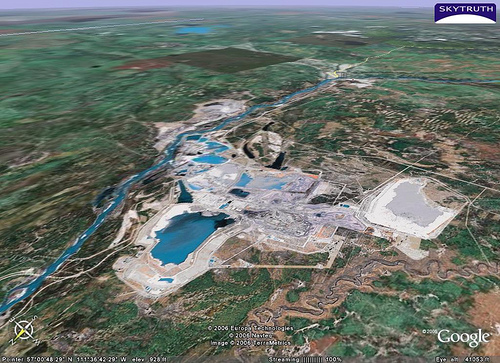
Alberta Tar Sands Mine
As one example, Monbiot pointed to tar sands mining wrecking boreal forests in Canada, a nation ostensibly “capped” by Kyoto. Monbiot agreed that unlike subsidies and “caps,” a revenue-neutral carbon tax would effectively curb demand while creating broad incentives for efficiency and increased supply of low-carbon energy.
Yesterday, the climate advocacy group 1 Sky held a conference call with Sierra Club’s climate and energy lobbyist David Hamilton. David pondered an updated version of Monbiot’s query: “Is the cap in the Kerry-Lieberman American Power Act worth the cost” in terms of subsidies for dirty energy and huge compromises including more offshore drilling. Hamilton called this a “cosmically difficult question.”
Not for me. Here’s why:
First and foremost, in dollars, Kerry-Lieberman is overwhelmingly a dirty energy subsidy bill with crumbs tossed to “green” energy. More money (loan guarantee, tax breaks, insurance subsidies) for nukes, “clean coal,” oil companies, and highways. As documented by Earth Track and Taxpayers For Common Sense, K-L’s “buy everyone off” approach means inducing more demand for energy, which in turn means driving drilling anywhere and everywhere, blowing up more Appalachian mountaintops, and maintaining and extending America’s military presence around the world: An addict’s frenzy for yet another “fix” of cheap fossil fuels.
For the utility sector, K-L relies on a “cap” with trading and offsets, ceding to traders (i.e. Wall St.) the authority to set carbon prices. In the transportation fuel sector, K-L at least uses a more direct approach of selling allowances at a price established by the utility permit auctions, thus limiting somewhat the problems from trading. (Oil companies don’t like volatility, either.) Yet nowhere does the bill set the clear, briskly-rising price on CO2 pollution essential to create incentives for efficiency and low-carbon energy development across the economy.
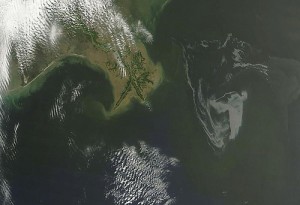
Deepwater Horizon Oil Spill (5/1/10)
K-L gives offshore drilling the green light. While K-L purports to let states “veto” drilling in previously-protected waters up to 75 miles off their coasts, it offers them a whopping 37.5% share of revenues generated by offshore oil and gas activity — no strings attached. How many cash-strapped states will resist cries to “drill, baby, drill” in coastal and marine areas already under stress from pollution, over fishing, ocean acidification and warming? And this virtual “bribe” to drill will run afoul of long-standing domestic and international maritime law holding that coastal waters (and revenue from leasing) belong to the entire nation, not just the adjacent state.
K-L continues the pretense that coal can be made “clean” through thermodynamically-challenged “carbon capture and sequestration” by throwing an additional $2 billion/yr on top of the $2.4 billion in the 2009 stimulus package. CCS is a speculative technology that (if viable at all) will require burning at least 30% more coal per unit of net output to power the process of “capture” and “sequestration” of CO2 and building an additional facility roughly equal in size and cost to every coal-fired power plant. Plus, a huge new network of pipelines. Then there’s the problem of finding the underground capacity for permanently storing a few billion tons more CO2 every year… from now on.
K-L’s vaunted “cap” is a joke. A “cap” that adds 2 billion tons of offsets on top of an economy that generated 5.4 billion tons of CO2 last year means that even if the cap tightens a few percent each year, polluters will be able to buy (cheap) offsets instead of making reductions for the next two decades. By design (K-L calls it “cost containment”), CO2 prices will be set in the offset market, not by supply constraints of the “cap.” Charles K. Ebinger, Director of the Energy Security Initiative at the – Brookings Institution critiqued the bill forcefully:
“If we are trying to reduce carbon emissions in the U.S., let’s do it. Otherwise we simply are exporting capital and jobs [via offsets]. The [K-L] bill’s price on carbon is unlikely to be high enough to generate any real movement away from fossil fuels. Furthermore, the provisions… for trading in carbon are too complex and as written could allow gaming of the system. Energy security and climate change are issues of the most urgent national significance. We should not pretend that we can do it on the cheap with no pain, at no cost, and with no sacrifice for the greater national good.”
In short, as climate scientist Jim Hansen articulated on Earth Day, we will not address climate and energy security without raising the price of cheap, dirty energy. And if we’re serious about a meaningful and effective price, we must return revenue to U.S. workers and families.
Senator Kerry has been boasting about returning revenue, apparently in response to Senator Cantwell’s “CLEAR” bill that proposes returning 75% of revenue to citizens. But K-L’s revenue return has barely budged from that in the Waxman-Markey bill. K-L would return about half of revenue generated by allowance auctions in the utility sector (about 40% of CO2 emissions) through local distribution companies. In states with aggressive public utility commissions, consumers would see some reduction in the fixed charges on electric bills. But in poorly regulated states, which include many in the South, revenue return will be a big windfall for utilities. And since a majority of electricity usage is commercial or industrial, that leaves only a minority of the returned revenue for households. Bottom line: K-L returns only a small fraction of CLEAR’s 75% revenue return.
Still, the Big Green groups and their allies in the US Climate Action Partnership insist that K-L is “better than nothing.” And “we have to do something about climate now.” In exchange for an energy-giveaway bill masquerading as a climate bill, they’re in effect lobbying for dirty energy subsidies and for undercutting much of EPA’s authority to regulate greenhouse gases — an authority that these same groups once vigorously defended, and which was recently upheld by the Supreme Court.
Though K-L would leave intact EPA’s recently-finalized CAFE (automobile efficiency) standards, it would limit the Agency’s authority to mandate technology to cut CO2 emissions from stationary sources (e.g., coal power plants) and would confiscate EPA’s biggest Clean Air Act hammer, the National Ambient Air Quality Standards (NAAQS). The Center for Biological Diversity petitioned EPA to “cap” CO2 emissions using NAAQS under which states would develop and enforce plans to reduce GHG emissions. Some analysts suggest that states’ existing Regional Greenhouse Gas Initiatives (RGGIs) could be adapted and approved by EPA under NAAQS.
Cap-and-trade simply cannot achieve emissions reductions large enough to avoid climate catastrophe. The price signal is too murky to trigger the needed shifts to clean energy, and the revenue return is too meager to cover the needed price rises. Nor can it lead to an international price on CO2 pollution supported by trade agreements. Big Green’s insistence that “we have to pass Kerry-Lieberman or we won’t have any climate program” is specious, therefore, insofar as K-L itself is no more a climate program than was any other energy-giveaway bill in recent decades. We still need a carbon fee that returns all or nearly all revenues to citizens to gain and keep broad bipartisan and public support. Passing K-L will only make this difficult task harder by entrenching traders, offset purveyors and recipients of the bill’s dirty energy subsidies.
K-L presents no “cosmic difficulty” for me. Let’s book a grand, New Orleans-style funeral for cap/trade/offset where concerned citizens gather, take stock and start working for a People’s Climate Bill – a revenue-neutral carbon tax.
Photos: flickr– Google/SkyTruth, NASA Goddard
Sequestration Is A Bad Bet On Carbon
China Expert: Carbon Tax Likely
Brad Plumer: Emissions Are Already Plummeting, So Why Not A Stronger Bill?
Join the Earth Day Climate “Revival” This Sunday
There are good reasons, ranging from corporate sponsorship to vapidity, to have been cynical about recent Earth Day observances. But there are even more compelling reasons — the imminence of the climate crisis and the recent gain in denialists’ political standing — to put cynicism aside and come to Washington this Sunday for what organizers hope will be the “largest climate rally ever.”
 Earth Day’s original national coordinator Denis Hayes and the Earth Day Network are aiming for a 40th anniversary revival of the “spirit of 1970” that catapulted environmentalism into public consciousness, launching a decade of environmental reforms, winning landmark legislation, and birthing the modern environmental movement.
The list of speakers is impressive for its heft and diversity. They include:
- Climate scientist James Hansen
- Filmmaker James Cameron (Avatar; Titanic) and author Margaret Atwood (The Handmaid’s Tale; The Blind Assassin)
- Business executives from Siemens and Phillips, and union leaders from the AFL-CIO and the SEIU
- Rainbow Coalition leader Jesse Jackson and NAACP V-P for advocacy Hilary Shelton
- Evangelical creation-care advocate Rev. Richard Cizik
- Climate-policy blogger Joe Romm
Plus a stellar roster of musicians including Bob Weir, Mavis Staples, Willy Colon, Booker T, and Sting
And the program’s diversity includes sharp differences over climate policy. Hansen in recent years has moved beyond climate science to climate politics, becoming the most visible (and perhaps most aggressive) U.S. advocate of fee-and-dividend — a federal carbon tax whose revenues would entirely be returned, per capita, to the American people. For his advocacy and his criticism of carbon cap-and-trade, Hansen has been censured by Romm, the climate blogger for the Center for American Progress, which is closely linked to cap-and-trade advocates in the Democratic Party and the mainstream environmental movement.
On Sunday, these differences can and should be put aside. As Romm did in his blog on the rally, we defer to Denis Hayes’ post on Grist:
Humanity must swiftly abandon dirty energy sources and switch to safe, clean, decentralized, renewable energy sources like solar, wind, and geothermal. The world, led by America, must abandon the appallingly inefficient way it uses energy and swiftly embrace the most efficient new housing, transport, and industrial processes that exist. We Americans must slash our politically risky and economically catastrophic dependence on the oil wealth of nations that don’t like us very much.
A necessary—though not sufficient—common denominator is to establish a price on carbon that reflects the costs of climate disruption, blowing the tops off mountains, and acidifying the world’s oceans. We must place a firm cap with no loopholes on the amount of carbon fuels we consume each year and ratchet that cap down at a prescribed rate every year in the future until we hit something very close to zero. Only a federal law can accomplish this goal.
If this were easy, we would have begun a quarter century ago. The junk science, climate-denying interest groups are rich, powerful, and ruthless. But sooner or later they will lose. Sooner is better
They will lose for the same reason that IBM and Control Data lost to Microsoft, Apple and Dell. They will lose for the same reason that Ma Bell—the most powerful monopoly in the world—lost to cellular upstarts and Internet-telephony. They lost because their thinking was anchored in the past instead of envisioning the future
The junk science, climate-disruption-denying interest groups will lose because 19th century answers won’t solve 21st century problems.
At some point, this climate-disrupting madness has to start to stop. Come to the Mall between the Capitol Building and the White House on Sunday, April 25. Bring your spouse, your parents, your kids, your neighbors, your friends, your co-workers, your congregation, your bowling league. Vote with your bodies on April 25th at the largest climate rally ever.
While we at the Carbon Tax Center differ with Denis’s emphasis on a cap — we’re convinced that only a carbon tax or fee can give U.S. entrepreneurs, investors and families the clear price signal they need to move to clean technologies, fuels and lifestyles — we salute Denis’s 40 years of advocacy (some of which is on fine display in the documentary Earth Days that PBS is airing this week).
We also salute the late Sen. Gaylord Nelson of Wisconsin, who more than any other individual conceived Earth Day (originally as a national day of teach-ins on the environmental crisis) and whose staff hired Denis Hayes to co-ordinate it.
Let’s come to the Mall this Sunday and make our voices heard for climate sanity and the central policy measure that can take us there: a federal, revenue-neutral carbon tax.
After Cap-and-Trade: Climate Change Plan B
Krugman on Building a Green Economy
Last week’s NY Times Sunday Magazine featured Nobel prize-winning economist Paul Krugman’s take on climate economics. Krugman notes that climate modelers have gained “enormous credibility” by successfully predicting the past 20 years of global warming. He concludes that climate trends over decades (which wash out short-term weather fluctuations), show that “the planet is indeed warming” which will lead to “massively disruptive events, like the transformation of the Southwestern United States into a permanent dust bowl over the next few decades.”
Krugman calls for the use of economic tools to curb the climate threat. He deftly articulates how (“Pigovian”) taxes discourage pollution by placing some of the “externalized” cost of pollution back on polluters, without the inefficiency and intrusiveness of regulations. He notes that a “cap-and-trade system produces the same incentives to reduce pollution… with the price of licenses effectively serving as a tax on pollution.” He explains:
A pollution tax… imposes costs on the private sector while generating revenue for the government. Cap and trade with auctioning… is just like a tax. [But current legislative proposals] involve[s] handing out licenses to existing players, so the potential revenue goes to industry instead of the government… as a way to partly compensate some of the groups whose interests would suffer if a serious climate-change policy were adopted. This can make passing legislation more feasible.
Krugman also acknowledges Dr. Hansen’s (and our) point that cap/trade punishes individual initiative to reduce GHG emissions. But Krugman never mentions the possibility of a carbon tax with revenue returned directly to the public, which should do even more to make passing legislation feasible and would avoid the volatility, manipulation and the need for “offsets” that effectively eviscerate the “emissions certainty” of a cap. Moreover, returning revenue to consumers rather than supporting “incumbent technologies” would encourage consumers to make the choices needed to speed our transition to a green economy.
Krugman confronts the problem of discounting the cost of future climate damage. Normal discounting (typically applied to business investments) drastically reduces the present value of future gains or losses; such discounting thus supports only small investments and low carbon taxes to avoid future climate damage. Siding with Sir Nicolas Stern, Krugman concludes that such large discounting is unfair to future generations; it effectively assumes away the potential for global catastrophe. Thus, despite his political judgment about cap-and-trade, Krugman’s reasoning supports the view that a substantial carbon price with a serious ramp-up is needed.