

Report Urges Congestion Charges, Fuel Carbon Tax (Irish Times – Dublin, Ireland)
Marketing Failure in Canada?
How to Fix the Green Shift, in today’s Toronto Star, is a sobering analysis of the impact of the Liberal Party’s proposed carbon tax on the Canadian national election. The bad news is that the carbon tax, called Green Shift by the Liberal Party, appears to be hurting the party’s chances in the Oct. 14 election. The better news is that the problem may be more message delivery than substance. Whatever the results of the Canadian election, carbon tax advocates in the United States and elsewhere will be able to build upon the Liberal Party’s experience.
Following are excerpts from the article, by the Star’s Sarah Barmak. We recommend that you read the full article.
“After the Liberal rank and file comes to grips with the results of the Oct. 14 election – which seems poised to turn out poorly for the troubled party – one question may loom large: was the Green Shift really that bad of an idea, or did Stéphane Dion fail to sell it to Canadians?
 “In many ways, a carbon tax should make sense to Canada’s electorate. Canadians place the environment near the top of the list of things they consider most when going to the polls, according to a Sept. 13 Angus Reid poll. …
“Yet another recent poll shows that whatever enthusiasm the Liberals had succeeded in inspiring about their environmental platform over the summer has evaporated. …This even though almost half of respondents believe pricing greenhouse gas emissions is a good idea. In fact, a majority of respondents – 66 per cent – believe the proposed plan will hurt low-income families, singles and seniors, even though cuts to income, personal and business taxes are part of the plan. …
“Are the Liberals mis-marketing the Green Shift, and shooting themselves in the foot in the process?
“On the surface, political campaigning might not seem to have much in common with the marketing of a product. In some ways, however, it makes sense to approach the Green Shift as a complex product that needs to be explained, packaged and sold to an electorate that doesn’t have the time or inclination to muddle through detailed documents on the plan. …
"’An emotional campaign . . . . would be one way of getting past objections around the tax,’ says David Dunne, a professor of marketing at the University of Toronto’s Rotman School of Management. ‘Make people feel warm and fuzzy about it. (The Liberals) seem to have slipped up on the emotional component. Their advertising is pretty boring, to be honest.’
“Also central in assuaging voter concern about the plan’s cost: Making sure they know what’s in it. According to one expert on climate change, the Liberal plan will be effective in reducing emissions. But you wouldn’t know that by reading the newspaper. …
“In some ways, Dion’s difficulty pinpointing a central slogan for his environmental policy mirrors the struggles of Obama to present his proposals on the economy, health care, and energy in a way that is easy for voters to digest.
"’I see some parallels between Dion and Obama in that they both avoid overly simplistic discourse,’ says Professor Ron Smyth, a linguistics expert who researchers marketing at the University of Toronto. ‘They try to be clear without insulting the public, while [Canadian Premier, the Conservative Stephen] Harper and [John] McCain are masters at reducing complex issues to simplistic slogans and hot-button issues.’
“In another sense, Dion is grappling with selling a complex solution to a problem – climate change – that is itself notoriously difficult to explain. …
“When a party markets a complex idea during an unexpected election, the rules of the game would seem to inherently favour the other side.
"’The most important thing when trying to sell a big idea like that is it’s a lot easier to poke holes in it than to sell it,’ explains David Soberman, an expert in marketing strategy from Rotman. ’The opposition is in a better position because they can cherry-pick ideas that might not be attractive to the general public while ignoring other aspects.’
“… No one expects (or wants) Dion to grow a beard and wave signs outside the gates of coal-burning power plants. Some marketing experts say changes to the Liberal campaign’s choice of words might be a less painful way to win the hearts of voters.
“For one thing, Dion could think twice about repeating that ugly word, ‘tax’ – replayed ad nauseam by Conservative attack ads. …
“Ultimately, whether voters ‘get’ a politician’s message reflects directly on the politician doing the explaining – not just the speechwriters or the media – in the eyes of the electorate.”
Photo: Flickr / archer10 (Dennis)
Why Revenue-Neutral Carbon Taxes are Superior to "Cap and Trade" Schemes
How to Fix the Green Shift
The Low-Carbon Diet
Carbon Tax Linked to Economic Growth
Berkeley Eyes Carbon Tax, Higher Rates
Campbell offers cities, schools carbon-tax rebate
7 Western States, 4 Canadian Provinces Ink Cap-and-Trade Pact
Bloomberg, Economists, Greens Tell Ways & Means: Price Carbon Upstream, Distribute Revenues to Consumers
Reported for the Carbon Tax Center by James F. Handley.
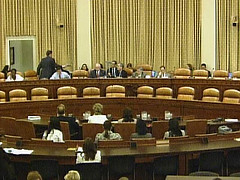
The "fierce urgency" of the climate crisis compels action, said Rep. John Larson (D-CT) at Thursday’s House Ways and Means Committee’s packed hearing on climate change revenue measures. Hurricane Ike’s devastation of coastal Texas imparted deeper meaning to Martin Luther King’s phrase. Witnesses pointed to storm-related damage as one of many ways in which failure to reduce the greenhouse gas emissions that drive global warming will destroy ecosystems and economies alike.
Citing the effectiveness and simplicity of a carbon tax, New York City Mayor Michael Bloomberg urged Congress to tax fossil fuel producers upstream, and distribute revenue downstream to consumers by reducing payroll taxes. A carbon tax would impose a cost proportional to carbon emissions, but because revenue distribution would not be linked to consumption, the system would “use capitalism” to create broad incentives for energy conservation and alternative energy, Bloomberg said.
 While reiterating that he favors a “straightforward carbon tax,” Bloomberg said carbon cap-and-auction would also work if revenues were distributed downstream, an idea elaborated later by Peter Barnes of Cap and Dividend. Bloomberg urged the U.S. to avoid competing to become the world’s cheapest producer — a strategy that has thrust China into an environmental nightmare and a downward wage spiral. Bloomberg and Dr. Frank Ackerman of the Stockholm Environment Institute and Tufts University cited Germany’s standing as a world leader in manufacturing high-value products despite high wages and energy prices.
Climate policy, said Dr. Peter Orszag of the Congressional Budget Office, poses the thorny problem of imposing short-term costs to achieve long-term benefits. The Lieberman-Warner cap-and-trade bill would have created $100 billion in carbon emission allowances. Orszag stressed that giving away permits to energy producers, as the bill proposed, would enrich fuel producers rather than protect energy consumers. To avert the extreme volatility experienced under EPA’s sulfur dioxide cap and maximize economic efficiency, Orszag urged that a carbon cap be designed flexibly with banking of permits.
Dr. Dallas Burtaw of Resources for the Future agreed with Orszag that giving away permits to energy producers wouldn’t reduce price increases felt by consumers. A tax with a direct dividend would function as a transparent system, Burtaw said, that would signal to the public that we are addressing climate change as a national initiative that is “not engineered to squirrel away special privileges.”
Tim Regan of Corning Incorporated warned the Committee over the competitive disadvantage to energy-intensive industries such as his own under either cap-and-trade or a carbon tax. But Robert Lighthizer, an attorney with Skadden, Arps’ international trade department, assured the panel that the WTO allows the U.S. to impose tariffs equivalent to domestic carbon prices on imported products to put domestic products on a level playing field. Gary Hufbaur of the Peterson Institute cautioned that the WTO has not ruled on these matters but argued that this need not delay U.S. action to create incentives for our trading partners to join in combating global warming.
The Committee questioned panelists extensively. Rep. Paul Ryan (R-WI) cited the conclusion of the February CBO study that a carbon tax would be five times as effective as a simple cap-and-trade system. Several panelists noted that setting tariffs to harmonize the burden on imported goods would be much simpler under a carbon tax because the exact price of carbon would be fixed while under cap-and-trade the price would fluctuate.
After a recess for floor votes, the Committee began its second panel with Frank Ackerman of the Global Development and Environment Institute of Tufts University. “The debate has shifted at last” Dr. Ackerman declared. “Climate science is no longer debatable and now the serious economic discussion is underway.” He insisted that costs of inaction would be staggering — far more severe storm damage, sea-level rise inundating coastal-area homes, farms and businesses, particularly in Florida and the Caribbean, and endemic water shortages. Ackerman testified that the costs of well-designed policies to cut carbon would be small by comparison, probably only 1% of output.
Daniel Abassi of the emissions trading and investment firm MissionPoint Capital called on Congress to price carbon through a cap-and-trade system, with 25% of allowances given to industry and 75% auctioned, with revenue used to reduce distortionary taxes, for tax incentives, efficiency upgrades and low-carbon energy R&D.
The climate crisis is “a major threat to national security,” declared Jerome Ringo of the Apollo Alliance Having just been in Louisiana and Texas, Ringo said average people aren’t talking about the Wall Street meltdown, they’re asking “why they’ve been hit with so many category 5 storms; climate change comes up in almost every conversation.” Ringo called for Congress to push the U.S. to a green jobs economy by funding public transportation and infrastructure. He warned that emissions trading could mean “rich companies get richer” and asked that carbon revenues be dedicated to training and investment in alternative energy.
Peter Barnes urged Congress to put cap-and-trade auction revenue where it will do the most good both politically and economically — into a direct monthly dividend to each U.S. resident along the lines of the Alaska Permanent Fund. A dividend would offset economic effects on consumers and also build the broad political support needed to support climate legislation, Barnes said.
Expanding on the Apollo Alliance’s call for funding public transportation, Bill Millar of the American Public Transportation Association cited DOE studies showing that transport generates a third of U.S. carbon emissions. [Ed. note: autos and light trucks generate 21-22% of U.S. CO2; air travel and freight add another 10%, approximately.] “If a typical two-car, two-adult household chooses to eliminate one car and take public transportation, walk or ride a bicycle for most of its trips, [its] CO2 emissions can be reduced 30% which is more than if that household went without electricity,” Millar testified. Millar said that spending $1 billion on public transportation would create at least 35,000 jobs. He also called transit a direct way to offset the effects of higher fuel prices on consumers.
David Kreutzer of the Heritage Foundation testified that a U.S. policy capping emissions or a carbon tax would do little to reduce global greenhouse emissions and would not be worth the cost. Ackerman strongly disagreed, “If the U.S. leads, the world will follow, but if we don’t, the worst consequences” can be expected.
Photo: Flickr / HispanicCaucus.