
Dodd brings pollution tax proposal to NH
By JOHN DISTASO
Senior Political Reporter, (New Hampshire) Union Leader
Friday, Apr. 20, 2007
NASHUA – Connecticut Sen. Chris Dodd brought his call for a $50 billion tax on polluters from a Washington think tank to a New Hampshire kitchen table today.
Over coffee, juice, fruit and cake, he told 10 local political and clean energy activists his plan contains “tough but important steps” toward reducing greenhouse gas emissions.
The Democratic presidential candidate continued his “kitchen table” discussion series at the home of Paul and Wendy Johnson a day after unveiling an ambitious plan to cut 80 percent of all greenhouse gas emissions in the country by 2050.
His centerpiece is a “Corporate Carbon Tax,” which would produce revenues to fund research, development and production of renewable energy technologies and make them more affordable.
Several greenhouse gas-related bills and plans propose some form of a cap-and-trade system, aimed at reducing carbon dioxide emissions by allowing more efficient polluters to sell emission credits to less efficient polluters. Dodd supports that system, but said it only works if it is combined with a tax.
“I don’t know how we can possibly talk about honestly getting to the number we need to get to if you’re going to just dance around that issue,” Dodd said. “Price is the last real barrier.”
He said believes many heavy polluters want to transfer to cleaner technologies, “and this will be the incentive to do it.” Dodd said the carbon tax would provide the “additional resources to” help industries make the transition.
Speaking with reporters after the hour-long discussion, Dodd acknowledged his plan is controversial.
“But it’s an honest answer,” he said. “As long as the oil industries, the polluting industries, can make a lot of money at a lot less cost a barrel, they’re going to drive these other technologies out of the market. If I can make these alternative
energy sources financially competitive with sources that leaves us more dependent on the Middle East, endangers our environment, endangers our health, endangers our economy, then I think people, if they understand that, will accept it as a smart move.”
Dodd said, “It’s not going to happen miraculously. It’s going to happen because political leadership makes intelligent decisions about how to move us in that direction.”
Dodd, accompanied by his wife, Jackie, said he hosts kitchen table talks because, “while people want to hear what I have to say, it’s also very important that as a candidate, I see what the people I seek to represent have to say.” Dodd, a 26-year
senator, said the format has worked well for him during his Connecticut campaigns.
CTC addendum: Follow link for Sen. Dodd’s April 27 op-ed, A Corporate Carbon Tax, in the Boston Globe.
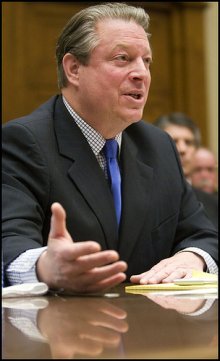 Gore also suggested that the United States push for the next global warming treaty to begin in 2010, two years before the expiration of the Kyoto Protocol.
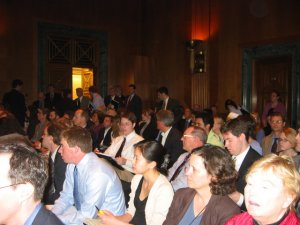 The briefing was sponsored by the Environmental and Energy Study Institute. Attendance at EESI briefings generally runs between 75 to 100, and the packed house for the March 14 panel was taken as a sign of surging interest in carbon pricing.
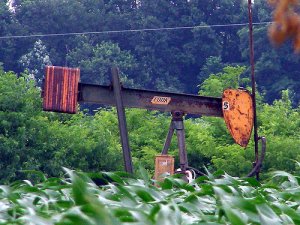 The bottom line: peak oil will come some day, but not soon enough to avert climate catastrophe. I’ve long maintained that "peak oil" wouldn’t be a climate lifesaver. In my first talk centered on carbon taxing, at the "Philly Beyond Oil" meeting in 2005, I noted that $70 crude would "stimulate conservation, extraction and substitution," and that only the first of this trio (conservation) would be a climate-helper. Quoting the trenchant economics writer