

A tax on carbon emissions isn’t the only way to “put a price on carbon” and provide incentives to reduce use of high-carbon fuels. A carbon cap-and-trade system is an alternative approach supported by some prominent politicians, corporations and mainstream environmental groups, despite its tilt toward the complex, indirect and opaque. Indeed those qualities may be integral to its appeal to those actors.
Cap-and-trade was the structure embodied in the Waxman-Markey climate bill that passed the House in 2009 but died in the Senate. It’s the cornerstone of the European Union’s Emissions Trading System (ETS), which began in 2005. California adopted cap-and-trade under its 2008 comprehensive AB32 carbon-emissions reduction bill and began implementing it at the start of 2013.
Cap-and-trade systems can be effective under certain conditions. The U.S. sulfur dioxide cap-and-trade system instituted in the early 1990s efficiently reduced acid rain emissions from power plants. However, the scale of a national carbon trading system — it would be up to 100 times larger than that for sulfur — combined with the lack of “technical fixes” for filtering or capturing CO2, makes sulfur cap-and-trade a dubious model for carbon. Moreover, for its initial decade or more, the EU’s ETS was undermined by price volatility and gaming.
Politically, cap-and-trade has functioned as a “safe harbor” for politicians who grasp the need to price carbon emissions but cling to the need to “hide the price” to appease interest groups and/or voters. But the point of carbon emissions pricing is to raise the price of emitting carbon. Better to make the price explicit, via a tax, and protect households by making the tax revenue-neutral.
CTC regards carbon taxes as superior to carbon cap-and-trade systems for seven fundamental reasons:
- Carbon taxes lend predictability to energy prices, whereas cap-and-trade systems aggravate the price volatility that historically has discouraged investments in carbon-reducing energy efficiency and carbon-replacing renewable energy.
- Carbon taxes can be implemented more quickly than complex cap-and-trade systems.
- Carbon taxes are transparent and understandable, making them more likely to elicit public support than an opaque and difficult to understand cap-and-trade system. The co-author of the U.S. Senate cap-and-trade bill, then-Sen. John Kerry (later U.S. Secretary of State) told a reporter in 2009, “I don’t know what ‘cap and trade’ means. I don’t think the average American does.”
- Carbon taxes are hard to manipulate, whereas the complexity of cap-and-trade leaves it rife for exploitation by the financial industry and vulnerable to perverse incentives that can undermine public confidence.
- Carbon tax revenues can be more or less guaranteed and integrated into state or federal fiscal policy, owing to their predictability, whereas the price-volatility of cap-and-trade precludes its being counted on as a revenue source; indeed, the costs of cap-and-trade systems can easily become a hidden tax as dollars flow to market participants, lawyers and consultants.
- Carbon taxes are replicable across borders, since the price “metric” embodied in a carbon tax is far more universal than the quantity-reduction metric underlying cap-and-trade.
- Perversely, cap-and-trade discourages voluntary/individual carbon reductions, since these cause a lowering of prices of emission permits which undercuts low-carbon investments; carbon taxes are free of this unintended negative consequence.
The details
1. Carbon Taxes Lend Predictability to Energy Prices.
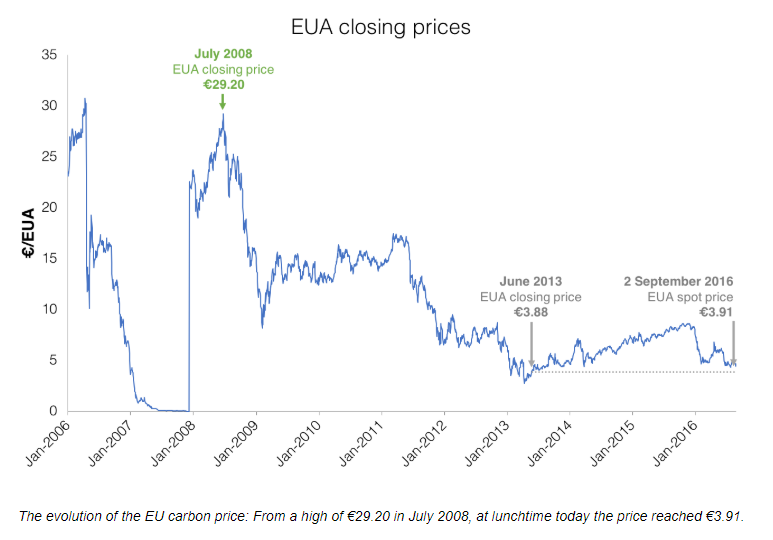
A picture of volatility: European Union Allowance (EUA) closing prices. Source: https://sandbag.org.uk/2016/09/02/eu-carbon-price-falls-below-e4-2/
With carbon taxes ramped up through a multi-year phase-in, future energy and power prices can be predicted well ahead of time with reasonable confidence, making it possible for energy-critical decisions — everything from the design of new electricity generating plants to the purchase of the family car to the materials used in commercial airframes — to be made with full cognizance of carbon-appropriate price signals. In contrast, a cap-and-trade program will exacerbate the volatility of energy prices since the price of carbon allowances will fluctuate as weather and economic factors affect the demand for energy.
The vaunted advantage of cap-and-trade — that future levels of carbon emissions can be known ahead of time — is mostly notional, particularly if the cap-and-trade system includes a “safety-valve” for auctioning off additional carbon allowances if the price of allowances exceeds a predetermined level. And even certainty in future emission levels is of questionable value, since there is no agreed-upon trajectory of emissions for achieving climate stability and preventing disaster. The real target for which the U.S. and other countries must aim is to reduce carbon emissions as much as possible, and then more.
2. Carbon Taxes Provide Quicker Results. The taxes themselves can be designed and adopted quickly and fairly. Cap-and-trade systems, by contrast, are devilishly complex and take years to develop and implement. Thorny issues must be addressed intellectually and resolved politically: the proper level of the cap, timing, allowance allocations, certification procedures, standards for use of offsets, penalties, regional conflicts, the inevitable requests for exceptions by affected parties and a myriad of other complex issues.
3. Carbon Taxes Are Transparent. A carbon tax is easy to understand; the government simply imposes a tax per ton of carbon emitted, which is easily translated into a tax per kWh of electricity, gallon of gasoline or therm of natural gas. By contrast, the prices for carbon set under a cap-and-trade system vary with market fluctuations, making them impossible even for big business (let alone small businesses or consumers) to predict. A cap-and-trade system requires a complex and difficult to understand market structure in order to balance the many competing interests and ensure that the trading system minimizes abuse and maximizes real carbon reductions.
4. A Carbon Tax’s Simplicity Inoculates it Against the Perverse Incentives and Potential for Profiteering that Will Accompany Cap-and-Trade. In contrast to the simple and straightforward process of implementing a carbon tax, the protracted negotiations necessary to implement a cap-and-trade system offer the fossil fuels industry and other invested parties constant opportunities to shape a system that maximizes their financial self-interests as opposed to an economically efficient system that maximizes societal well-being. If allowances are allocated based on some type of baseline reflecting past pollution (as has been the practice with NOx and SO2trading programs) rather than being auctioned, polluters will have perverse incentives to maximize emissions before the cap-and-trade system goes into effect in order to “earn” those pollution rights.
5. Carbon Taxes Can Produce More Equitable Outcomes than Cap-and-Trade. As discussed on our Tax Shifting page, carbon tax revenues can be returned through dividends or used to fund progressive tax-shifting to reduce regressive payroll or sales taxes. But since cap-and-trade emission permit revenues are hard to predict, there is less possibility of rebating or tax-shifting them. Moreover, because cap-and-trade relies on market participants to determine a fair price for carbon allowances on an ongoing basis, it could easily devolve into a self-perpetuating province of lawyers, economists, lobbyists and other market participants bent on maximizing their profits on each cap-and-trade transaction.
6. Carbon taxes are replicable across borders. Costs to make a kilowatt-hour of electricity don’t differ greatly from one country to another. Likewise, the cost to obtain a gallon of petroleum fuels. This means that the “metric” or mechanism in a carbon tax — a price to emit a ton of carbon dioxide — is pretty fungible from one country to another, in that the same carbon tax on two or two hundred different countries will raise the price of electricity or gasoline by roughly the same amount. As a result, no country gains huge advantages over another from the same level of carbon tax. Applying the same carbon tax to each is equitable and just. Not so for cap-and-trade systems. A reduction of, say, 10 percent in allowable emission permits for a poor country is more onerous than in a rich one.
7. Carbon caps will discourage voluntary/individual carbon reductions. They do so by canceling out emissions reductions resulting from personal choices. How? By reducing prices for emission permits, which stimulates more consumption by others. CTC analyst James Handley created this neat hypothetical in an essay he wrote for us in 2009:
Consider a commuter who, independent of any price signal or federal legislation, resolves to give up solo car commuting for a carpool. Under a cap system, this “exogenous” reduction in demand for carbon emitting will lead to a slightly lower emission permit price — thus stimulating some additional use of fossil fuels elsewhere. The incremental usage might be a reciprocal departure from a carpool, or cranking up the heat at home, or a return to buying bottled water rather than refilling at the tap … or any of a thousand other ways to burn carbon. The result, in the end, will be the same: virtue in one arena will be offset elsewhere, due to the price-equilibrium-seeking mechanism of the cap.
A carbon tax, in contrast, is free of such “canceling out” mechanisms. Indeed, if anything, “my” tax-induced conservation will tend to encourage “yours” by helping move societal norms away from consumption.
An Important “Official” Report
On Feb. 1, 2017, the European Commission issued a Report on the functioning of the European carbon market to the European Parliament. The dense 34-page document is a detailed and perhaps definitive examination of the EC’s Emissions Trading Scheme, at least from the EC’s standpoint. We hope to review it soon. (Readers who wade into it are asked to share their impressions with us, via info@carbontax.org.)
We debated carbon tax vs. cap-and-trade with Dave Roberts, in 2012.
In late 2012, then-Grist political-and-climate blogger David Roberts posted a sharp challenge to carbon-tax advocates, contending that we were, in effect, ascribing “magical” properties to carbon taxes. Roberts spelled out 10 drawbacks to carbon taxes, with this bottom line: any carbon tax legislation that could make it through Congress would likely be feeble and regressive, and perhaps even counter-productive.
Even then, David was arguably the green community’s most astute blogger, particularly on environmental politics. His qualms about pushing for a U.S. carbon tax deserved to be taken seriously. We combined his Grist post with point-by-point responses, resulting in a classic debate, Carbon Tax on Trial: Chimera or Green Charm?.
Four Useful Resources
- In 2009, Robert Shapiro, chair and cofounder of the U.S. Climate Task Force and former Undersecretary of Commerce for Economic Affairs (and, since 2013, a member of CTC’s board), posted a powerful essay, Is Cap and Trade a Dead Policy Walking?, in which he predicted that “The costs and lessons of the financial crisis may effectively swamp the prospects for cap-and-trade,” rendering it “a dead policy walking.” In that event, he argued, “those who care deeply about climate change will find that a carbon tax system has become the last, reasonable policy standing.”
- Also in 2009, Yale Professor William D. Nordhaus critiqued cap-and-trade and articulated the essentiality of pricing carbon emissions clearly and transparently in the Economic Issues in Designing a Global Agreement on Global Warming, his keynote address to an international meeting on climate change in Copenhagen.
- On the other side of the argument is Emissions Trading in Practice: A Handbook on Design and Implementation, a 210-page volume published in 2016 by the World Bank that appears to compile the strongest arguments and best evidence for emissions trading systems, to date.
- Lessons Learned from Three Decades of Experience with Cap-and-Trade, published in November 2015 by Harvard University’s Belfer Center, is a useful retrospective on what the authors, Profs. Richard Schmalensee of MIT and Robert N. Stavins of Harvard, call six “textbook cap-and-trade systems”: the SO2 allowance trading program under the Clean Air Act Amendments of 1990, the Regional Clean Air Incentives Market in southern California, NOx trading in the Eastern U.S., the RGGI program among 10 northeast U.S. states, California’s AB-32 cap-and-trade system, and the European Union Emissions Trading System. The paper also briefly reviews an early precursor system, U.S. EPA’s leaded gasoline phasedown in the 1980s.
Addenda
The “emissions certainty” touted by cap-and-trade supporters was put in perspective by the Financial Times: “[Carbon cap-and-trade systems] fix the amount of carbon abated, not its price. Getting the amount of emissions a little bit wrong in any year would hardly upset the global climate. But excessive volatility or unduly high prices of quotas on carbon emissions might disrupt the economy severely. [Carbon] taxes create needed certainty about prices, while markets in emission quotas [i.e., cap-and-trade systems] create unnecessary certainty about the short-term quantity of emissions.” Financial Times, Carbon Markets Create a Muddle, April 26, 2007.
In May 2007, CTC co-director Charles Komanoff examined the unsettling environmental politics behind cap-and-trade in a piece for Grist, while also debunking climate crisis denial from Nation columnist Alexander Cockburn. Environmental Defense posted a response, also in Grist, to which we replied in Grist. The full discussion is here on our blog. (In Feb. 2007, Grist also carried Environmental Defense’s argument against carbon taxing, and CTC’s rebuttal.)
That same month, during the 2007 Memorial Day weekend, the Los Angeles Times ran a superb and comprehensive (1,600 words) editorial Time for a Carbon Tax. Under the banner, “A carbon tax is the best, cheapest and most efficient way to combat cataclysmic climate change,” the editorial delivers a point-by-point refutation of arguments for settling for a carbon cap-and trade system. Here are key excerpts:
[F]or all its benefits, cap-and-trade still isn’t the most effective or efficient approach [for reducing carbon emissions]. That distinction goes to … a carbon tax. While cap-and-trade creates opportunities for cheating, leads to unpredictable fluctuations in energy prices and does nothing to offset high power costs for consumers, carbon taxes can be structured to sidestep all those problems while providing a more reliable market incentive to produce clean-energy technology.
To understand the drawbacks of cap-and-trade, one has to look not only at the successful U.S. acid rain program but the failed European Emissions Trading Scheme, the first phase of which started in January 2005. European Union members each developed emissions goals, then passed out credits to polluters. Yet for a variety of reasons, the initial cap was set so high that the polluters fell under it without making any reductions at all. The Europeans are working to improve the scheme in the next phase, but their chances of success aren’t good.
One reason is the power of lobbyists. In Europe. as in the U.S., special interests have a way of warping the political process so that, for example, a corporation generous with its campaign contributions might win an excessive number of credits. It’s also very easy in many European countries to cheat; because there aren’t strong agencies to monitor and verify emissions, companies or utilities can pretend they’re cleaner than they are.
The latter problem might be avoided in the U.S. by beefing up the Environmental Protection Agency. But there’s reason to suspect that many of the corporate interests pushing for a federal cap-and-trade program are hoping for a seat at the table when credits are passed out, and they will doubtless fudge numbers to maximize their credits; some companies stand to make a great deal of money under a trading system. Also hoping to profit, honestly or not, would be carbon traders. Large financial institutions would jump into the exchange to collect commissions on carbon trades, just as they do with crude oil and wheat. This presents opportunities for Enron-style market manipulation.
Cap-and-trade would also have a nasty effect on consumers’ power bills. Say there’s a very hot summer week in California. Utilities would have to shovel more coal to produce more juice, causing their emissions to rise sharply. To offset the carbon, they would have to buy more credits, and the heavy demand would cause credit prices to skyrocket. The utilities would then pass those costs on to their customers, meaning that power bills might vary sharply from one month to the next.
That kind of price volatility, which has been endemic to both the American and European cap-and-trade systems, doesn’t just hurt consumers. It actually discourages innovation, because in times when power demand is low, power costs are low, and there is little incentive to come up with cleaner technologies. Entrepreneurs and venture capitalists prefer stable prices so they can calculate whether they can make enough money by building a solar-powered mousetrap to make up for the cost of producing it.
Carbon taxes avoid all that. A carbon tax simply imposes a tax for polluting based on the amount emitted, thus encouraging polluters to clean up and entrepreneurs to come up with alternatives. The tax is constant and predictable. It doesn’t require the creation of a new energy trading market, and it can be collected by existing state and federal agencies. It’s straightforward and much harder to manipulate by special interests than the politicized process of allocating carbon credits.
And it could be structured to be far less harmful to power consumers. While all the added costs under cap-and-trade go to companies, utilities and traders, the added costs under a carbon tax would go to the government, which could use the revenues to offset other taxes. So while consumers would pay more for energy, they might pay less income tax, or some other tax. That could greatly cushion the overall economic effect.
In a strong brief against cap-and-trade and for carbon taxing in the Wall Street Journal (Dec. 3, 2008), Ralph Nader and Toby Heaps presented “three reasons why countries, such as China and India, that have traditionally resisted any notion of a common responsibility to make current polluters pay would do well to enlist in this effort” for a global carbon tax:
First, while there is no limit on the downside for missing a hard cap, with a carbon tax you just pay as you go. If a fast-growing country like China accepted an emissions cap and then overshot it, they would have to purchase carbon credits on the international market. If they missed their target by a lot, carbon credits would be scarce, and purchasing them would suck dry their foreign exchange reserves in one slurp. That’s why a carbon tax is much easier to swallow and, anyway, through the power of the price signal, it would produce the same desired result as a hard cap.
Second, administering billions of dollars of carbon credits in a cap-and-trade system in an already chaotic regulatory environment would invite a civil war between interest groups seeking billions in carbon credit handouts and the regulator holding the kitty. By contrast, a uniform tax on CO2 emissions levied at a small number of large sites would be relatively clear-cut. During the Montreal Protocol talks in the 1980s, India smartly balked at a suggestion to phase out CFCs in certain products and not in others because of the chaos that would result from the ambiguity.
Third, key people in China read our newspapers. They see the ominous clouds of protectionism under the guise of environmentalism in bills like Lieberman-Warner and they don’t want to be harmed; neither should we, given the trillions of dollars of Treasury bills they hold. Showing compliance with a harmonized carbon tax at a small number of large bottleneck points would be child’s play compared to the chaos of cap-and-trade.
More: A New York Times Nov. 2, 2007, The Real Climate Debate: To Cap or to Tax?, quoted CTC’s Charles Komanoff for the carbon tax side. Earlier that year, in an April 11, 2007 interview on the the Newshour with Jim Lehrer, CTC’s Dan Rosenblum made a compelling case for a carbon tax rather than cap-and-trade. Most recently, in January 2009, Komanoff told the Nature Network in New York City that the financial crisis as well as considerations of lead time and transparency militate strongly for taxing rather than trading carbon emissions. To view a 5-minute video of his remarks, click here.
Note: EU ETS graph comes courtesy of Dieter Helm, professor of energy policy at Oxford, and is from his presentation to the Bruegel Energy and Climate Exchange, “Climate change and EU policy — why has so little been achieved?”