

September 2021 poll: Record share of Americans are “alarmed” or “concerned” on climate change.
A record one-third of Americans now say they’re “alarmed” about climate change, while another one-quarter call themselves “concerned,” according to Sept 2021 polling by the Yale Program on Climate Communications.
“Today, the Alarmed (33%) outnumber the Dismissive (9%) by more than 3 to 1,” the Yale researchers declared in their latest climate polling report, Global Warming’s Six Americas, September 2021. “About six in ten Americans (59%) are either Alarmed or Concerned, while only about 2 in 10 (19%) are Doubtful or Dismissive,” the researchers noted in their summary of polling conducted last September and released on Jan. 15, 2022.
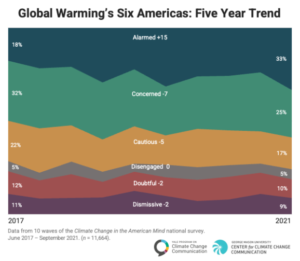
Chart from Yale-George Mason report, “Global Warming’s Six Americas, September 2021.” Link in text.
The Yale team, with their partners at George Mason University, noted that the “Alarmed” segment had replaced “Concerned” as the dominant opinion group., though “Concerned” is now firmly in second place:
When our surveys began in 2008, the Concerned were the single largest group. By 2010, they were slightly smaller, while the Cautious grew and became about equally as large. By contrast, the Alarmed were the second smallest group as recently as early 2015 (only the Disengaged were smaller), but have grown rapidly to become the largest segment of the U.S. population today. Meanwhile, the Cautious, Doubtful, and Dismissive groups have all gotten smaller in recent years.
The latest Yale-George Mason findings were first reported by Inside Climate News on Jan. 15.
December 2020 poll finds 2/3 of American voters support carbon tax.
Two-thirds of registered voters support making fossil fuel companies pay a carbon tax, according to December 2020 polling released in January 2021.
The poll, part of the roughly-annual survey compiled by the Yale Program on Climate Communications, was published on Jan. 14, 2021 under the rubric, Politics & Global Warming and reported on Jan. 15 in a New York Times story, Survey Finds Majority of Voters Support Initiatives to Fight Climate Change.
The Times story focused on the strong support expressed for solar power, efficient automobiles and clean-energy research. But the 67 percent positive score for “Requiring fossil fuel companies to pay a tax on the carbon pollution they produce, and using that revenue to reduce other taxes (such as the federal income tax) by an equal amount (i.e., a revenue-neutral carbon tax)” was notable as well.
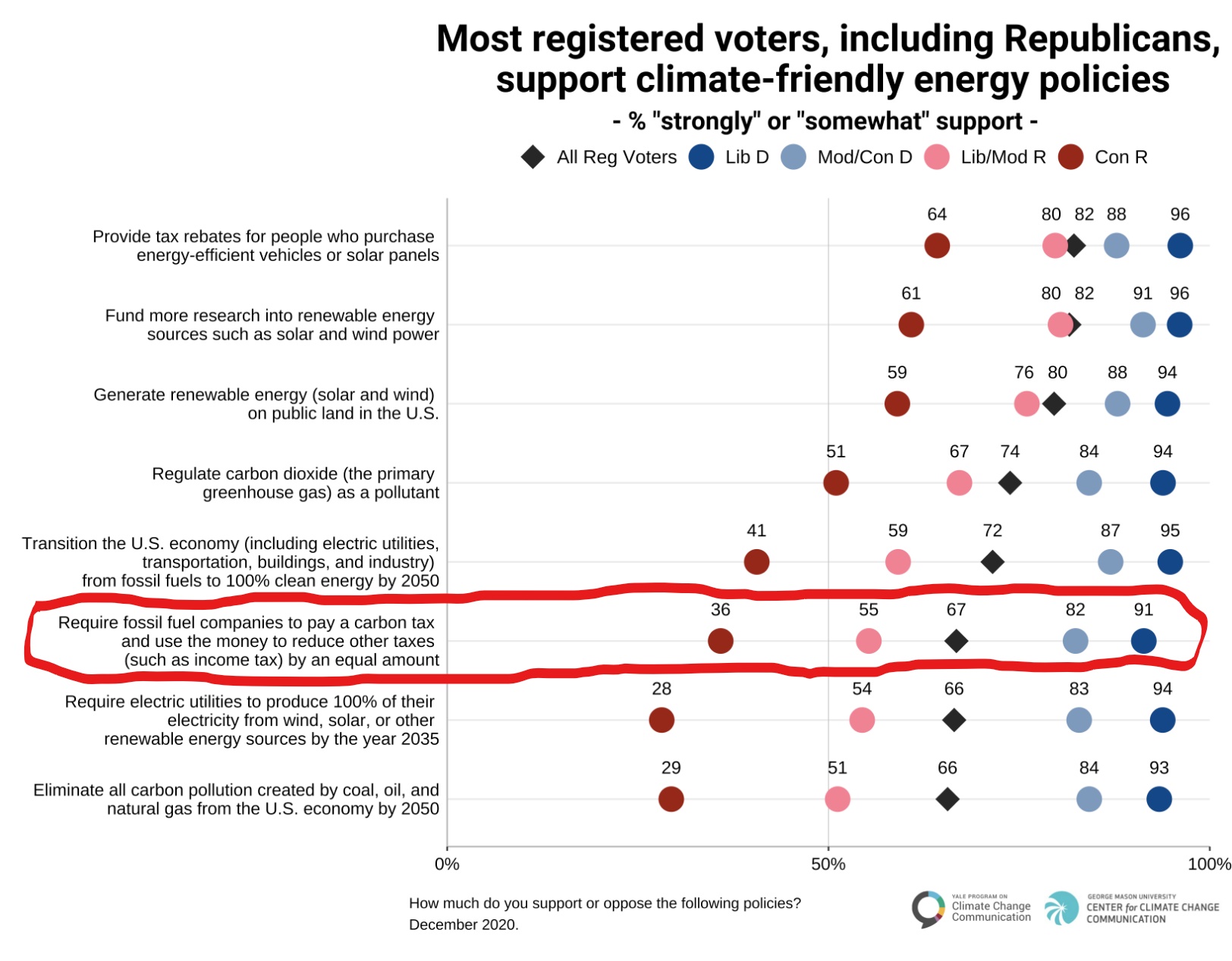
Polling graphic may be viewed on this Yale Climate Communications page.
February 2020: Protecting the environment and tackling climate change have climbed up the list of Americans’ political priorities as economic concerns have faded, according to a new report from Pew Research Center, reports The New York Times.
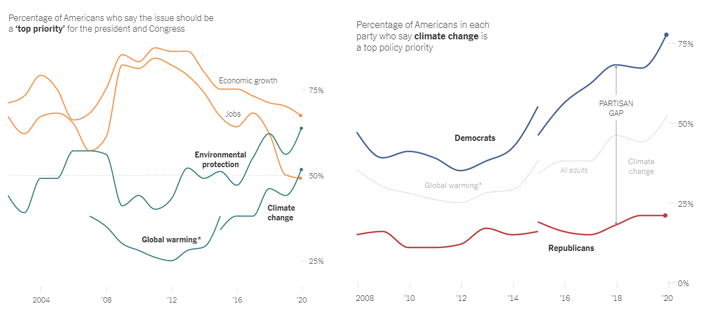
For the first time in the Pew Research Center survey’s two-decade history, a majority of Americans said dealing with climate change should be a top priority for the president and Congress. That’s a 14 percentage point rise from four years ago. But the surge in climate concern is mostly driven by Democrats. Fewer than 25% of Republicans view climate as a top policy priority.
Graphs and most of caption above are from Feb. 20, 2020 New York Times story, Climate Change Rises as a Public Priority. But It’s More Partisan Than Ever. Here’s more:
Addressing climate change has become more urgent for Democrats in recent years, with 78 percent calling it a top policy priority in 2020. But Republicans have, by and large, remained unmoved. The partisan gap over climate change was the widest to date in 2020 and the most yawning among 18 issues covered by the survey. Protecting the environment, including air and water quality, was the second most divisive issue.
(Note: A more useful characterization than “divisive” or “partisan” may be that on climate, as on virtually all salient issues of the day, Republicans are backward and obstructionist.)
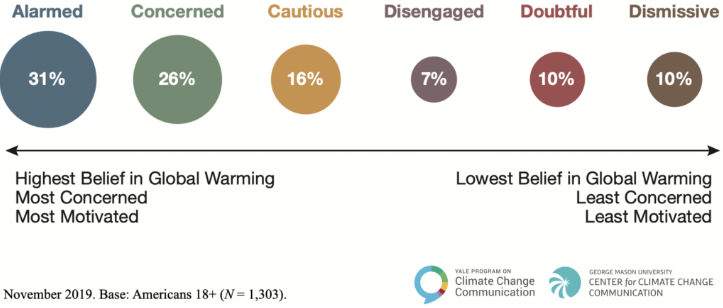
January 2020: Yale Poll reports nearly six in ten (58%) Americans are either “Alarmed” or “Concerned” about global warming. From 2014 to 2019, the proportion of “Alarmed” nearly tripled, making them (31%) the largest of the six opinion blocs.
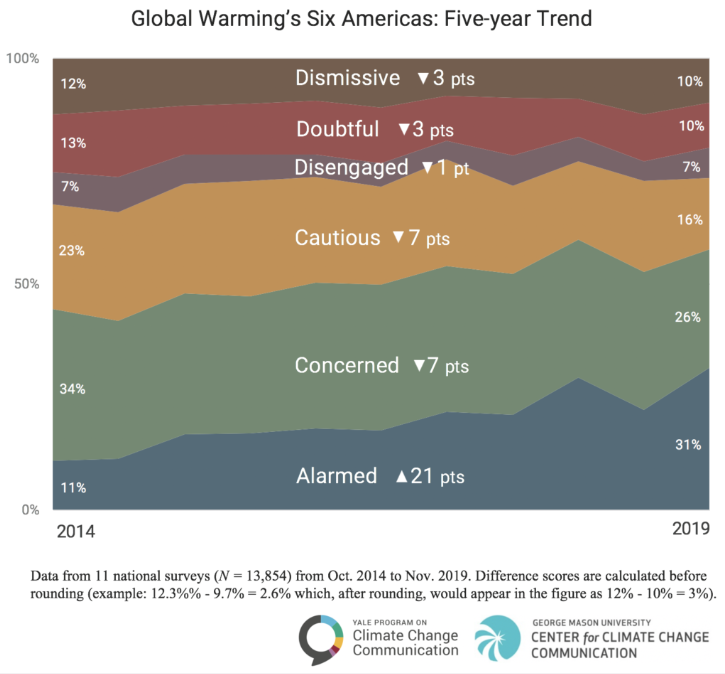
The graph above and the following text are from the Yale Program on Climate Change Communication:
Our prior research has categorized Americans into six groups, based on their climate change beliefs, attitudes, and behaviors. The “Alarmed” are the most worried about global warming and the most supportive of strong action to reduce carbon pollution. In contrast, the “Dismissive” do not think global warming is happening or human-caused and strongly oppose climate action.
Our latest survey (November 2019) finds that the Alarmed segment is at an all-time high (31%). The Alarmed segment has nearly tripled in size since October 2014. Conversely, the Dismissive (10%) and Doubtful (10%) segments have each decreased over the past five years. The proportion of Americans in these two segments combined has decreased by about five percentage points since 2014.
The new opinion data are from surveys conducted during November 2019, before the onset of the apocalyptic Australia climate-driven fires that have drawn widespread attention in the U.S. and elsewhere.
For those who prefer the opinion results in snapshot form rather than time series, the Yale people included this unmistakable chart:
August 2018: Yale Maps of Public Opinion on Climate Change and Policy
The Yale Program on Climate Change Communication is out with a remarkable series of maps summarizing Americans’ opinions on climate change. By county, metro area, state, congressional district or the U.S. as a whole, the Yale Climate Opinion Maps present views on a broad spectrum of climate questions and issues.
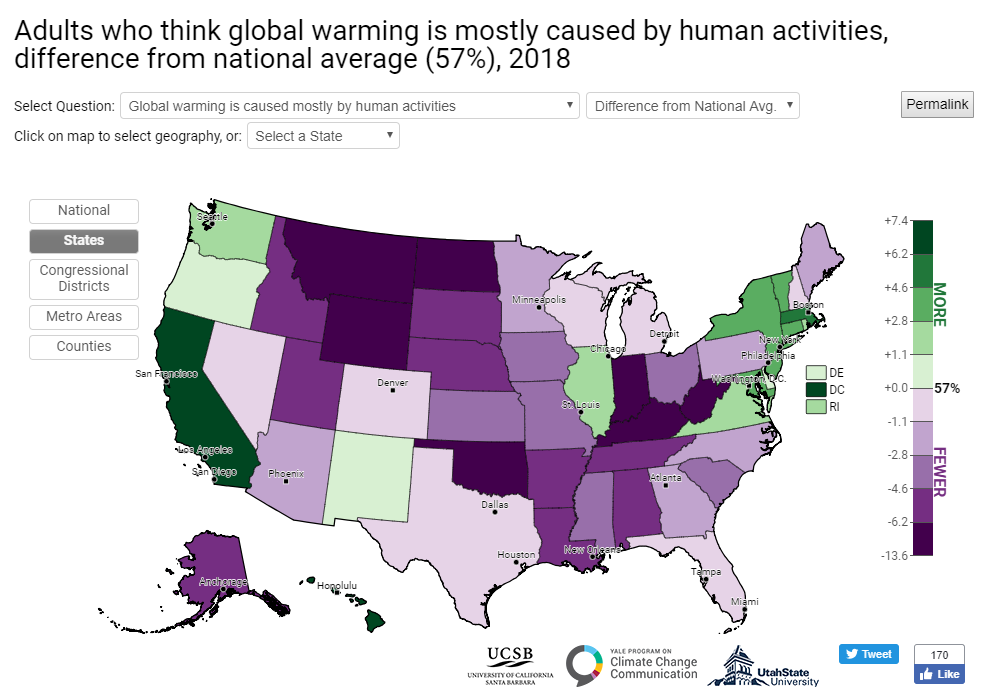 The map above is just one of several hundred that may be viewed and downloaded from the Yale web site.
Note that the link in the prior paragraphs goes to a different map than the one at right. The interactive menu lets you move among more than two dozen survey questions collated at five different geographical levels and showing either absolute percentages or deviations from the national norm.
We’re still digesting the survey methodology and findings. Come back to this page soon for more commentary, but be sure to go to the Yale site and take your own tour.
June 2017 Poll: Climate Change Now “Extremely or Very Important” to Majority of Americans
Graphic from NORC-AP poll released 6-16-2017 (annotation by CTC).
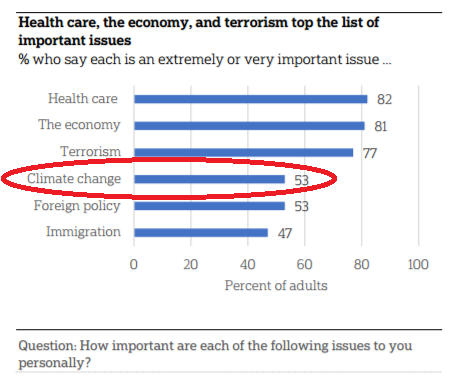
The widely respected National Opinion Research Center – Associated Press polling collaborative issued its latest poll results late Friday, June 16. While the NORC-AP press release led with Pres. Trump’s abysmal (64%) disapproval rating, a potentially more significant result was the one highlighted in the graph at left.
Fifty-three percent of people polled called climate change “extremely or very important.” This may be the first time a majority of U.S. respondents assigned climate change such a high level of concern. Indeed, climate is often viewed in political circles as a “low-salience” issue, one that people profess to care about but don’t act on via political channels. That may be changing, though it may also be that the rating was pushed up in this poll by asking respondents to specifically rate climate change (and other issues) rather than elicit, say, “the three most critical issues to you and your family.”
If this result indicates genuine public sentiment, it could translate into repudiation of climate-denying and climate-ignoring candidates in the 2018 Congressional primaries and elections. It may also portend and provoke more members of Congress to endorse the Citizens’ Climate Lobby’s Republican Climate Resolution or take similar steps diverging from G.O.P. anti-climate orthodoxy.
The full NORC-AP poll may be downloaded here. Go to p. 4 for a breakout of the climate change responses.
Earlier Polls (March 2017)
“Global Warming Concern at Three-Decade High in US,” the Gallup Organization pronounced in a March 2017 news release. “Americans are increasingly warming to the idea of a carbon tax,” reported the National Survey on Energy and Environment (NSEE) from the University of Michigan and Muhlenberg College, one day later.
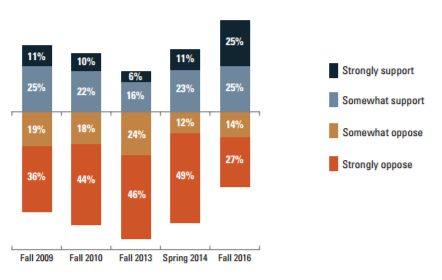
Support for carbon taxes registered 14 points higher than in prior surveys, with strong support now at 25%, more than double its prior high. Source: NEES poll, Fall 2016 (see text).
The findings from NSEE are especially significant. First, their poll, from Fall 2016, just before the elections, concerned carbon taxing specifically rather than climate change generally. Second, this was their fifth survey with that question, going back to 2009, allowing comparisons over time. The graph at left makes the rising support crystal clear.
Here’s how the NSEE researchers summarized the poll results:
The results from the latest round of the NSEE, fielded in the weeks just prior to the November 2016 elections, show that support for carbon taxes appears to have increased significantly compared to earlier iterations of the survey. Respondents were asked four previous times over the last seven years whether they would support “a tax to reduce greenhouse gases by taxing fuels such as coal, oil, and natural gas.” On each of these earlier rounds, support never registered above 36%. In the Fall 2016 survey, however, half (50%) of Americans expressed support for a carbon tax, and strong support for the tax is more than twice as high as any previous round of the survey. (emphasis added)
The survey [found that] support for a carbon tax has substantially increased across the political spectrum from when the question was last asked in Spring 2014. Support this fall was 66% among Democrats (a 29 percentage point increase from Spring 2014), 30% among Republicans (a 15 percentage point increase), and 47% among Independents (a 9 percentage point increase).
The NSEE opinion researchers also found that support for a revenue-neutral carbon tax exceeded that for a generic carbon tax for which revenue use was unspecified. While this may not reflect a preference for revenue-neutrality as much as revenue salience (since the question may have tipped off the interviewees that revenues are part of the carbon tax equation), it suggests that proponents of revenue-neutral approaches such as Citizens Climate Lobby and the Climate Leadership Council have their fingers closer to the public pulse than do economists who prefer tax swaps as the means to a revenue-neutral carbon tax.
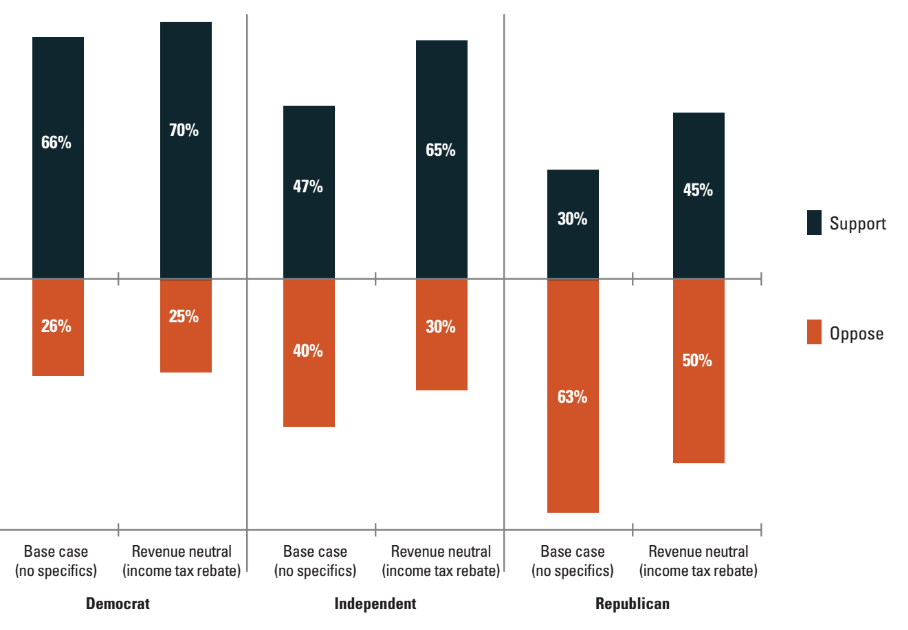
Support for a revenue-neutral carbon tax (with revenues returned as income-tax cuts) exceeds that for a carbon tax with no revenue use details, especially among independents and Republicans. Source: NSEE poll (see text).
Even newer is the poll conducted in March 2017, by Gallup, with results shown at right. Most significant, perhaps is the rise to 45% in the number of respondents who “worry a great deal about global warming.” The 45% figure is up from 37% a year ago and well above the recent low point of 25% in 2011. Worry — anxiety, fear, upset — is more easily translated into political preference and action than is mere belief.
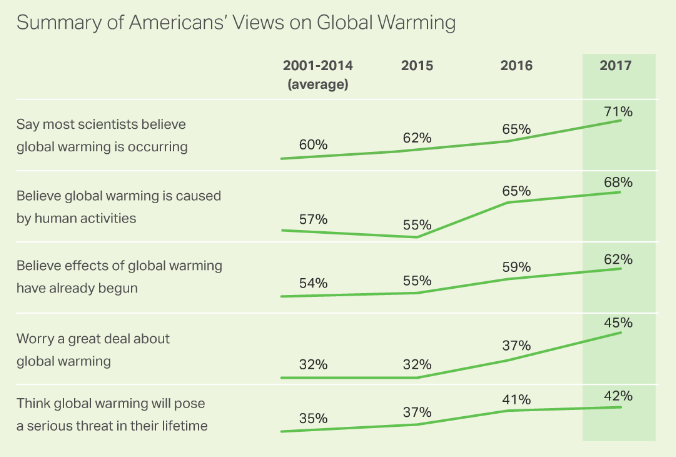
These findings led Gallup to proclaim “global warming concern at three-decade high.”
According to Gallup, the 45% figure for “worry a great deal” about global warming is the highest ever, besting the previous top figure of 41%, recorded in 2007 — a couple of years before the hydra-headed Koch Brothers-funded front groups unleashed their “the science isn’t settled” assault on the broad scientific consensus that climate change is real, human-caused and dangerous. The lost decade will haunt humanity and Earth’s other living beings for centuries, perhaps forever; but it appears that American public opinion may have climbed back from the denialist-made abyss.
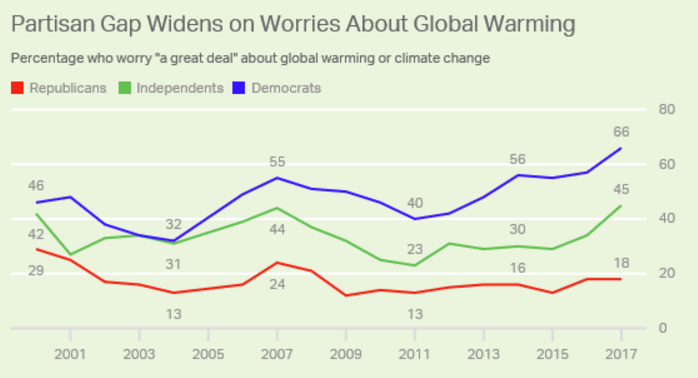
Self-declared Independents showed the biggest rise when Gallup asked, “Do you worry a great deal about global warming.”
Unfortunately, this rebound in polling has not occurred across the political spectrum, according to a companion post from Gallup, Democrats Drive Rise in Concern About Global Warming. Actually, that headline appears to be misdirected; as the Gallup graphic at left shows, the striking rise in concern (as measured in responses to the worry a great deal” question) is most evident in independents, who registered 45% on that score in March, up from 30% several years ago. Democrats who say they worry a great deal also increased, to 66% from 56%, but Republicans hardly budged, polling at just 18%, barely up from 16% a few years back.
Polls from 2016 or earlier
Three polls from early 2015 and much of 2016 heralded the very strong poll findings reported above.
In January 2015, political scientists at Stanford University and Resources for the Future who for years have been polling Americans on climate concern and policy commissioned the polling firm SSRS to interview 1,023 U.S. adults on climate-related issues. Perhaps because CTC had been beseeching the lead Stanford researcher (Jon Krosnick), or maybe because the time was finally ripe, SSRS included questions designed to take Americans’ temperature on revenue-neutral carbon taxes. (We had explained the need for carbon-tax polling to incorporate the option of returning revenues to households; otherwise, the tax would appear as all stick and no carrot.)
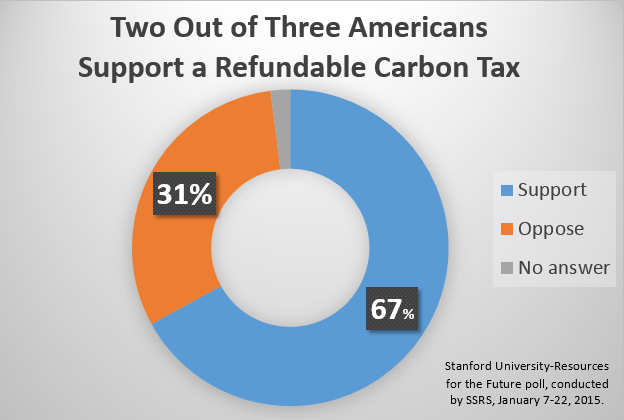
In 2015 we called this the most carbon-tax-positive datapoint yet.
The results, released in April 2015 (pdf), showed that two-thirds of Americans support making corporations pay a price for carbon pollution, provided the revenues are redistributed, i.e., made revenue-neutral. At the time, we called the finding the most powerful indication yet that the public is warming to carbon taxation as the premier policy for combating climate change.
Those findings were buttressed by a poll of more than 1,000 voters conducted close after the 2016 elections, between Nov. 18 and Dec. 1. The “Politics and Global Warming” poll performed by the Yale Program on Climate Change Communication found that:
“Two in three registered voters (66%) support requiring fossil fuel companies to pay a carbon tax and using the money to reduce other taxes (such as income tax) by an equal amount – a plan often referred to as a ‘revenue neutral carbon tax.’ 81% of Democrats, 60% of Independents, and 49% of Republicans support this policy.”
Full Yale poll here, Yale summary here, CNBC article here (“Nearly half of Republicans favor this kind of carbon tax, contrary to GOP platform”). A related publication, Climate Change in the American Mind, contains revealing details on the evolution of climate concern (but not on carbon taxes or other possible policy responses) among Americans since 2008.
Similarly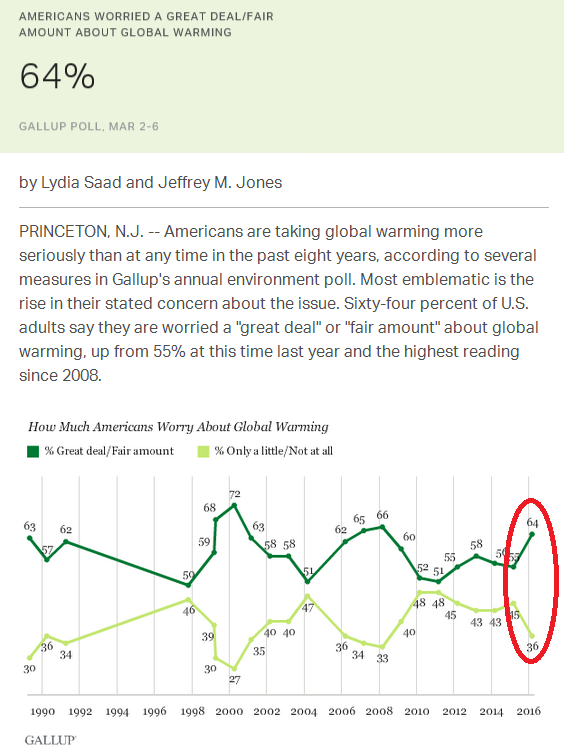 , in March 2016, nearly two-thirds (64%) of American adults told Gallup’s annual environmental poll that they were worried a “great deal” or a “fair amount” about global warming. That figure was up from 55% in March 2015 and was the highest reading since 2008, according to Gallup. (See graphic at right.)
Other results from the 2016 Gallup poll were equally striking. They showed a record-high share of Americans stating that climate change poses a threat to them and their way of life; a record number agreeing that climate change is caused primarily by human activity; and climate concern climbing across the political spectrum: on the left, center and right.
Other Opinion Polling
- Two-thirds of Americans accept that global warming is occurring, including 56% of Republicans. (Acceptance of Global Warming Among Americans Reaches Highest Level Since 2008, National Surveys on Energy and Environment, University of Michigan 2015.) Acceptance of global warming has varied between about 52% (2010) and 72% (2008) over the last decade.
- A similar proportion (68% of those surveyed, including 53% of Republicans) consider carbon dioxide to be a pollutant whose emissions should be reduced. (Yale Project on Climate Change Communication, 2014.)
- Support for action to combat global warming is growing among younger Republican-leaning voters. (Washington Post poll, November 2014.)
- Three fourths of Republicans support expanded support for renewable energy; only about 1/3 would support a candidate who says climate science is “too unclear” for government to take action. (“Republicans, Clean Energy and Climate Change,” Clear Path Survey, 2015.)
- 70% of Democrats and 51% of Republicans would support a carbon tax to fund research and development of renewable energy. Slightly less, 65% of Democrats and 43% of Republicans, would support a carbon tax whose revenue was returned via a “dividend” check. (“Public Views on a Carbon Tax Depend on the Proposed Use of Revenue,” NSEE Survey, 2014.)
- One in five respondents to a 2016 Guardian solicitation to readers named climate change as the “one issue that affects your life you wish the presidential candidates were discussing more.” While this sample was explicitly non-random, climate change’s #1 standing in the poll belies the prevailing notion that it doesn’t resonate strongly with U.S. voters. (Climate change: the missing issue of the 2016 campaign, July 5, 2016.)
- Alas, some pollsters have yet to figure out how to pose unbiased questions about carbon taxes. In a Sept 2016 poll promoted by the Associated Press, the NORC Center for Public Affairs Research and the U-Chicago Energy Policy Institute asked whether people were willing to pay more for electricity to combat change (Poll: Americans Favor Slightly Higher Bills to Fight Warming). Because the question didn’t mention dividends or other ways in which the proceeds could benefit households, the results were tepid: “If the cost of fighting climate change is only an additional $1 a month, 57 percent of Americans said they would support that. But as that fee goes up, support for it plummets. At $10 a month, 39 percent were in favor and 61 percent opposed.”
Older Surveys
Polling the American Public on Climate Change (April 2013), by the Environmental & Energy Study Institute offers comprehensive data on U.S. public opinion on climate change. It deftly graphs the ups-and-downs of public opinion since 2006 as registered in half-a-dozen leading surveys, and summarizes (with links) 20 different climate polls from 2012 and 2013 — all in just four pages.
Yale Project on Climate Change Communication (Public Support for Climate and Energy Policies, Nov. 2013) reported that:
-
-
- 83% of Americans say the U.S. should make an effort to reduce global warming, even if it has economic costs.
- 65% say that corporations and industry, 61% say that citizens themselves, and 52% say the U.S. Congress should be doing more to address global warming.
- 71% say global warming should be a “very high”, “high”, or “medium” priority for the president and Congress.
- 67% of Democrats and 52% of Republicans support eliminating all subsidies for the fossil-fuel industry.
-
National Survey of American Public Opinion on Climate Change (Brookings, April 2011) polled and compared the perceptions and preferences of 916 residents of the United States with those of 1214 Canadians. Brookings found that 56% of Americans supported national cap-and-trade while 46% supported higher fossil fuel taxes. In Canada, the figures were 63% for cap-and-trade and 58% for fossil fuel taxes, respectively.
Hart – U.S. Climate Task Force (December 2009) survey of 1,002 adults found that of those who supported action to address global warming, 58% supported a tax on carbon emissions that created incentives to reduce emissions and increase efficiency and provided tax refunds to individuals and households to offset the overall impact of the carbon tax. This compared to 27% who preferred a cap-and-trade option setting an overall limit on emissions, allowing companies to buy and sell permits.
The difference between the Hart results and those of the Brookings and Yale surveys may be explained in part by the more detailed explanations of the policies offered in the Hart poll. This suggests that clear articulation of the benefits of a carbon tax (and the options for revenue return) could result in majority support, at least among those willing to support action to mitigate global warming.